


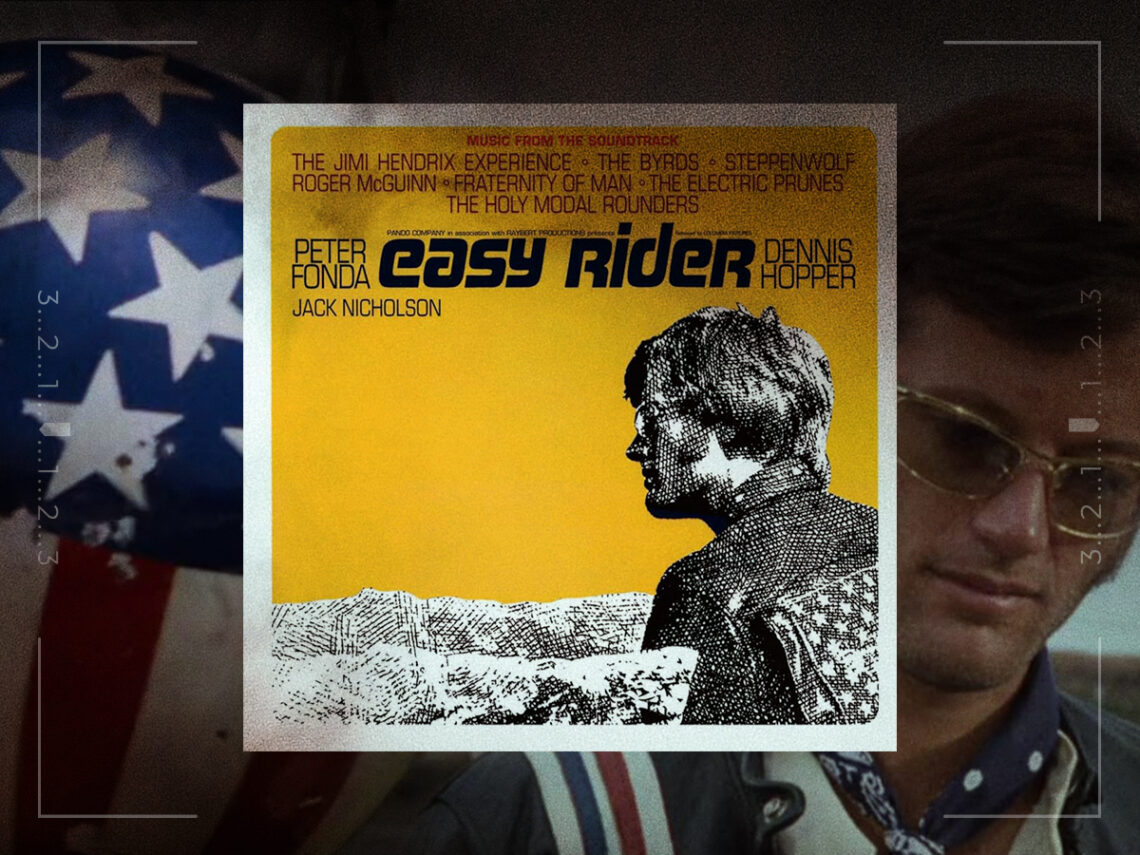
Was the ‘Easy Rider’ soundtrack the real defining album of the 1960s?

It’s often said that the 1960s was such a transformative and eventful decade that it really ought to be considered in two halves: the first being a continuation of the more conservative ‘50s, shattered with the assassination of JFK, and the second representing a completely new wave in views on race, gender, sex, drugs, and music.
If you really want to get into the weeds, though, or even just the weed, it could be argued that the year 1969 deserves a separate classification all to itself. Not only did ‘69 bear no resemblance to those buttoned-up years of the early ‘60s; it also broke with its immediately preceding years of the late ‘60s in many ways, as the idealistic dreams of the hippie movement began to weaken under the weight of increasing cynicism, the ongoing war in Vietnam, and the growing realisation that recreational drugs weren’t going to be the all-purpose answer.
In the dead centre of that year, between the inauguration of Richard Nixon and the disastrous Altamont Speedway Festival, was the film Easy Rider, a low-budget road movie that captured the mood of the moment and wound up the fourth highest-grossing release of the entire year.
The performances of lead actors Peter Fonda, Dennis Hopper, and Jack Nicholson were a big part of that success, as was the sort of odd American romanticism of the motorcycle lifestyle combined with the dropout counterculture of the era. The music, though, was arguably the most critical element of the whole Easy Rider experience, and as no surprise, the official soundtrack album, released a month after the film, quickly entered the Top Ten on the US Billboard chart.
What made the Easy Rider soundtrack so revolutionary wasn’t just the quality of the songs, but the way they were used. Prior to this film, Hollywood tended to rely on orchestral scores or original pop tunes written specifically for movies. Easy Rider flipped that convention on its head, instead using pre-existing rock songs to give its scenes a lived-in authenticity, almost like the characters were soundtracking their own lives from the radio. It was one of the first films to fully integrate the contemporary sounds of the counterculture into its DNA, making the movie feel like an extension of the late-’60s youth experience itself.

The film opens with Steppenwolf’s ‘Born to Be Wild,’ arguably the greatest needle drop in cinema history. That instantly recognisable guitar riff and John Kay’s roaring vocal became the defining anthem for the biker generation and, in a broader sense, for the restless, road-tripping spirit of the late ’60s. Elsewhere, The Byrds’ ‘Wasn’t Born to Follow’ plays as Fonda and Hopper ride through the wide-open American landscape, its jangling Rickenbackers, sweet harmonies, and discordant psychedelic sound effects creating a slightly unnerving version of a ramblin’ country-rock vibe.
Roger McGuinn, who arranged several of the songs used in the film, also contributed a haunting cover of Bob Dylan’s ‘It’s Alright, Ma (I’m Only Bleeding)’, while The Band’s ‘The Weight’, covered for legal reasons on the LP by the band Smith, underscored one of the movie’s most introspective moments. The latter track has since become arguably the most covered song of the late ‘60s, especially at all-star award ceremony jam sessions, and Easy Rider certainly played a role in its legendary status.
Jimi Hendrix’s ‘If 6 Was 9′ added some swagger and defiance to the mix (“I’m gonna wave my freak flag high!”), though he’d notably be dead just a year later. The Electric Prunes’ ‘Kyrie Eleison’, meanwhile, lent an eerie, quasi-religious air to one of the film’s most surreal sequences.
Altogether, these songs weren’t just background music. They were the foundation to the story Fonda and Hopper were telling, amplifying the characters’ confusion, search for freedom, and disillusionment in real time.
Of course, you could certainly enjoy the songs on the Easy Rider soundtrack without having ever seen the film, but it seems like just about everybody had done both in the summer of ‘69. As a result, even though the decade was coming to an end, this major pop-cultural touchstone felt like one of its last great yelps into the abyss. Nixon was here, the 1970s were coming, and the hippie dream was dying. But Easy Rider, the film and its songs, remain frozen in time, reminding the Baby Boom generation of an alternate road they nearly rode down, or imagined they could have.
