


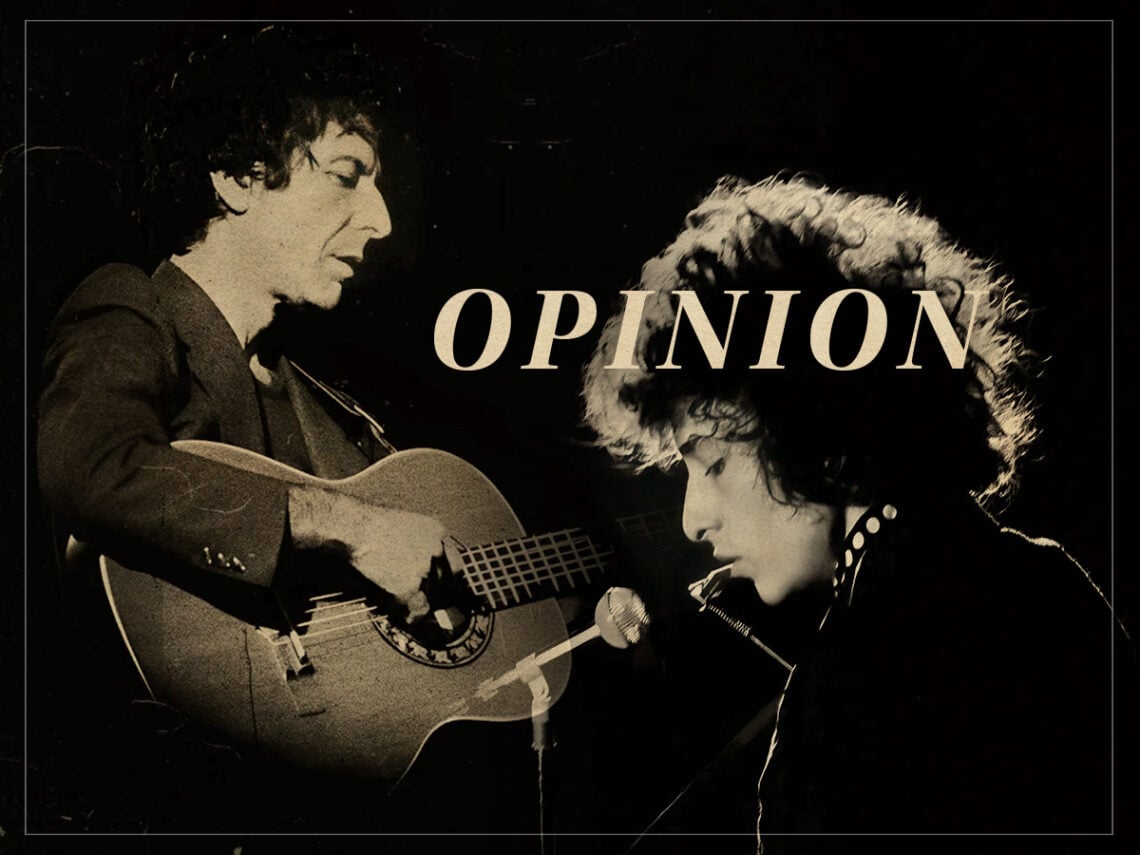
Was Leonard Cohen a better lyricist than Bob Dylan?

In the world of football, or soccer to those who are that way inclined, one question has dominated the sport’s quick-fire discourse for the last decade: Lionel Messi or Cristiano Ronaldo. In truth, there is an obvious correct answer, but the prevalent response has always been the most tedious option on the table: ‘Why does it have to be a competition; why can’t we just enjoy both?’ The same is true for Bob Dylan vs Leonard Cohen.
Of course, we can just enjoy both—that’s what anyone with half decent taste in music has been doing for the last six decades. But as any pre-millennial biology teacher will tell you, there is no harm in a gentle bit of dissection. As you wade through the tomes of these two titans, on certain terms, a victor becomes plainly apparent.
It is easy to see why Cohen and Dylan have been pitted against each other so many times. Their voices are distinct, characterful and rich, but they’re hardly virtuosic tenors. They’ve written some of the most sumptuous melodies of all time – tunes that offer beautiful counterpoints to what they are saying – but neither would shine in a solo-off. They are captivatingly charismatic performers, but placed under the same spotlight, David Bowie would undoubtedly draw the eye.
However, the one spot where they surpass their peers is the realm of lyricism. The two folk masters aren’t far from being in a league of their own on this front. From Cohen crooning classic one-liners like “Well, never mind, we are ugly, but we have the music,” and, ”Like a drunk in a midnight choir, I have tried in my way to be free,” the Canadian has offered up some of the most poetic lyrics that have ever been put to a song.
When Cohen said, “Music is the emotional life of most people,” it wasn’t just a pithy soundbite with a grain of truth but a veracious belief that he candidly propagated throughout his career. Music is a boon, and Cohen’s work harnessed what is best about a lot of art in general: he divulged hard truths with the sort of careworn beauty that triumphantly makes sense of human tragedy.

Life is destined to be filled with snaps of sadness, but the inverse cushion of that concrete universal truth is that when you are on the receiving end, there are gifts left over from those who have been there before you to help see you through. In this regard, there is a benevolence to Cohen’s music. He is a comfort blanket to the heartbroken, weary and the dispossessed.
He consistently captured life in the most poetic tones possible and penned some of the most beautiful music of all time in the process. So, when it comes to prowess, it is hard to look past his honed literary craftsmanship. It’s even harder to look past his consistency. Unlike Dylan’s back catalogue, you won’t find any ‘Wiggle, Wiggle’ atrocities. Even when Cohen misses the mark, he does so in a manner that honours the virtues of earnest artistry.
But while his music might have cast its arms around countless lonely wanderers in a warm embrace, it has never quite done the same for a crowd. Where Dylan far outstrips his ‘Hallelujah’ contemporary is the impact his music had on society at large. As the last 60 years of dwindling artistic revolutionaries have proved, the hardest thing for an artist to do is not to create great art, but rather for that great art to grab society by the scruff of the neck and make it take note.
There is no doubt that ‘So Long Marianne’ is a masterpiece of the highest order, but it didn’t galvanise 250,000 people to march on Washington. The wry satire of ‘First We Take Manhattan’ is as wise and sagacious as anything you could pit against it, but it didn’t leave politicians quaking in their boots. There are plenty of subtle social statements in ‘Chelsea Hotel #2’, but none of them managed to free a wrongfully imprisoned man.
While these factors might be apples and oranges, one is somewhat easier to achieve than the other. To be a great poet, it takes a rare set of skills. But to be a revolutionary, it takes traits so scarce and demanding that even those who possess them have rarely dared to deploy them. Dylan has the guile of one and the bravery of the other. How many musicians could you name who match him on either front?
In the years since Cohen and Dylan’s heyday, many beautiful songs have heeded their call for greater depth in pop songwriting. We’re up to our eyes in beauty, but what the world wouldn’t give for another musical revolutionary to come along and illuminate a brighter future. As Bruce Springsteen put it himself regarding his idol, ”Bob pointed true north and served as a beacon to assist you in making your way through the new wilderness America had become. He planted a flag, wrote the songs, sang the words that were essential to the times, to the emotional and spiritual survival of so many young Americans at that moment.”
While Cohen’s songs are essential in a more personal manner, Dylan made the person political, offering not only comfort but a semblance of change. Cohen held your hand through the darkness, but Dylan showed up with a match.

Never Miss A Tale
The Far Out Bob Dylan Newsletter
All the latest stories about Bob Dylan from the independent voice of culture.
Straight to your inbox.