War Child – ‘Help(2)’: Inside the cause for collective change

In 1995, various artists, including Paul McCartney, Radiohead, Oasis, and Paul Weller, came together for War Child’s The Help Album in aid of war-stricken communities. Produced and mixed over just two days, The Help Album was a powerful call to action that beckoned action immediately, a mantra it epitomised with its fast turnaround and broader musical themes.
Now, its follow-up, Help(2), continues that legacy, with producer James Ford leading an explosive bastion of major players, including the likes of Arctic Monkeys, Damon Albarn, Wet Leg, Depeche Mode, Pulp, Foals, Olivia Rodrigo, Ellie Rowsell, Fontaines DC, and more, to “protect, educate, and stand up for the rights of children living through conflict around the world”.
The record, which Far Out gave four-and-a-half stars out of five in a reivew, thrives on its own contradictions, demonstrating the value and power of collaboration and cross-generational convergence in uniting for a common cause. Across 23 tracks, War Child’s artists call for change across various styles, genres, and atmospheres, with fast, rhythmic grooves that hook in deep and softer, sentimental soundscapes that reflect the poignancy of coming together to help those in crisis.
Speaking exclusively to Far Out, Rich Clarke, Head of Music at War Child, explains how the project came together and why this continuation is especially important in today’s landscape. “The desire to do another record has been bubbling for at least a decade,” says Clarke. “I think a lot of people’s entry point [was the ‘95 record], that really created the legacy and credibility of everything we’ve done with music over the last 30 years.”
He continued, “It’s a real tipping point, where a very fledgling organisation, that had been around for a couple of years, went from wanting to make a difference to actually being able to do it. It was everything. Had that album not come along, I don’t think the organisation would exist today. So, when we talk about War Child and its origins, The Help Album is interwoven in the fabric of it, and we always thought we’d love to try and do it again.”
Back in ‘95, Clarke recalls how things were slightly different, with the record only being released on CD at the time. Thus, for the 25th anniversary in 2020, commemorating the milestone called for a more accessible drop, with vinyl pressings and availability on streaming services, so that more people could listen and appreciate what it represented at the time, and what it still represents now.
Then, of course, the pandemic “really rocked the live fundraising side of things for us”, says Clarke, but then, the launch of War Child Records in 2021 sought to better support the charity’s ongoing work in the musical field. “Every artist who contributed a track did it to raise money for children affected by conflict,” says Clarke. “And then we sort of stopped there, and it’s taken a minute to get round to the new projects.”
According to Clarke, real, tangible change is born out of action, which is born out of need. In ‘95, this initiative stemmed from many of the same issues we see in the current landscape, with people wanting to come together to address the surge of reports of violence against women and children in Bosnia and Herzegovina.
“Looking at it now in 2026, and seeing the rise in violence around the world, [we’re] getting people to understand the impact on children – they’re the innocent victims of war,” says Clarke. “Children should never be involved in a conflict. They are always the most affected. Losing parents, losing their education, losing their livelihoods, losing all the structures that are around them at such a vulnerable time of life is hugely traumatic.”
He continues, “The problem is huge. We’re in 14 countries around the world, and we’re reaching a lot of kids, but we’re nowhere near reaching as many as we’d like to. And I think that creates a sense of urgency, and collective action is the answer. Small changes inspire big differences.”
For Help(2), James Ford was selected based on a series of factors: one, that he seemed the perfect fit for the job in a general sense, and two, that his reputation and approach echoed those that Brian Eno brought to the first project. “People were desperate to work with Brian Eno, because he’s Brian Eno,” says Clarke. “It’s like a stamp of authenticity, right? So, we thought, ‘Who is that in this day and age?’”
At the time, Ford had just worked on Fontaines DC’s Romance – a “masterpiece”, says Clarke – and everything, from his work on the Arctic Monkeys catalogue to his broader “integrity”, felt like a no-brainer. And then, when they presented Ford with the proposition, he was all in. “He just brings that creative genius,” says Clarke. “But also that authenticity and credibility.”
A big part of Help(2) was also the collective collaborative spirit at London’s Abbey Road Studios, with many of its featured artists working together on different tracks for the record. This enhances the overall feel of the album, giving it that sense of unity built around its core message. During part of the project, Ford encountered certain health battles of the time, which called for a new team of producers and engineers, including Marta Salogni, Catherine Marx, and lots of others who helped keep the ball rolling in his absence.
“I think because it was everyone pushing together, that translated into the artist in the studio as well, and it just felt really natural,” says Clarke. “Damon [Albarn] had come with this track he’d written for it, and he had this vision of some of the artists he might want on it, and Kae Tempest and Grian [Chatten] said yes straight away, which was amazing. And he built this band that has Dave Okumu, Johnny Marr, and Seye from Gorillaz, and Femi from Ezra Collective, and Adrian Utley from Portishead.”
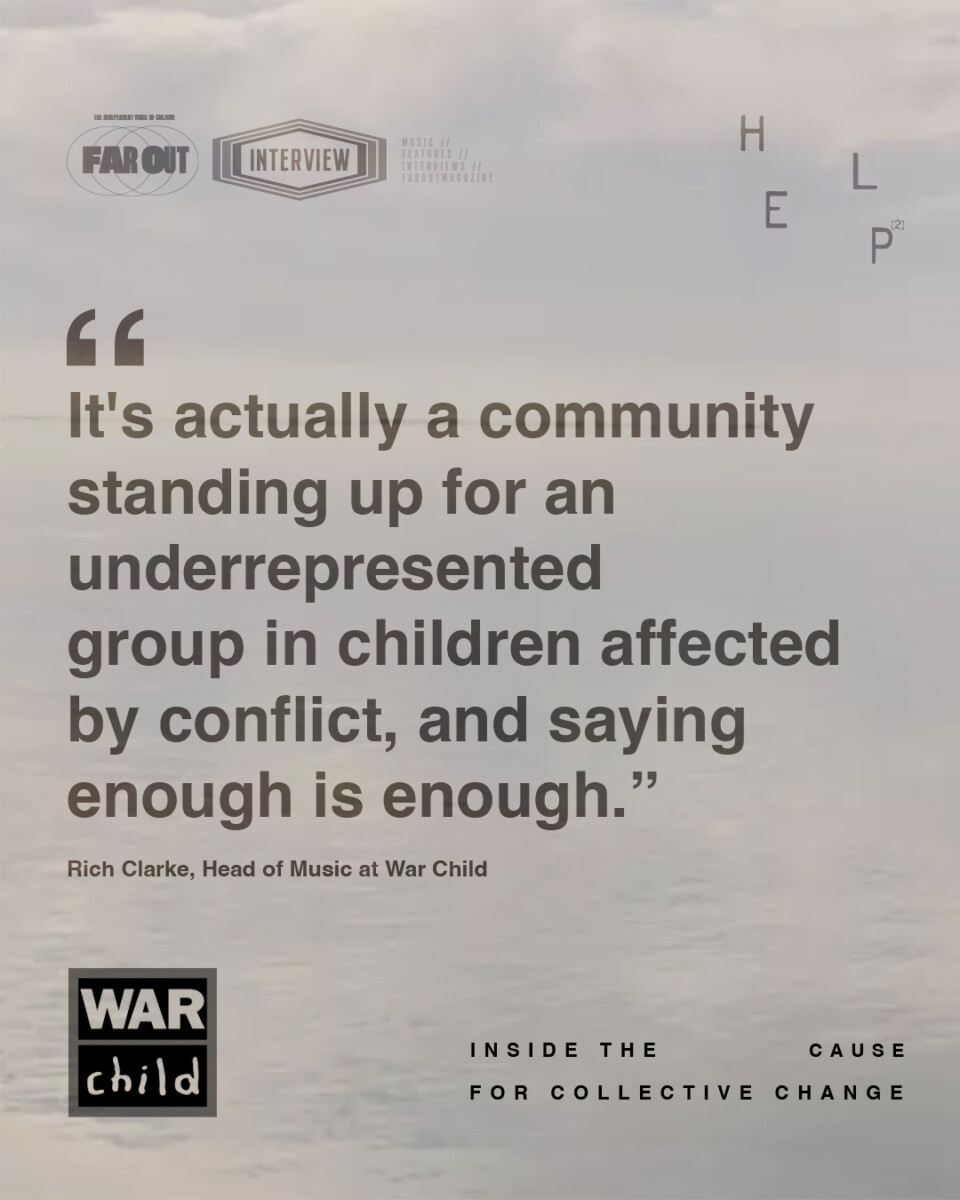
“He was on the first record, and there were points where Damon jumped in and did some vocals on the Pulp track, and a big choir that appeared on the Damon track. So it was important to have that collective spirit, because he wanted to show it’s not just individual artists taking individual actions. It’s actually a community standing up for an underrepresented group in children affected by conflict, and saying enough is enough.”
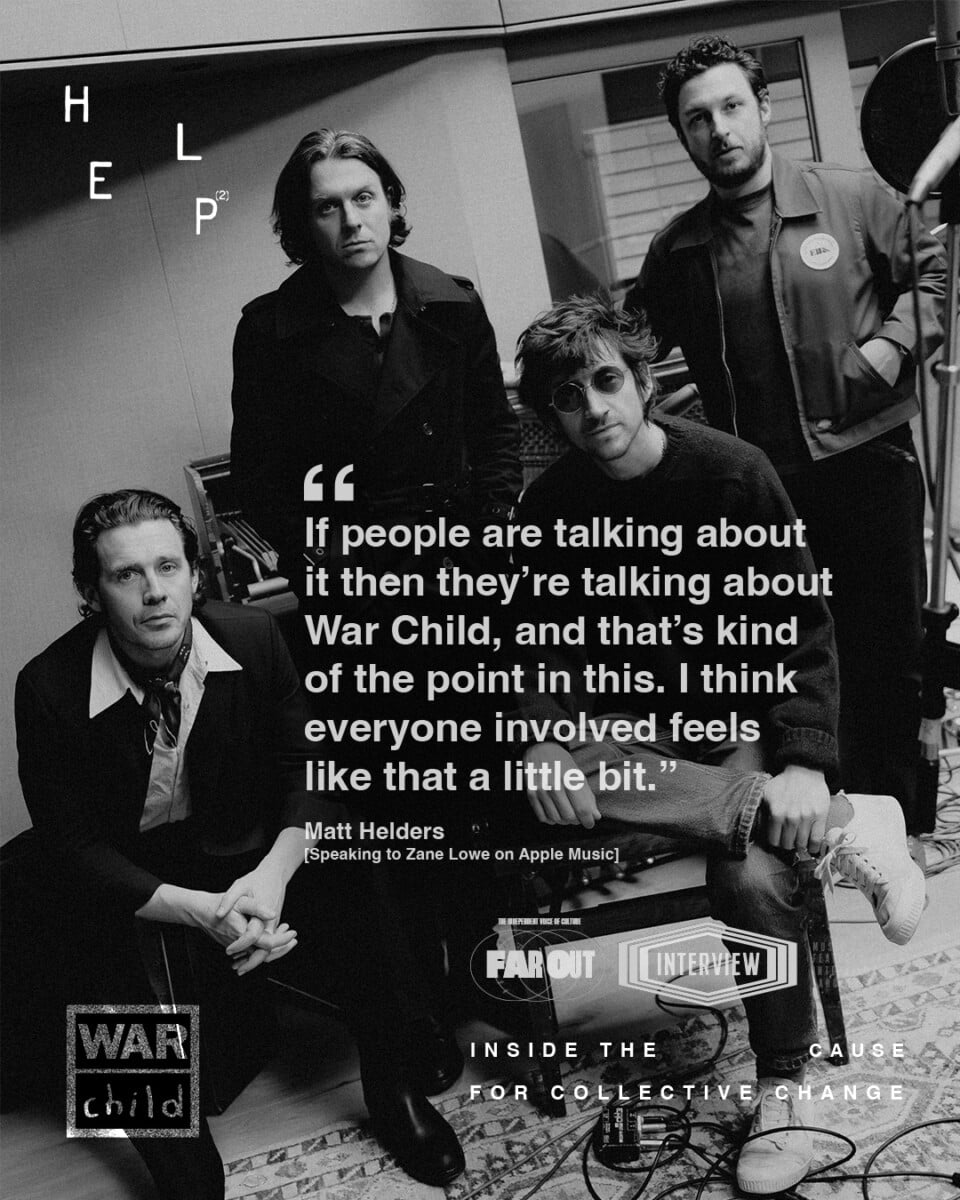
When looking at how the record came together in this way, it’s interesting to wonder how organic those dynamics were, and whether this was something that the team anticipated before any work on the material began. According to Clarke, this setup was “partly by design” due to the nature of the project itself, but also because everybody involved was also “unbelievably generous”.
It also brought its own kind of energy, which, while unique, ultimately enhanced the collaborative process. There can be quite a lot of pressure when an artist is asked to come up with a track in a certain time frame, but that pressure was helped by a variety of factors, including the general environment itself, which welcomed a group of children with their own sets of cameras to capture any part of the process they wanted.
At the same time, there was a constant sense of unpredictability, especially with so many players involved in making the best possible record they could. Because of this, many of Clarke’s favourite moments occurred in the canteen – the communal area at Abbey Road – which witnessed many of the record’s defining interactions, as different artists came together to share ideas and figure out what worked best.
“You can be having a cup of tea, [and] you look up, [and] you’ve got Jonathan Glazer and two of the directors from Academy Films having a chat with Damon Albarn and Kae Tempest, and then [elsewhere] you’ve got English teacher huddled in the corner, and Lily [Fontaine] is like, ‘Oh my gosh, I’m going to say hello to Jarvis Cocker because he’s my hero.’”
He continued, “You just had all this collection of just amazing people. Sometimes, I saw Johnny Marr sneaking into the Fontaines session when they were doing ‘Black Boys on Mopeds’. It was all very free and easy and collective. And it felt like a really joyous environment, and when you take the commercial pressure away, everyone’s there to do a good thing, and it creates a lovely environment.”
While artists were required to bring their best song to the table, taking the project’s “commercial pressure” away meant that artists felt there was space to explore and experiment with different ideas. It introduced a light, openness that thrived on spontaneous decision-making and trial and error, like Albarn’s ‘Flags’, which changed and developed as sessions progressed, with him deciding halfway through the first day that the track would benefit from a children’s choir.
Another example of this openness was the situation involving Young Fathers, who’d initially had around five songs, but realised the one to move forward with was ‘Don’t Fight the Young’ when they played it to the children in the studio, and they responded the most to that one. As for his own personal highlights, Clarke praises Bad For Lashes’ “beautiful” ‘Carried My Girl’ as one that positions “childhood and the plight of children affected by conflict”.
“I think if the whole record had been like that, it would probably be too dark to listen to,” Clarke jokes. “But I like when those themes come – Depeche Mode’s cover of ‘Universal Soldier’ by Buffy Sainte-Marie is about war and the futility of war, and they’ve given it a full Depeche treatment of a folk song. I love the way they’ve transformed it into their own. Beth [Gibbons]’s voice, for me, is one of the greatest voices the world’s ever seen, and she said she does ‘Sunday morning’ by the Velvet Underground, and it’s just such an understatedly beautiful piece of music. It’s incredible.”
He concludes, “And then there’s the Anna Calvi track that she wrote called ‘Sunday Light’, which, again, in that collective spirit, it was just a demo we heard from her, and then it was going to be just her and Adrian Utley in the studio. And then, somehow, Nilüfer Yanya got involved, who’s amazing, and Dove Ellis. And then Ellie Rowsell came along, and the way their sort of four voices meld together is really beautiful.”