


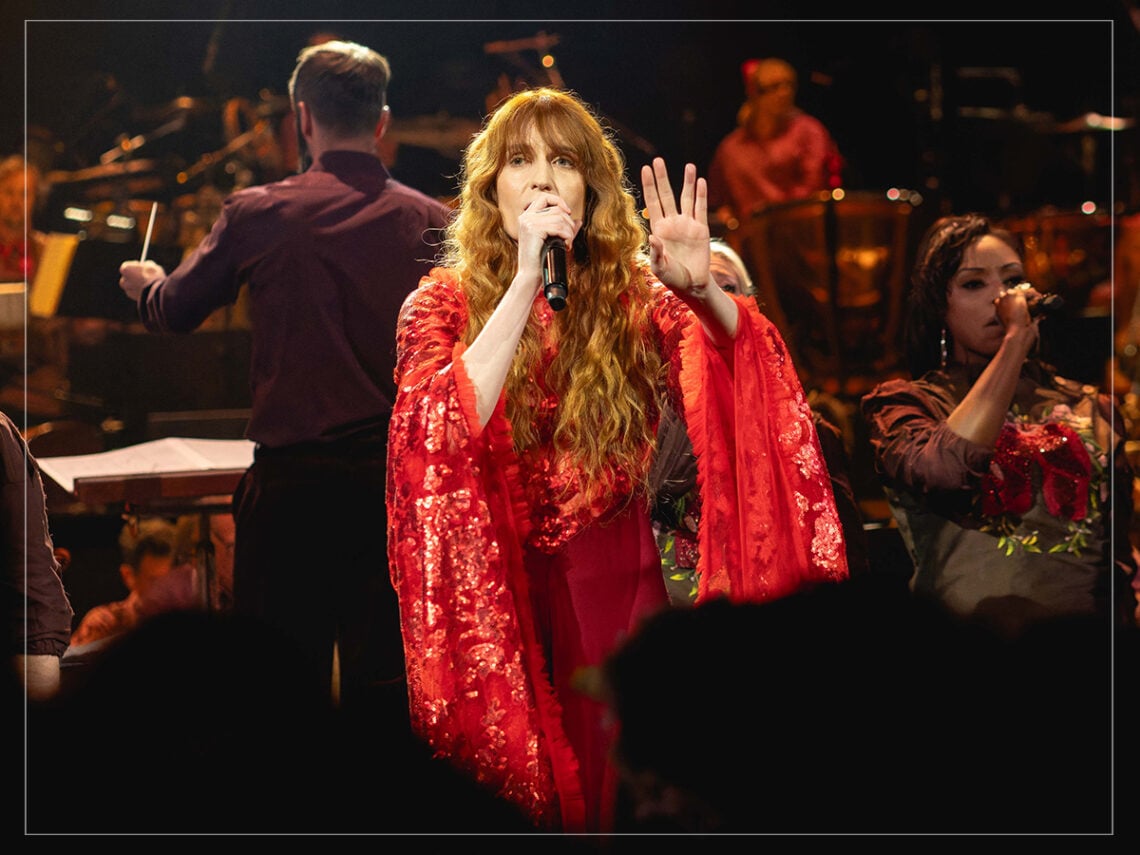
Florence Welch and the transition from oceanic grandiose to broader experimentation

“In music and art what I’m really interested in are the things that are overwhelming,” Florence Welch once said, “The ocean seems to me to be nature’s great overwhelmer.” From the beginning, Welch has risen like a tsunamic force, her ethereal voice brimming with complex emotions as she builds worlds of sound that sweep everything in its wake. Each note she sings is a wave of intensity, just like the ocean itself, capturing the beauty and chaos of life and romance.
In the beginning, Florence and the Machine wasn’t just another pop outfit trying to find a place in the already oversaturated landscape. Rather, this band already had a good idea of what it wanted to be, with Welch’s voice guiding the way with a raw, unfiltered intensity that set them apart from the start. Welch’s voice acted as both compass and storm, steering the band towards an anthemic, soul-baring sound that transcended typical pop conventions.
Her vocals, rich with vulnerability and strength, carried an emotional weight that felt larger than life yet deeply personal. This was evident from the moment they released Lungs, which, although more indie and baroque pop in nature than their sophomore album, held an almost primal expression that allowed them to carve out a distinctive space, not just in music, but in the hearts of those seeking something deeper, more visceral, and above all, human.
‘Dog Days Are Over’, ‘I’m Not Calling You A Liar’, ‘Kiss With A Fist’, and ‘Cosmic Love’ all earned Welch comparisons to legends like Kate Bush and Fiona Apple, but there was something else there, too: a certain contemporary twist that made the songs feel exceptionally hard-hitting. ‘Cosmic Love’, in particular, carried Welch’s signature folkish twang infused with other, less easily describable musical qualities, providing a rich and textured experience unlike anything else that charged the airwaves at the time.
Her long, drawn-out vocalisations were a defining quality, but she took this a step further on their second album, Ceremonials, as they stepped into more gothic-leaning compositions. With Ceremonials, Florence and the Machine continued their commercial appeal while diving deeper into the more ethereal and atmospheric realms, with Welch’s voice taking on a particularly heady delivery. Except for ‘Shake It Out’, the album was a much more daring affair than Lungs, specifically because Welch suddenly emitted a more controlled use of her upper register, allowing for soaring melodies while maintaining clarity and power.

‘What The Water Gave Me’ was the embodiment of this transition. While the song carries the crux of her broader manifesto by incorporating themes inspired by “children who are swept out to sea, and their parents go in after them and try to rescue them”, ‘What The Water Gave Me’ builds beautifully, allowing Welch space to experiment with her haunting vocalisation without holding back when the song takes on a more overwhelming register in the midsection.
‘Never Let Me Go’ was another example of her extraordinary ability to flit between delicate atmospheric qualities and more overwhelming oceanic soundscapes. Based on the idea of giving in to something that has long been all-consuming, the song was a power hit because of Welch’s exceptional control, the emotion she naturally embodies in voice alone providing the perfect backdrop for an enormously complicated romance, one that’s impossible not to get swept away in.
With the following songs, How Big, How Blue, How Beautiful, and High as Hope, Welch adopted more nuanced and introspective vocals, playing more with pace and rhythm to deliver a voice that was more intertwined with the musical arrangements than a driving force. That said, many of the songs, like ‘Hunger’, present her voice in a more natural, stripped-back manner, allowing her to shine in a more effortlessly intimate way.
High as Hope, in particular, saw Welch allowing herself to explore her folk roots, with songs like ‘Sky Full Of Song’, as her voice took centre stage with a sound that generally moved away from the grandiose, orchestral sound of the previous albums. This aligned well with the more personal themes she explored, with songs like ‘South London Forever’ providing a reflection on her youth and weaving folk influences to create a more overt level of simplicity.
When we finally get to Dance Fever, we’re presented with a Welch that wraps all of the previous albums into one perfect masterpiece with swimming notes of folk, pop, rock, baroque, and, of course, the usual overwhelming sense of grand emotion that has become her signature. From the indie-leaning sensibilities within their debut through folkish experimentation, Dance Fever provides a culmination of everything that makes Florence and the Machine great, complete with a newfound touch of catharsis and freedom.
‘King’, ‘Free’, and ‘My Love’ embody Welch’s vocal evolution through the years, from her early days’ raw, unpolished power to a more refined and controlled mastery of her voice. It shows she is still firmly in touch with her earlier appeal but unafraid to explore other genres, presenting even the more commercially pop tracks with an emotional flair, highlighting how she has honed her range and encapsulating the heart of her vocal evolution—bold, evocative, and undeniably powerful.
