


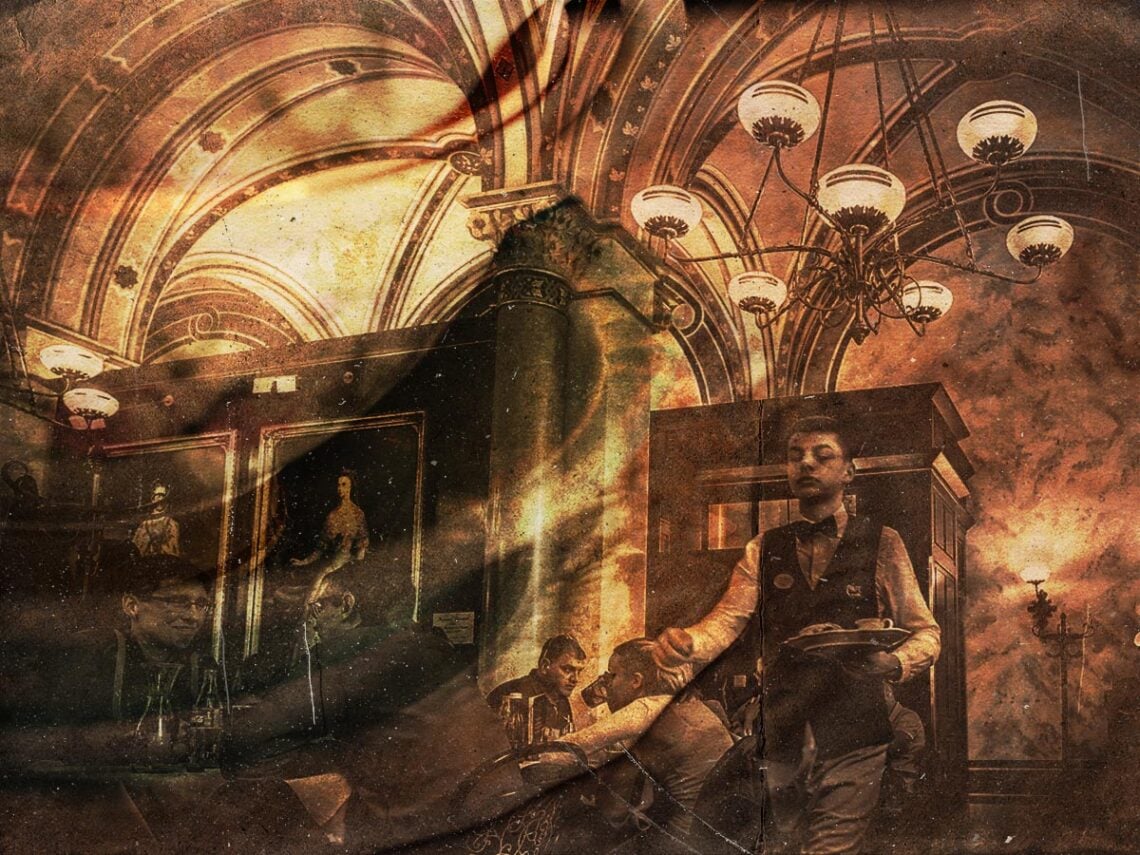
Inside Vienna’s old-world coffee houses

When asked to describe the Austrian city, Bertolt Brecht thought for a moment, then said: “Vienna: it’s this small city built around coffee houses.” He was right: Vienna’s grand, chandeliered cafés are not only an integral part of the city’s urban fabric but also integral to the Viennese way of life.
The Viennese have war to thank for their rich café culture. Coffee beans were introduced by the Turks back in the 1680s. The Ottoman army was defeated, but its soldiers left countless treasures behind, including sacks of coffee beans. Only one man knew enough about Turkish culture to know what they were, a spy named Jerzy Franciszek Kulczycki.
Kulczycki opened the first café in Vienna shortly afterwards, and before long, coffee was the Viennese drink of choice. Of course, even in those early days, people were coming to the coffee houses for more than just coffee. These were regarded as convivial and contemplative spaces, and many came to regard them as an extension of their living rooms.
To this day, a Viennese coffee house is regarded as a sort of semi-domestic sanctuary where one can sketch or peruse the daily newspaper without being expected to buy another slice of cake. We would obviously recommend buying another slice of cake, though. Many of Vienna’s oldest coffeehouses have their own private bakeries and pastry kitchens, and giving in to temptation is sort of the whole point.
Below, we’ll be giving you a tour of some of Vienna’s oldest coffeehouses – establishments that pride themselves on their cosiness, decadence and century-spanning heritage.
Inside Vienna’s old-world coffee houses
Café Frauenhuber
To drink: A Weiner Melange
To eat: Eggs in a glass (trust me)
The oldest continually operated coffee house in the entire city, Café Frauenhuber is also one of the most tranquil. The original establishment existed as early as 1746 and, though renovated in 2000, has preserved much of its old-world charm.
First mentioned as a coffee house in 1824, the Café Frauenhuber quickly developed a reputation as one of the best spots for that great Viennese pastime: quiet contemplation. This was down to the fact that its clientele consisted mainly of pensioned military officers and chess-obsessed civil servants. That’s not to say the patrons of the Frauenhuber didn’t know how to have a good time – the cafe once hosted recitals by Mozart and his moody, romantic successor Ludwig van Beethoven.
Location: Himmelpfortgasse 6, 1010
Café Landtmann
To drink: Verlängerter
To eat: Sachertorte
With its snug booths, mahogany panelling and imperial Thonet furniture, to stop for a cup of coffee in Café Landtmann is to immerse oneself in the warm embrace of a true Grand Café. Expect speciality coffees, fresh pastries, and enlightening conversation.
Like the best period-style coffee houses, Café Landtmann is at once warm, inviting and cosmopolitan. The café’s convivial atmosphere is a huge part of its charm, as it was for famous regulars Sigmund Freud, Gustav Mahler, and the writer Felix Salten. Another iconic patron was French-German actress Romy Schneider – star of 1955’s Sissi, the 1969 psychological drama The Swimming Pool and, perhaps regrettably, What’s New Pussycat?, with Woody Allen.
Location: Universitätsring 4, 1010
Café Schwarzenberg
To drink: Kapuziner (a double espresso with masses of whipped cream, served in a mug)
To eat: Warmer Topfenstrudel
While Italians like their coffee black, the Viennese can barely look at a mug of the stuff without covering it in some sort of delicious cream. Reading the menu at Café Schwarzenberg, one thing is clear: cream is most definitely king. Whether it’s a Kapuziner (a double espresso with whipped cream) or an Übersturtzer Neumann (a double espresso poured over whipped cream), there are countless variations on this most delicious of themes.
One of the last remaining Ringstraße cafés, Café Schwarzenberg was built in 1861 on one of Vienna’s (if not Europe’s) most beautiful boulevards. It survived both world wars, though many of its original furnishings were destroyed after Soviet Army officers occupied the café for one of their regular events in 1945 and decided to spray the interior with bullets. Marble-clad and impossibly elegant, Café Schwarzenberg is relatively unique among Viennese cafés in that it serves full meals. No wonder so many visitors struggle to leave.
Location: Ringstraßen Galerien
Café Central
To Drink: Einspanner (espresso topped with whipped cream and served in a glass)
To Eat: Esterhazytorte
Few coffee houses can claim to have served a revolutionary exile, a psychoanalyst and a modernist poet in the same morning. Of course, working at one of Vienna’s most revered establishments, the waiting staff at Café Central were more than likely used to seeing Trotsky, Freud and Peter Adler sitting at different tables perusing the morning papers.
Originally referred to as the “chess school” owing to the chess players who occupied this expansive building’s first floor, Café Central opened in 1876 and would go on to serve as an incubator for some of the most powerful philosophical, scientific and political ideas of the 20th century. Before the Russian Revolution kicked off, Trotsky, Lenin and Stalin would meet here and discuss their plans over coffee, cake and the odd cigar. It’s said that when Victor Adler bought news of a possible revolution in Russia, Count Berchtold, the foreign minister of Austro-Hungary, replied: “And who will lead this revolution? Perhaps Mr Trotsky sitting over there at the Cafe Central?”
Location: Herrengasse 14, 1010
Café Museum
To Drink: Kleiner Brauner (single/double espresso with a jug of milk or cream on the side)
To Eat: Guglhupf
Boasting a more restrained, modernist style than the likes of Café Central, the Café Museum – established in 1872 – is just a strudel’s toss from Vienna’s Academy of Fine Arts and was a popular spot for Vienna’s artistic community. Needless to say, both Egon Schiele and Gustav Klimt spent many an hour here sketching and sipping melange. Who knows, maybe Adolf Hitler would have visited, too, had he been accepted as a student.
The stripped-back purity of the Café Museum’s interior is the work of Adolf Loos, an innovative architect with a taste for simplicity and elegance. He was famously critical of the knowingly decadent art nouveau movement. The coffee house’s interior was then redesigned in the 1930s by the architect Josef Zotti, who installed the red half-round sofas that give this cost spot its world-famous living room atmosphere.
Location: Operngasse 7, 1010
