


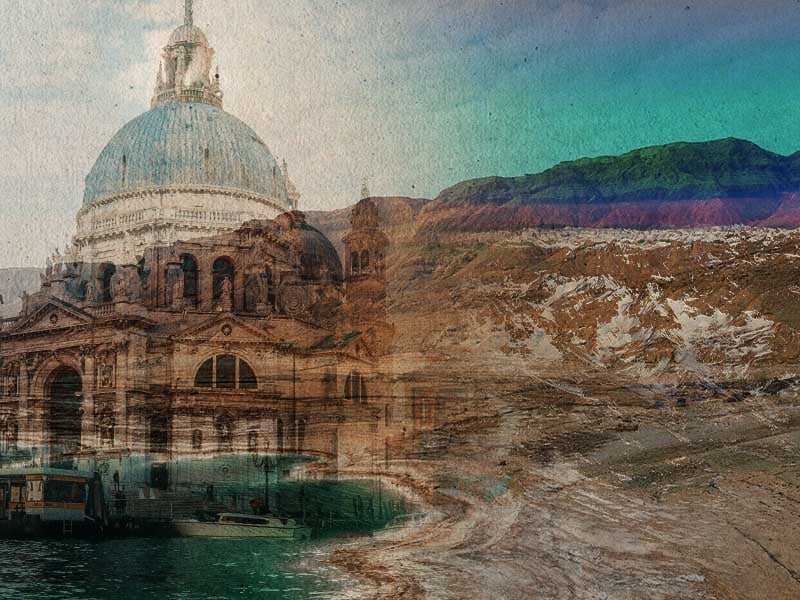
From Venice to The Dead Sea: Five rapidly vanishing places

The impact of climate change is now impossible to ignore. From Venice to the Dead Sea and beyond, nations are coming to terms with the fact that once-in-a-generation floods, droughts and storms are now yearly. Crops are failing in their droves. Coastal towns are being swallowed up. Entire ecosystems are dying.
The sheer scale of the climate crisis bewilders us to the point of apathy — many people regard it as too enormous to fathom, terrifying, and complex. Perhaps imagining a world upended goes against some basic human instinct, some innate desire for stability. Of course, stability is already a thing of the past.
Before we begin, it’s worth addressing the paradox at the core of such articles. In researching this piece, I came across countless writers who seem completely unaware that they are contributing to their demise by framing disappearing places as ‘must-see’ destinations. I want to clarify that the entries below are not advertisements; they are warnings – reminders that our world is fragile and worthy of protection.
Venice (Italy)
Venice is the perfect example of how a location’s vulnerability to climate change can create a vicious circle of over-tourism. The island city has long been associated with the impermanence of civilization. In the age of package tourism, this has led to a “see it before it sinks” mentality that has forced the tourist board to introduce an entrance fee for day-trippers in the hope that this will stave off the masses.
Sadly, Venice is indeed sinking – and at a frankly startling rate. Today, flooding is commonplace in Piazza San Marco and other low-lying areas. Forecasters have claimed that Venice could be an underwater city by 2100, with the Mediterranean expected to rise by up to 140 centimetres in the next century. If that sounds overzealous, it’s worth remembering that 70% of the city was submerged in tidal water as recently as 2019.

The Dead Sea
The Dead Sea is actually dying. The salt lake, mentioned in biblical accounts dating back to the time of Abraham, is shrinking by three feet every year. That’s not even considering that it has already lost one-third of its surface area due to development in the area.
There are several factors contributing to the rapid evaporation of the Salt Sea. Over the years, the construction of dams, reservoirs, and pipelines has reduced inflow to just five per cent. Dead Sea salt has been revered for its therapeutic properties since antiquity hasn’t helped either, with cosmetic companies being allowed to extract huge amounts of minerals. Locals are full of stories about sinkholes emerging where the water has receded, and scientists predict that by 2050, the Dead Sea will be completely dry.

The Sundarbans (India)
Sundarbans is a vast mangrove area in West Bengal, home to various endangered species. The biosphere has long protected the coastal communities of Bangladesh from hurricanes and floods crashing in from the Bay of Bengal.
Like so much of India, the Sundarbans and the people who depend on it face various challenges due to climate change. Sea levels are rising, increasing the salinity in the water and threatening the health of the mangrove forests (which provide habitats for countless species) and nearby farmland. Gabura, which lies at the entrance to the Sundarbans is so exposed to the impact of climate change that it’s been almost totally abandoned.

The Alps
Stitched across eight countries and boasting some of the best slopes in the world, the Alps are a haven for snow sports enthusiasts. Although if temperatures continue to rise, you’ll likely have to climb to around 10,000 feet to see any snow.
Already in 2017, the snow sports season was 38 days shorter than it was back in 1960. This is not good news for ski resorts, which are now reevaluating their business models. They are right to be concerned: a study of satellite footage from 1984 revealed that green areas in the Alps have increased by 77 per cent since 1984. Consequently, the unique biodiversity of the Alps is under a huge amount of pressure.

Skara Brae (Scotland)
Scrawled on a wall in the Skara Brea visitor centre is a poem by George Mackay Brown which includes the prescient line: “The sea gives and takes. The sea devoured four houses one winter”. However, the sea surrounding this crescent-shaped Orkney isle has also revealed houses that were once lost.
In 1880 a particularly violent storm exposed an old Neolithic village with roofless stone houses. The discovery convinced local landowners to initiate an excavation of the site, which the sea then proceeded to take a huge bite out of in the mid-1920s. Today, this UNESCO World Heritage Site is under greater threat than ever. Coastal erosion, rising sea levels and increasingly extreme weather events prove the area’s acute vulnerability to climate change.

