


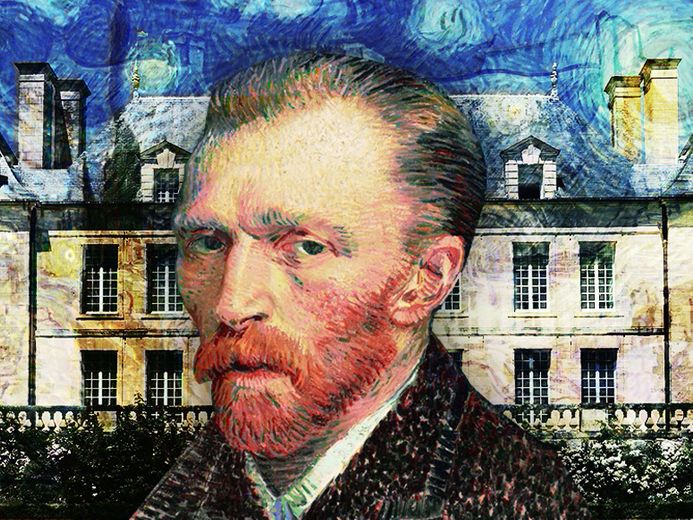
Vincent van Gogh spent a year in South East London, and you can visit his house

At the start of the 1870s, Vincent van Gogh was not yet an artist. After leaving secondary school halfway through his second academic year, Vincent’s uncle found the 16-year-old dropout a job at the Hague branch of international art dealer Goupil & Cie. It was around this time that he began writing letters to his brother Theo, detailing his movements, discoveries and epiphanies. In 1873, for example, we know that Vincent was transferred to Goupil’s London branch in Covent Garden. He would live in the city for just one year before moving to Paris.
Van Gogh had never lived in another country before. He was completely on his own for the first time in his life. On arrival, he lodged at several different houses before settling on a modest room at 87 Hackford Road, Stockwell, which was transforming from a semi-rural fringe into an elegant middle-class suburb at that time. In the 1860s, a handful of public and philanthropic institutions were introduced, including an orphanage and a school. Number 87, an 1820s Georgian terrace, was home to a widowed landlady called Mr.s Ursula Loyer, her daughter Eugenie Loyer and another lodger called Samuel Plowman. Mr’s Loyer ran the local school, assisted by the 19-year-old Eugenie, who van Gogh is believed to have fallen in love with during his stay.
While living in London, Vincent found the time to visit cultural institutions like the British Museum and the National Gallery, where he was introduced to the works of “peasant painters” like François Millet and Jules Breton. He soaked up everything he could, reading museum guides, pamphlets, magazines, literature and poetry without prejudice. He also became increasingly religious. Indeed, the letters he wrote to Theo at this time are packed with Bible quotes and accounts of church sermons. In 1875, Vincent, increasingly disillusioned with his job at Goupil & Cie, was sent to Paris, leaving London behind in a swirl of pearlescent fog.
It wasn’t until 1971 that anyone knew van Gogh had once lodged at Hackford Road. During a postal strike, postman Paul Chalcroft found the time to identify the residences of Mrs Loyer, who he heard had once rented a room to the artist. The 1871 census records had just been made public, so it was the perfect time to do a bit of digging. Two years later, a blue plaque appeared above the front door of number 87. At that time, it was still the property of Arthur and Marjorie Smith, who had bought the house in 1947 when it was still partially damaged from wartime bombing. The houses on either side were demolished, but number 87 was left standing. In fact, following The Smiths’ initial repairs, the hours remained unchanged for 70 years, meaning much of its original interior is still intact.
In 2012, Jian Wang and Alice Childes bought 87 Hackford Road for £565,000. Advertised as the ultimate fixer-upper, the duo quickly began renovating the three-story property. Several fascinating discoveries were made during the works, such as a bundle of papers dating back to van Gogh’s time hidden under the floorboards in the attic. These turned out to be insurance documents bearing the name Ursula Loyer as the policyholder, two of which were printed between 1873-74, the very year van Gogh was her lodger.
The bundle of papers also included an 1867 edition of A Penny Pocket Book of Prayers and Hymns, published by Frederick Wayne. Their offices were located on the same street in Covent Garden where Vincent worked for Goupil. Considering that Vincent became an evangelical Christian in London, it’s perfectly possible that he borrowed the book from Ursula. Perhaps most intriguing of all, however, are the scraps of paper featuring watercolour paintings and decorative flowers discovered by a builder underneath another floorboard. Sadly, the works show little evidence of Vincent’s style, and it’s believed that while he did sketch during his time in London, he never used watercolours.
Today, 87 Hackford Road is home to the Van Gogh House London, which aims to celebrate “the house’s remarkable legacy by hosting artist residencies in addition to guided tours, exhibitions and events.” To learn more about the Van Gogh House, visit the museum’s website.
