


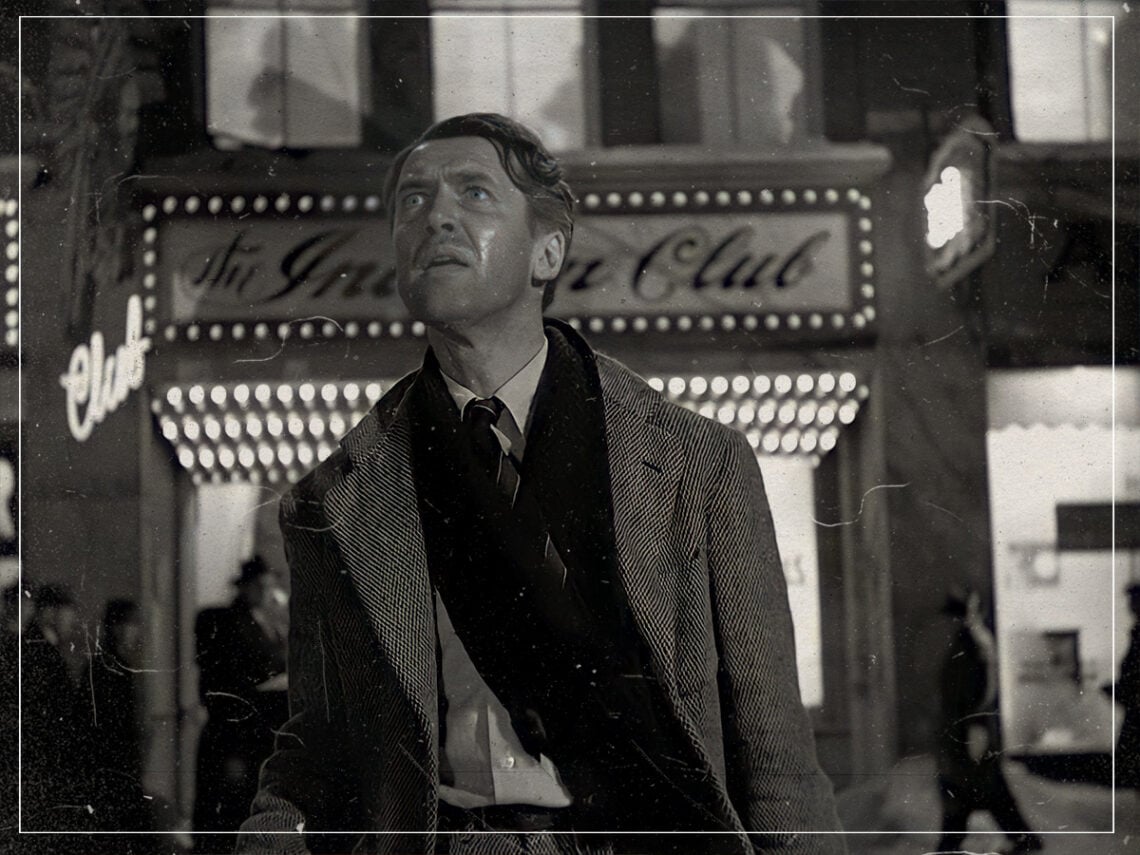
The unscripted James Stewart scene that made ‘It’s A Wonderful Life’ more powerful

Everybody has their favourite Christmas movie. For some, it might be something light-hearted like Elf, while others may enjoy the emotional gut punch of a Love, Actually. However, if you want a film that encapsulates all of those feelings and more, chances are your go-to festive flick is the Frank Capra classic It’s a Wonderful Life.
The story of George Bailey and his remarkable, uncomplicated kindness is simple yet extremely effective. Bailey, brought effortlessly to life by James Stewart, is pure good. He sacrifices his time, money, and dreams to help those around him, even if he barely knows them, all because he knows it’s the right thing to do. Yet, he’s not a one-dimensional character. He has a fraught relationship with his own charitable behaviour, to the point where it nearly drives him to suicide, yet he persists. The story of It’s a Wonderful Life is good versus bad, and although it may have consequences, good always wins.
It’s a Wonderful Life, which came out in 1946, contains many scenes that have found a special place in the hearts of millions. The obvious is its grand finale when the people of Bedford Falls rally together to replace the $8,000 George needs to stay afloat as the folk hero basks in the loving embrace of his family. Zuzu Bailey’s (Karolyn Grimes) delivery of “every time a bell rings, an angel gets its wings” might be a little on the shrill side, but it would take a heart of stone not to be moved by it each and every time.
Another touching moment comes when George prays to God for guidance, saying he’s “at the end of his rope.” It’s tough to see a man who has been nothing but selfless his entire life reduced to such a state, made even tougher by Stewart’s heartfelt performance. As it turns out, the screen legend was drawing on his real-life experience to hammer this scene home, as he told Guideposts in 1987.
“As I said those words,” Bailey said of his plea to the Almighty. “I felt the loneliness, the hopelessness of people who had nowhere to turn, and my eyes filled with tears. I broke down sobbing. This was not planned at all, but the power of that prayer, the realisation that our Father in heaven is there to help the hopeless, had reduced me to tears.”
It’s a Wonderful Life was the first movie Stewart made after his service in World War II. He was the first major Hollywood star to join the cause, serving as a lieutenant in the Air Force. Robert Matzen, who wrote a book on Stewart’s time during the war, told CNN, “It’s a Wonderful Life was a result of Jim’s war experiences because it unlocked this depth of soul in Jimmy … He had to learn to act again, and that’s what you’re seeing on screen. It’s like lightning that just got captured in a bottle.”
There’s no doubt that the “hopelessness” Stewart mentioned was at least somewhat informed by his wartime experiences. World War II was a time of great hopelessness for everyone, and many people would have surely turned to prayer in order to get through the day. That’s why Stewart’s performance resonated with so many people at the time, and even though the war is now a shadow of history, the character of George Bailey continues to be relevant eight decades after he first appeared on screen.
