


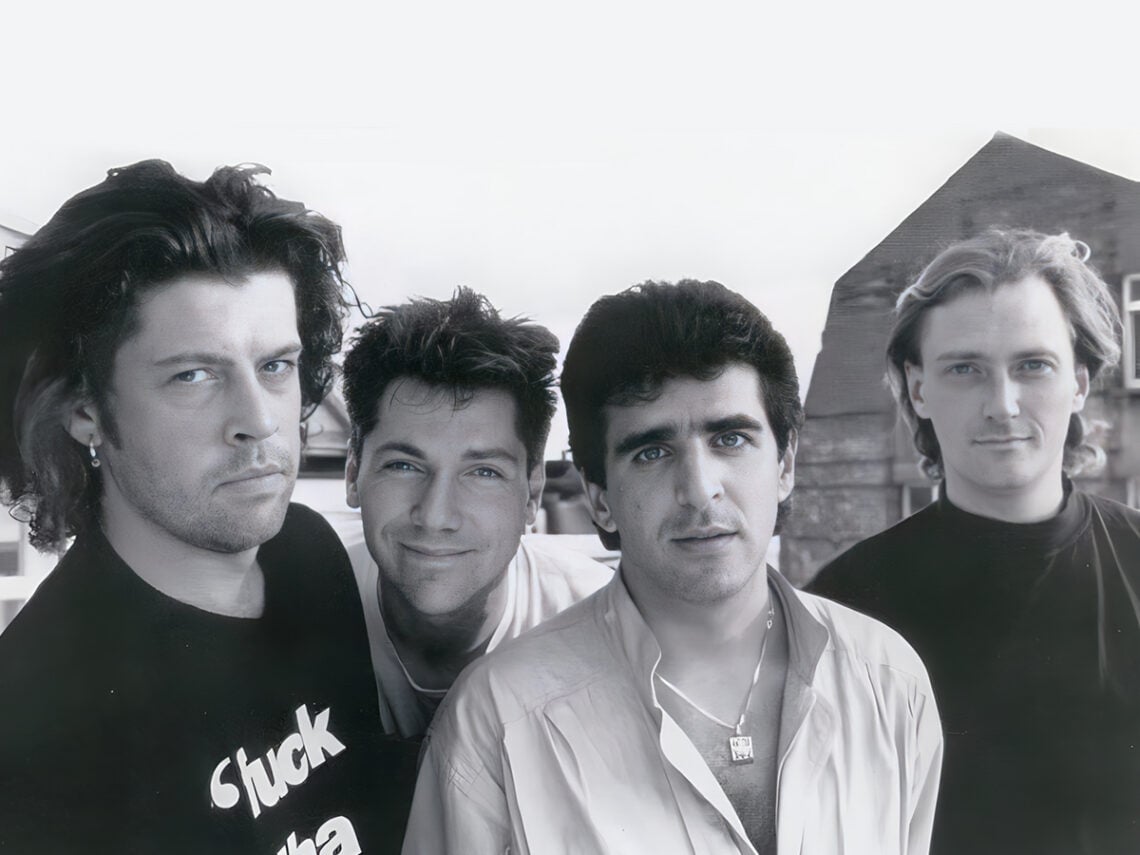
The unique songwriting practice behind Killing Joke: “Have a drink”

During the heyday of Killing Joke in the mid-1980s, frontman Jaz Coleman wasn’t exactly a safe bet for a straightforward, thoughtful quote. Call him an eccentric, a contrarian, a mischief maker, etc, but journalists were routinely left scratching their heads at whether to take the man seriously or not.
Case in point, Coleman once cited Libyan dictator Muammar Gaddafi as his favourite celebrity “because of his sense of humour”. He also routinely talked about wanting to flee the UK because of an impending apocalypse, only admitting many years later that “I told everybody the end of the world was coming, but that was to get people off my back”.
In 1989, despite Killing Joke’s first seven albums failing to chart in America, Jaz also told a Boston Globe reporter that his band was “about to take this country by storm. … Next to this, bands like REM and U2 will pale in significance.”
That certainly didn’t happen, but in other cases, Coleman’s seemingly tongue-in-cheek, over-the-top statements actually did prove to be the genuine article, like when he briefly quit Killing Joke in the band’s infancy and threatened to become a classical composer. Jaz rejoined the band shortly thereafter, but he also followed through on his other promise, eventually becoming an accomplished orchestral composer, highlighted by several successful projects adapting the music of rock gods Pink Floyd, Led Zeppelin, and The Doors into classical compositions.
Fans who were aware of Coleman’s background – notably his classical training and early years studying music in Leipzig and Cairo – were rarely surprised at what the man brought to the table. It also was a safe assumption that, as a songwriter, he was someone who took the process seriously, understanding the deeper “craft” perhaps a bit more than some of his post-punk contemporaries.
Speaking to International Musician and Recording World in 1985, though, Coleman discussed that subject in a way that, once again, leaves one to wonder whether he was taking the piss or not.
“When we write songs,” the then 25-year-old Jaz claimed, “We record various ideas onto a ghetto-blaster, sit down and listen, have a drink, do it again, have another drink, do it again, have another drink, do it again, have another drink, do it again, have another drink . . . then we can’t get up any more!”
That description of the creative process certainly wouldn’t sound out of place coming from Sid Vicious or Nikki Sixx, but it’s a tad harder, maybe, to picture the notoriously cerebral and mystical Jaz Coleman getting obnoxiously shit-faced around a boombox with Geordie Walker, Paul Raven, and Paul Ferguson.
Then again, if we’re to believe Coleman, his band’s often heavy, apocalyptic musical themes weren’t always coming from a place of deep thought or analysis.
“We’ve always written from our fears,” he told the Boston Globe in 1989, “From our paranoia, from emotions that other people generally reject. It’s undeniably therapeutic. From singing about our horrors, we can come to terms with them and feel better for it. When I get offstage all I remember is this fantastic oil painting, the songs merging into one another. For me Killing Joke is the ultimate anti-intellectual music.”
From that point of view, maybe a little numbing of the senses could have helped the songwriting process, after all. As Killing Joke became an increasingly political-minded band over time, however, and Coleman’s own concerns about climate change and environmental sustainability led him to a cleaner, sober lifestyle, it probably goes without saying that any earlier reliance on the “another drink” approach to songcraft would have gone out the window long ago.
