


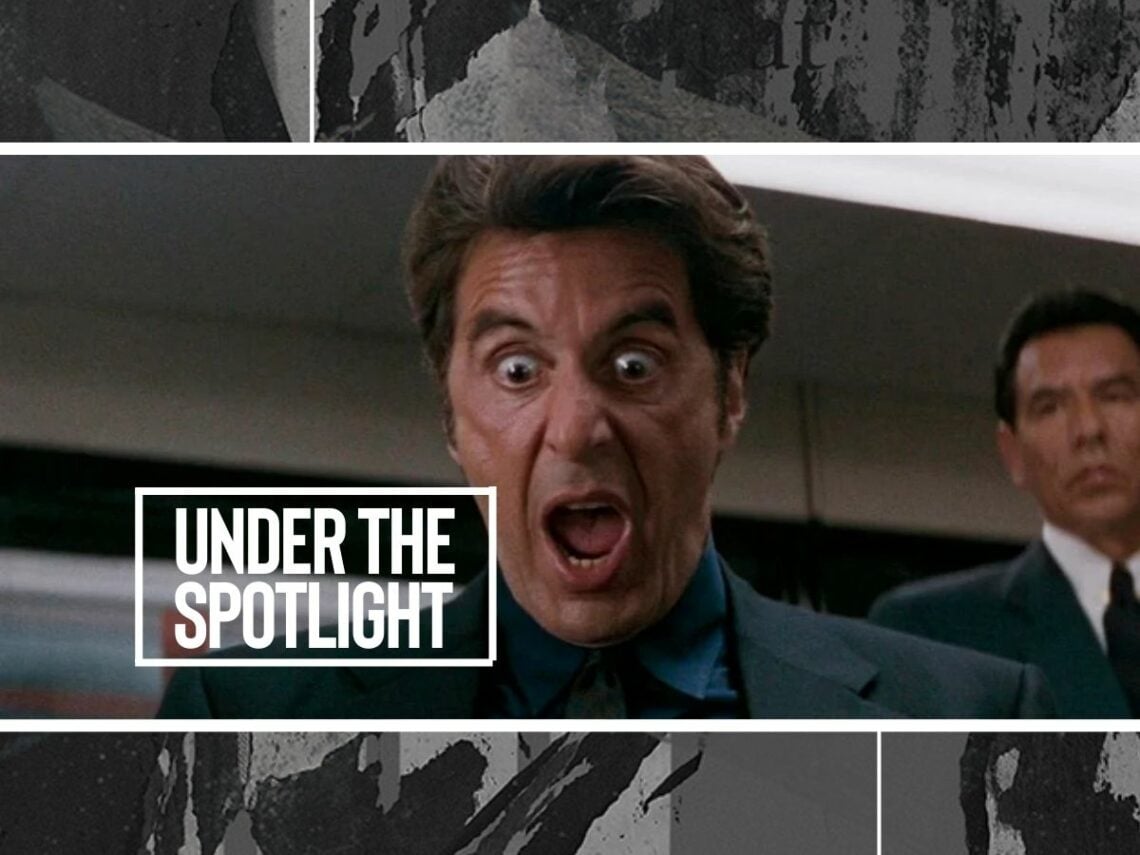
Under the Spotlight: Al Pacino’s bizarre performance in ‘Heat’

As 2008’s abysmal Righteous Kill proved well beyond any reasonable doubt, having Al Pacino and Robert De Niro share the screen in a hard-boiled crime thriller is no guarantee of quality. But their first on-screen partnership in Heat benefitted immensely from Michael Mann overseeing one of the genre’s modern greats.
The main selling point of the film to cinephiles and casual audiences alike was the mouth-watering prospect of seeing the two all-time greats and grizzled veterans go toe-to-toe as an honourable thief and dedicated detective, with each one of them operating on a completely different side of the law. The iconic coffee shop exchange is understated, played straight, and the effortless work of two old pros knowing exactly when, where, and how to pitch their performances, but the same can’t be said of Pacino at large.
Characters who anchor a movie as rivals being two sides of the coin is very much a cliché. But it’s an entirely fitting one in Heat‘s case. Pacino’s Vincent Hanna leads the investigation into De Niro’s Neil McCauley, and there’s always a clear measure of respect between the two, indicating they may well have been the best of friends in a different life. However, while the latter remains firmly grounded in reality, the former grows more exaggerated and borderline hammy as the narrative progresses.
Of course, Pacino had been coming under increasing criticism in the years leading up to Heat for flirting with the notion of descending into self-parody, propelled along by his signature “Hoo-ah!” technique for substituting nuance in favour of simply yelling as loud as he could. That’s not to say Hanna is a demonstrably quiet figure who actively flies in the face of that belief. However, the over-the-top elements of the actor’s performance were heavily indebted to a character beat that wasn’t even acknowledged in the final cut.
Hank Azaria was famously caught off-guard when Pacino embarked on his wild-eyed “she’s got a great ass” monologue, having no idea his scene partner was about to launch off the rails and deliver one of Heat‘s most memorable moments. Hanna veers from introspective to hammy throughout, and the reason why is simple: Pacino had decided he would play him as someone with a cocaine addiction.
Mann even filmed a shot of Hanna snorting a line from the blade of a dagger he kept in his back pocket to make his drug issues patently clear, but it was ultimately removed because it was “too strong a message”, when that assessment could comfortably be reached through Pacino’s performance alone without having to spell it out to the audience.
It wasn’t until more than a decade after Heat‘s release that Pacino confirmed it, in a Q&A session moderated by Christopher Nolan, no less: “I’ve waited to say this for a long time”, he admitted, “just so you know where some of his behaviour comes from”. Again, it can easily be inferred when Hanna goes from gently nibbling on the scenery to devouring it whole on a dime. However, not having it explicitly confirmed nonetheless left many wondering why he’d opted to go on so many unhinged performative tangents.
As the credits roll, Hanna is hardly defined by his exuberant eccentricities. He’s an archetypal protagonist, without a doubt, being a big city cop who neglects his family with a sense of duty, dedication, and commitment to his job that borders on obsession. Still, Pacino’s hangdog expression and lived-in gravitas transform him into a richly drawn and fully realised character, aided significantly by the shared and intertwining baggage he and De Niro carried into the film.
Quiet and soulful in one moment but strutting around with his chest puffed out in the next, Pacino treads a delicate tightrope that a lesser performer would have fallen from multiple times, but at the end of the day, his mission statement in Heat is simple. If he continues doing what he’s doing in his professional life, he’ll lose everything he holds dear on the personal side of the equation. And yet, he’s unwilling to give either of them up, with his mood swings from calm and collected police officer to maniacal to over-actor extraordinaire driven by a drug habit that didn’t even make it past the cutting room floor.
