


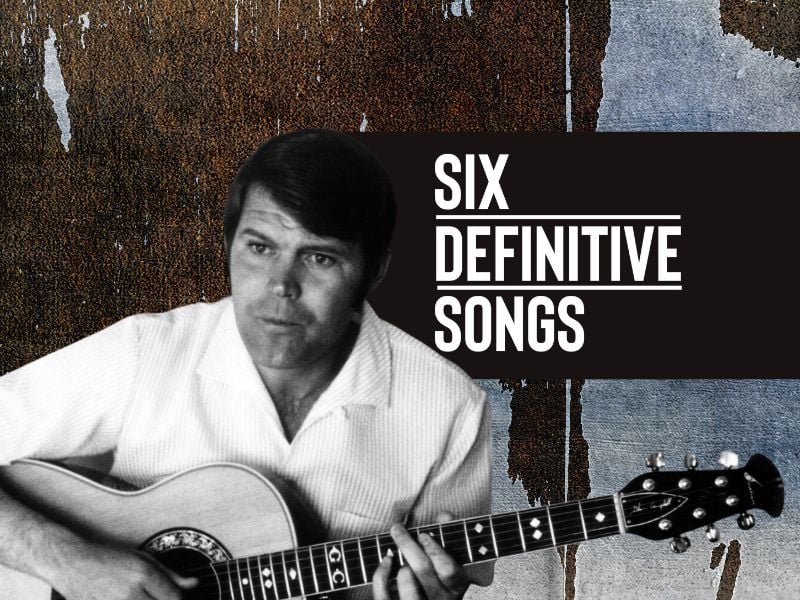
Six Definitive Songs: The ultimate beginner’s guide to Glen Campbell

There are some artists forever tied to a particular era of musical history. Glen Campbell is perhaps the most vivid example. His music is not only synonymous with the golden age of country but responsible for giving the genre life well into the 1970s.
Born in Arkansas in 1936, Campbell spent much of his childhood “at the south end of a northbound cow”, as he would later put it. With no money and no electricity, life was hard. His family got by growing crops like potatoes, watermelon, corn and cotton, but Campbell had his eyes set on bigger things. He first learnt to play the guitar at the age of four after his dad bought him a five-dollar Sears as a gift, with his uncle Boo helping him to learn the fundamentals of the instrument. By the age of six, he was something of a child prodigy and often appeared on local radio stations.
Throughout his adolescence, the young Campbell felt the pull of music and began performing in local nightclubs after work. Then, in 1954, he moved to Albuquerque, New Mexico, with his family, where he joined his uncle’s band, Dick Bills and the Sandia Mountain Boys. Four years later, he formed a group of his own, the Western Wranglers.
By the beginning of the 1960s, Campbell was working as a session musician in Los Angeles. He’d also been approached to join The Champs and would later take up a full-time day job as a songwriter for American Music. Soon enough, Campbell had established himself as an in-demand session musician and joined The Wrecking Crew, a group of studio musicians responsible for defining the sound of popular music in the 1950s and 1960s. Indeed, Campbell played on records by everyone from the Beach Boys to Frank Sinatra and Elvis Presley.
Glen Campbell’s six definitive songs:
‘Turn Around, Look at Me’ (1961)
Glen Campbells’s first solo single was released in 1961, shortly after he left The Champs. It wasn’t long before the established session musician was signed to Crest Records, who released ‘Turn Around, Look at Me’ in the May of that same year.
The single, a swooping, string-led number, had modest success, reaching number 62 on the Hot 100. However, it was The Vogues’ subsequent version, which peaked at number seven, that made the song a hit.
‘Gentle On My Mind’ (1967)
In 1962, Campbell singed to Capitol Records and began releasing a string of singles such as ‘Kentucky Means Paradise’, which was followed by several unsuccessful releases. Still, by 1963, his vocals and fretwork had already appeared on a stunning 586 records. Things changed in 1964 when Campbell began his TV career as a regular on Star Route. The year after, he released his biggest single to date, a version of Buffy Saint-Marie’s ‘Universal Soldier’.
Then, in 1967, Campbell soared into the stratosphere. After nearly being dropped from Capitol, he released ‘Burning Bridges’ with Al De Lory. Following the success of the Top 20 hit, Glen struck gold again with ‘Gentle On My Mind’, which was originally written by John Hartford and earned Campbell a Grammy award for Best Country & Western Solo Vocal Performance.
‘Wichita Lineman’ (1968)
1967-1968 was a very busy period for Glen Campbell. After ‘Gentle On my Mind’ made the singer a household name, he released even bigger hits in the form of ‘By The Time I Get To Pheonix, ‘I Wanna Live’ and ‘Wichita Lineman‘, the latter of which is undoubtedly his best-known work.
The track, written by Jimmy Webb, was recorded with help from Campbell’s former Wrecking Crew colleagues and featured on the same name’s album. The tender offering reached number three on the US pop chart, sitting alongside the likes of ‘Hey Jude’ and ‘Sittin’ On The Dock of The Bay’ by Otis Redding. It remained in the Top 100 for no less than 15 weeks, also topping the American country music chart.
‘Rhinestone Cowboy’ (1975)
In the final years of the 1960s, Campbell was a regular face on American TV as the host of the variety show Glen Campbell’s Goodtime Hour. CBS decided to axe the series in 1972, at which time he began starring in made-for-television films like 1974’s Strange Homecoming and making frequent appearances on network talk shows and variety programs.
Amid all of this, he still had the time to release a few hits, one of the most memorable of which is 1972’s Rhinestone Cowboy’, which made number one and became Campbell’s biggest-selling single to date, with over 2 million copies sold initially. Today, it’s just about the most iconic Americana anthem of all time.
‘Southern Nights’ (1977)
Two years after the release of ‘Rhinestone Cowboy’, Campbell offered up another era-defining single. ‘Southern Nights’ was originally written and recorded by Allen Toussaint in 1975 for his album Southern Nights, but Campbell felt that the song perfectly captured his rural childhood in Arkansas, so he decided to release a new arrangement.
The song encapsulates a nostalgia for rural America that runs throughout many of Campbell’s most celebrated singles. Apparently, of all the tracks he released during his expansive career, ‘Southern Nights’ was his absolute favourite. It’s certainly one of the grooviest singles he ever released.
‘I’m Not Gonna Miss You’ (2013)
The 1980s and ’90s were a fairly quiet period for Campbell when it came to music. He continued to star in films and TV shows, but it wouldn’t be until 2008 that he would release any new music. Meet Glen Campbell, which saw the singer covering tracks by the likes of Travis, U2 and Tom Petty and The Heartbreakers, was followed by his 2010 farewell album Ghost On The Canvas, released around the time of his Alzheimer’s diagnosis.
In 2013, Campbell recorded what would turn out to be his final song. ‘I’m Not Gonna Miss You, for which he reunited the legendary Wrecking Crew. The recording process was captured in the 2014 documentary Glen Campbell: I’ll Be Me. Two years later, it was confirmed that Campbell was in the final stages of Alzheimer’s disease. In the August of 2017, he sadly passed away at the age of 81.
