


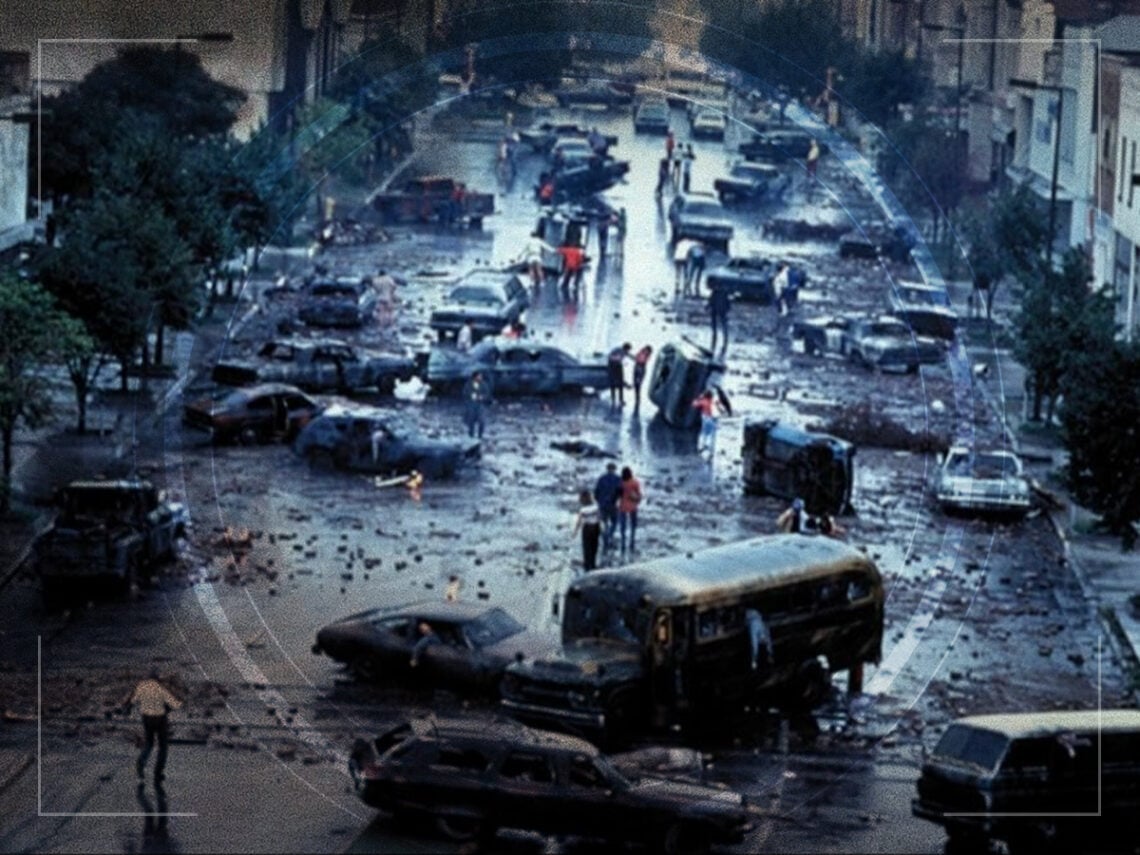
The TV movie that changed the course of the Cold War: “Very effective and left me greatly depressed”

It’s not every day that a movie can realistically be credited with changing the course of a global conflict that raged for more than four decades. However, in 1983, a TV movie aired on ABC that put the fear of God in the American people so thoroughly that it forever altered how they viewed the devastating potential of Nuclear War. Amazingly, it just so happened that one of those citizens was the one man who had the power to change official policy on the matter.
It all began in 1979 when ABC’s head of TV movies, Brandon Stoddard, watched Jane Fonda and Michael Douglas’ thriller The China Syndrome, which told the unnerving story of a near-meltdown at a nuclear power plant, followed by a sinister cover-up of the event. Incredibly, it was released only 12 days before the Three Mile Island disaster, in which a nuclear plant in Harrisburg, Pennsylvania, suffered a partial core meltdown, releasing radioactive gases and iodine into the environment.
Stoddard was stunned by how quickly real life imitated art, and how much fear there was among the populace about nuclear radiation. However, he couldn’t help thinking about how the world was seemingly always on the brink of nuclear annihilation, with the US and Soviet Union engaged in the Cold War for decades. Yet, for some reason, since the Cuban Missile Crisis in 1962, which saw the world come as close as it ever has to nuclear war, Americans had mostly put nuclear weapons to the back of their minds.
So, Stoddard – convinced the world was still one push of a button away from becoming a nuclear wasteland – contacted director Nicholas Meyer and asked, “What if we showed a nuclear exchange and what would happen to regular people if they got nuked?” At the time, Meyer was most famous for helming 1982’s Star Trek II: The Wrath of Khan, and he eagerly came on board the project, which was to be written by Barnaby Jones’ Edward Hume.
However, the project, which gained the title The Day After, soon ran into resistance from ABC executives, who weren’t overly sold on the idea of showing Middle America what it would be like if Kansas were incinerated by nuclear hell. This was the network that made The Love Boat and Three’s Company, after all. It was in the business of entertaining the country, not terrifying it.

Despite this pushback from the network and conservative elements accusing the project of being Soviet propaganda, The Day After made it to air on November 20th, 1983. It starred a powerhouse cast including Poltergeist’s JoBeth Williams, Jason Robards of All the President’s Men, and Blow Out’s John Lithgow. However, even though Stoddard and Meyer were confident they’d made a good, thought-provoking movie, they were sure it would tank in the ratings.
Instead, an astonishing 100 million Americans tuned in to watch the film, which made it the most-watched TV movie in history. To say the film’s effect on the populace was profound would be a gross understatement. Horrified viewers jammed the White House’s switchboard with calls, and countless shellshocked citizens called the 1-800 numbers ABC had set up to talk to counsellors. An ABC news special was aired in which critical voices like the scientist Carl Sagan, former Secretary of State Henry Kissinger, and former Secretary of Defence Robert McNamara debated America’s nuclear policy.
However, The Day After had perhaps its most profound effect more than a month before it even aired on ABC. On October 10th, President Ronald Reagan watched a screener copy of the film at Camp David, and it left him so shaken he wrote in his diary, “It has Lawrence, Kansas, wiped out in a nuclear war. It is powerfully done. It’s very effective and left me greatly depressed.”
Indeed, Reagan’s biographer claimed he spent three years shadowing the President in the White House, and only saw him visibly upset once: when he watched The Day After. On top of that, when the film was shown to the Joint Chiefs of Staff, a government advisor who attended the screening told Meyer, “If you wanted to draw blood, you did it. Those guys sat there like they were turned to stone.”
Only four years later, Reagan and Soviet Union Premier Mikhail Gorbachev signed the Intermediate-Range Nuclear Forces Treaty, which dismantled many of the two superpowers’ nuclear and conventional ground-launched ballistic missiles, cruise missiles, and missile launchers. By 1991, 2,692 nuclear missiles had been eliminated completely.
So, was Reagan so petrified by the realistic vision of nuclear war in The Day After that he seriously rethought whether America should keep producing nuclear weapons? By extension, because he convinced the Soviet Union to reduce its nuclear arsenal as well, did The Day After play a part in shaping the course of the Cold War? Extrapolating further, did it potentially save the world from being turned into one big mushroom cloud? Meyer certainly thinks so.
“I’ve come to believe that’s true,” he told The Hollywood Reporter in 2023. “The movie may have indeed helped prevent a nuclear war. It certainly changed one person’s mind on the subject.” That person was the leader of the free world, and Meyer argued, “Ultimately, it sent Reagan into such a tailspin that he signed…the only treaty that ever resulted in the physical dismantling of nuclear weapons.”
