


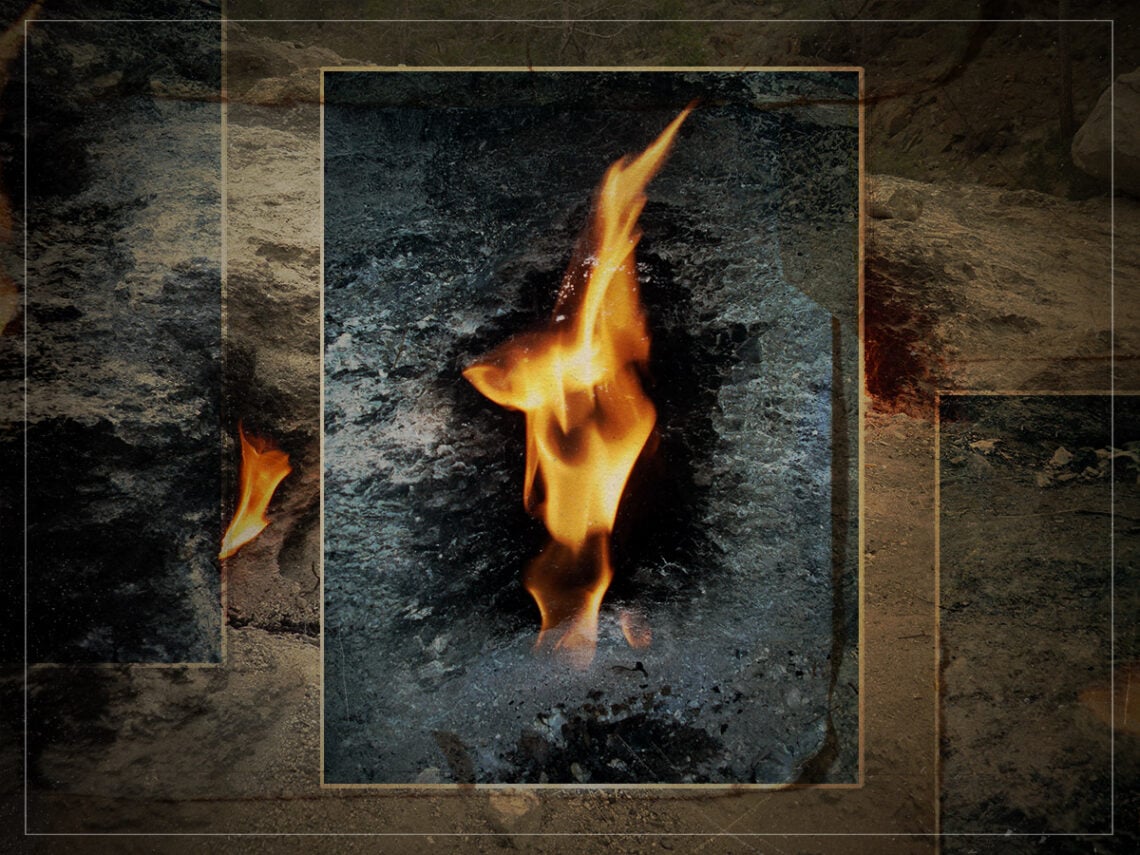
The fantastic story of the Turkish mountain of eternal flames

So many ancient Greek myths centre on a dangerous, fantastic beast slain by a handsome, good, and muscular hero, and then, once the battle has ended, the site where it happened is remembered with a monument, painting or some kind of symbol.
But, only a few myths have had such marvellous outcomes that they foresaw the occurrence of true geological phenomena. Confused? Let me explain. In the famous epic poem The Iliad, Homer recounts the story of a fire-breathing monster that posed a grave danger to all who came near him. “In her forepart, she was a lion; in her hinderpart, a dragon; and in her middle, a goat, breathing forth a fearful blast of blazing fire,” wrote the ancient Greek poet Hesiod.
This monster was called Chimera because it lived on Mount Chimera in the Olympos valley, which is in the modern-day Antalya Province in southwestern Turkey. It was slain by Bellerophontes, a valiant god who shot the monster with an arrow aboard his winged horse Pegasus. Its body was left on the mountain, and finally, the danger had disappeared. But the story doesn’t stop here…
2500 years ago, in real life, after the killing of Chimera, bright and brilliant flames started to appear randomly out of the exact rocks on which its body was said to have lain, and the flames haven’t stopped burning since.
This site has become a fascinating attraction for locals and tourists alike. They hike the mountain, now in the Olympos Beydagları National Park, to see the dozens of flaming tendrils that sprawl out of holes in the rocks of over 5000 square meters of craggy mountains, like serpent tongues.
Legend has it that these are the flames of Chimera that were forever stuck in the ground on which she died. Indeed, this entire stretch of land is a holy place associated with fire, as it also houses the temple of Hephaistos, the Greek god associated with fire through his role as the blacksmith to the gods.
But how can such a thing occur and carry on for thousands of years? Well, scientists have concluded that the fires are fueled by gas buildup, which exerts pressure below the Earth’s surface. One of these gases is methane, which, when released into the atmosphere, reacts with oxygen and causes the fires.
The fires are most powerful during winter months when the air vents are most vigorous. People travel in waves in the evening and at night to view the brilliance of the flames that seemingly spring out magically from the rocks, amidst pine trees and lake pools. In the air, a faint smell of gas fills one’s nostrils while the cicadas ring rhythmically in one’s ears as the fires blaze in front of you. It’s truly a surreal landscape.
