


How an FBI agent infiltrated the mob: The true story behind ‘Donnie Brasco’

Although it’s not a requirement, it’s not a coincidence either that many of the greatest crime movies ever made are rooted in true stories to varying degrees. Sometimes, the names, faces, and events are burnished with a little artistic or creative licence, but real life has been a recurring theme throughout countless classics.
Martin Scorsese’s Goodfellas and The Irishman were both adapted from nonfiction books, and The Departed weaved in elements of Boston’s notorious Winter Hill Gang into its fictitious narrative. Frank Sinatra was pissed at how closely The Godfather mirrored the personalities of several people he was familiar with, while The French Connection, Zodiac, and The Untouchables were all inspired by genuine cases.
If Mike Newell’s Donnie Brasco has a spiritual connection to one of those aforementioned films above all others, then it would be Goodfellas. However, the shoe was on the other foot this time around, with federal agent Joe Pistone infiltrating an infamous organised crime family as an undercover operative, which isn’t quite the same as Henry Hill working his way up the ranks before turning informant.
The film was based on a book, though, with Pistone’s Donnie Brasco: My Undercover Life in the Mafia published in 1988, before almost immediately being optioned by Hollywood. Stephen Frears was initially attached to direct, but rather ironically, Scorsese’s masterpiece was too fresh in the mind for the studio to mount something similar, causing the project to be pushed back.
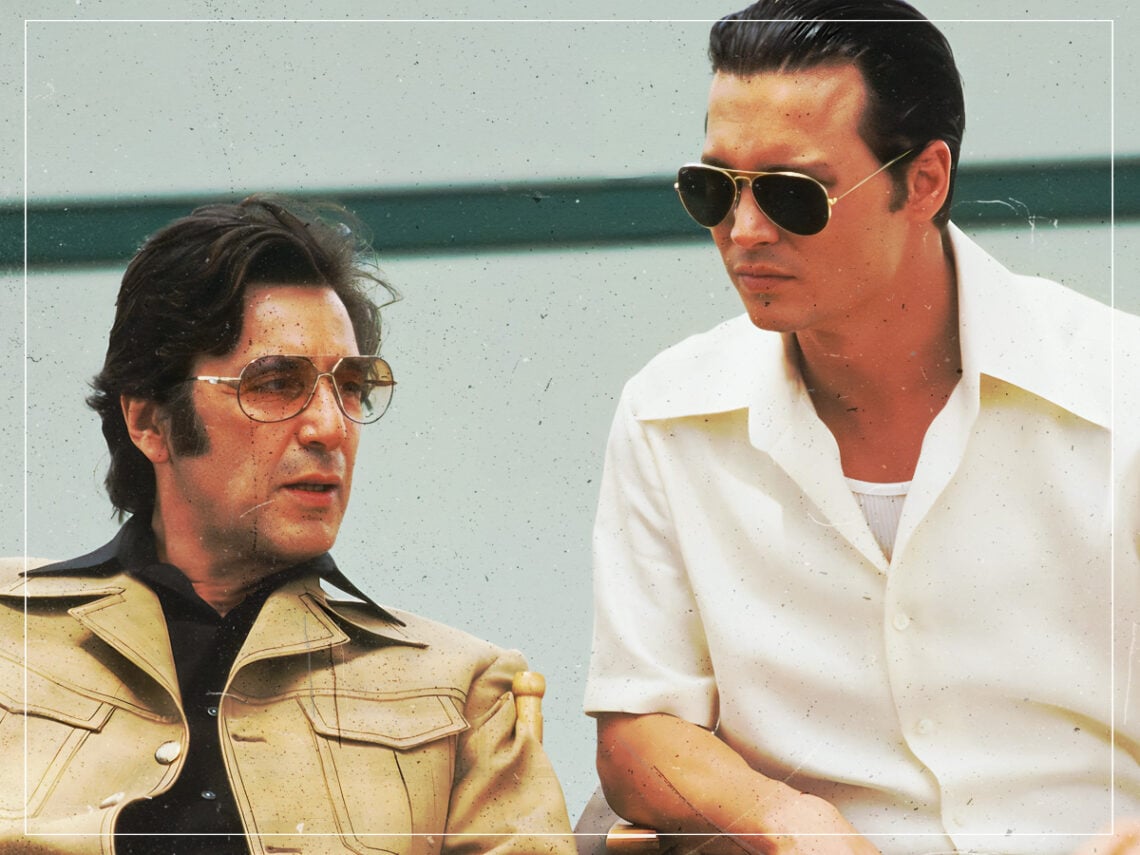
Released in 1997 with Newell at the helm, Johnny Depp played the dual role of Pistone and Brasco, with Al Pacino as Benjamin ‘Lefty’ Ruggiero. The two strike up a mutual respect that soon blossoms into friendship, placing Pistone in a personal and professional predicament, knowing that if he completes the task the FBI has assigned to him, there’s a distinctly high possibility Lefty won’t make it out alive.
Although Donnie Brasco‘s story doesn’t begin until 1978, Pistone had started his undercover work two years previously, where he took down a theft ring. Rechristened as Donnie, he began his operation as a low-level member of Bonanno crime family, where he first encountered Lefty. Depp spent months shadowing the real Pistone to get into character, to add an extra layer of authenticity and realism to his portrayal.
The former fed estimates that 85% of Donnie Brasco is completely accurate, which extended to the Pennsylvania-born Pistone being inducted into the mafia as a jewel thief and petty criminal from Florida. He picked that particular profession because it helped his backstory; it was a non-violent means of illegality, the practitioners regularly worked alone, and successful heists always led to the evidence being sold off for profit.
Lefty becomes so won over by Donnie that he continually vouches for him as he moves his way up the ranks, which comes back to haunt him in the end. Lefty had resigned himself to the fact he was going to be killed by his associates for letting an FBI agent infiltrate the Bonnano family, but he was instead arrested by the FBI in August 1981, shortly after Pistone was pulled from his assignment.
Over 200 indictments and 100 arrests were made as a result of the slow-burning investigation that pulled the wool over everybody’s eyes, and Pistone’s biggest source of umbrage with Donnie Brasco comes not from the recreations of his subterfuge, but the way the movie depicted his relationship with wife Maggie.
When he slaps Anne Heche’s spouse on-camera, Pistone admitted that even though he “went ballistic” at the fabrication, he let it slide because he didn’t “outrank the director.” In the end, Donnie Brasco is one of the more faithful translations of a true-life mob tale, and it also happens to be one of the best to emerge during the 1990s.
