


Track by Track: Flamingods break down latest album ‘Head of Pomegranate’

The album title Head of Pomegranate finds its origins in the Arabic translation of Ras Rumman (رأس الرمان), the name of the Bahraini village where Flamingods‘ Kamal Rasool’s late father spent his early years. It was a place known for its cultivation of pomegranates, and, following Rasool’s father’s passing due to Covid during the album’s writing, the record’s direction became clear. The LP is scattered with tributes that explore themes of grief, spirituality, culture, identity, and recovery.
To record the album, the band travelled to the warm city of Atlanta, Georgia, where they spent a month in the studio under the guidance of Ben H. Allen. The sunny and hot location mirrored the climate they grew up with in Bahrain. For Rasool, this experience came at a time when they were questioning the band’s future, and it served as a significant reconnection with their roots. It represented their “redemption moment”, which was only further strengthened by the support of Allen.
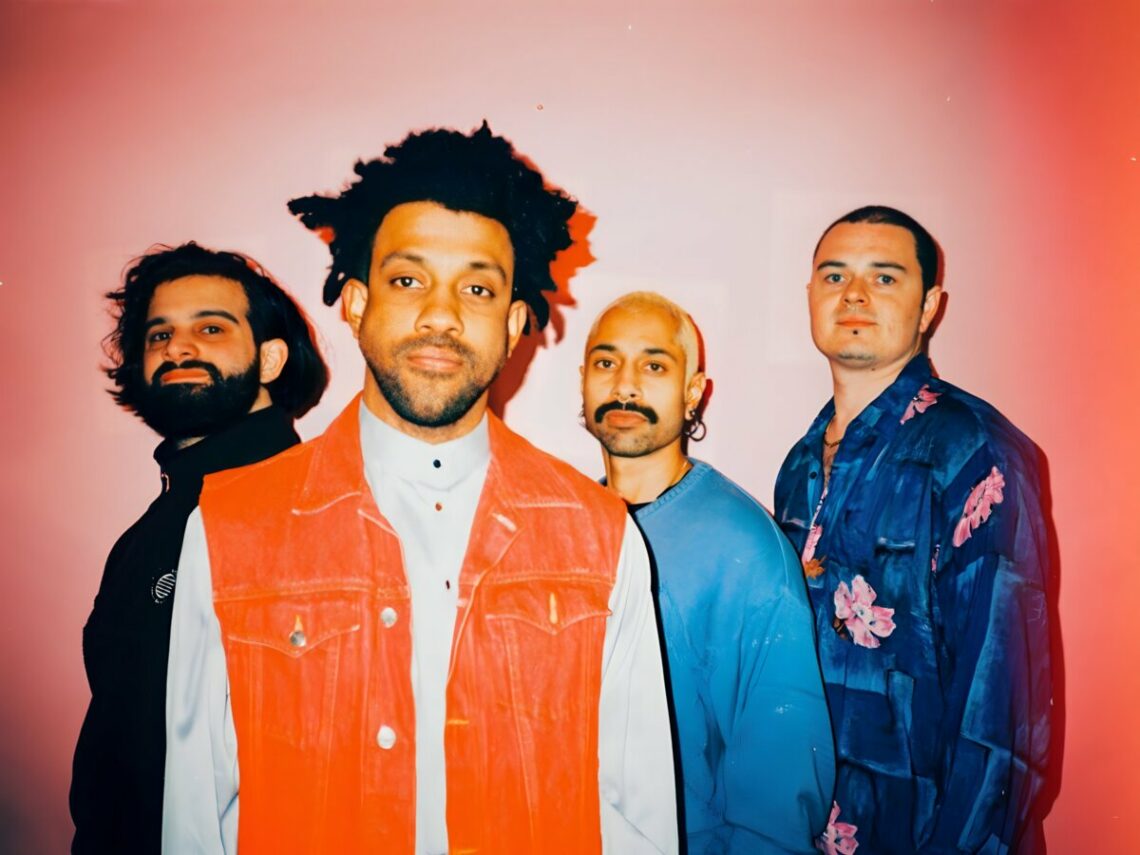
In addition to Rasool, the Flamingods consist of Charles Prest, Sam Rowe, and Karthik Poduval. Despite all being under 30 years of age individually, these musicians have been creating music together in various forms since they were sixteen. Their strong connection can be traced back to their shared upbringing in Bahrain, and this close-knit bond forms the foundation for their almost intuitive musical collaboration, establishing their reputation as a distinct presence in the UK music scene.
Fluent in a diverse range of musical genres, including psychedelia, new wave, electronica, and punk, they often seamlessly blend these styles within the same song. The band also excels in incorporating influences from their unique cultural backgrounds and their shared love for 70s British rock and roll. “We’re a band of mixed-race boys making alternative rock music, something that’s quite rare within our scene,” comments Poduval, “We aren’t engrossed in making traditional or obvious rock music. We’d rather make it our own.”
To gain some insight into the new record, Far Out sat down with the band to discuss how each track came to be.
Track by Track: Flamingods – Head of Pomegranate
‘Dreams (On The Strip)’
The group journeyed to Atlanta to record ‘Dreams (On The Strip)’ for a comeback that marked a remarkable fusion, bringing together elements of ethereal psychedelia, analogue synthesizers, Middle Eastern disco, and a myriad of other influences. “The first single we released off the album a few months back was actually the last song we wrote and nearly didn’t get finished in time,“ recalls Rasool. “We knew we wanted another dance track for the LP, so we started looping arpeggios and drum machines and layering over it with disco, punk and electronica influences.“
He continued: “To us, it ended up sounding like a cross between Donna Summer, Gary Numan and Kraftwerk, and we were totally cool with that. Thematically, the song explores the idea of dreams and the different ways they can affect you. When my dad died three years ago, I started having lucid dreams about him where he existed within these surrealist settings that felt both poetic and nonsensical. It felt like he was trying to reach me in these dreams, to give me advice or perhaps just be closer to me. It made me realise that this was probably the only way I was going to be able to connect to him from now on and so it changed my perspective of dreams and the sometimes-potent effects they can have on you.“
‘Adana’
‘Adana’ existed in demo form for over seven years and was initially considered for both of Flamingods’ prior albums until they eventually reworked it to suit this latest record. The song draws inspiration from a blend of influences, encompassing krautrock, UK new wave, and the realms of Turkish psychedelia and Anatolian rock in equal measure. “It was a demo for Majesty and then for Levitation until we finally re-shaped it to work for HOP,” Rasool explains.
Adding: “Having grown up together, there’s a brotherly bond that comes through on the track. We’ve been playing music together under various guises since the age of sixteen and there is a near telepathic level of musicality that extends into the music we create these days. Lyrically, this shines through, and I get to share some memories of times we’ve had on tour from our decade-plus as a band.“
‘The Dip’
‘The Dip’ embarks on a profoundly personal and introspective musical journey, taking its inspiration from the members’ initial and serendipitous encounters. “The idea of warmth has always been deeply connected to so many of our songs,” explains Prest. “Growing up, my dad was a pilot for Gulf Air, and our family was stationed out in Bahrain which is where I met Kamal and Sam.
Adding: “I have a lot of distant memories of being outside, enjoying long summers and being near water, which is imagery I call back to on ‘The Dip’. There’s a sense of longing and a drive to get back to that adolescent innocence of being outside in nature, sinking some cold ones with your mates. Musically, the song came out of a jam we had with our friend Go from the band Kikagaku Moyo. There was a summer where he visited London, and we got to hang out in the sun and have a few jams at Kamal’s garden shed studio, which was a lot of fun. The song takes inspiration from Can, with its repetitive Krautrock-inspired beat and has this hypnotic bass line steering the rhythm. We used our Turkish saz guitar here too, which is fuzzed out and pinging into action in a surf-guitar B-52s kind of way.“
‘Dirty Money’
Following the release of singles ‘Tall Glass’, ‘Dreams (On The Strip)’ and ‘Gutterball’, Flamingods dropped ‘Dirty Money’, an anti-war anthem taking influences from Bruce Haack, Gonjasufi and Kendrick Lamar’s ‘For Sale? – Interlude’. “The narrative is a mix between politics and surrealism. I wanted it to have this almost film-noir feel to it with lyrics largely about how governments paint a dishonest picture of reality whilst throwing around their dirty money and dividing communities,” says Rasool.
Adding: “Me and Charles both sing on this song, coming together for chorus harmonies and taking turns to sing between the sections. The song also features clarinet – an instrument I started teaching myself during the first lockdown. I think it adds to the track’s seedy Middle Eastern atmosphere, something we worked quite hard on creating.“
‘Gutterball’
‘Gutterball’ came into existence when the band simply aimed to craft a punk, new wave track with a Middle Eastern influence that would captivate their live audience. The song’s lyrical themes took a political and satirical direction, drawing inspiration from protests and revolutions. “We hooked up our Turkish Saz guitar to a ton of fuzz and looped distorted bass and synthesizers over Sam’s repetitively tight punk beats until the song kind of made itself,” remembers Rasool.
Adding: “It’s a protest song, but I didn’t want it to take itself too seriously in the words and so the instrumental’s velocity is the key here as it packs a real punch and creates the much-needed sense of urgency. This was another song that I wanted to mess around with political/satirical themes for, looking to protests and revolution for inspiration. The Mahsa Amini protests in Iran have been particularly compelling to me, and I’ve been super inspired by the brave women of Iran fighting back for their freedom.“
He concluded: “I’m part Iranian and have family who live in Tehran who have had to deal with this suppression for so long, so it’s one that’s close to home. I wanted to tap into the very real significance of fear and how it’s used to control people by governments, both in the East and the West. The mantra of the song is ‘Spit it out’ – if something is rotten, you don’t swallow it, and so the phrase is used repetitively to convey the urgency to stop ingesting lies fed to you by corrupt entities.“
‘Born Lucky’
Every great record starts somewhere, and Head of Pomegranate started with ‘Born Lucky’. What initially commenced as a simple jamming session quickly evolved into the foundation for the entire album, encapsulating the essence of the project in its themes of community, identity, and culture. “This was the first track we wrote for the record, and were super excited with how it came together,” says Rasool. “It felt like a fresh start for us but also had this great Flamingods feel to it in a way that we hadn’t achieved before.“
Adding: “KP had brought back a tabla machine from a trip home to India, and we started jamming over a bunch of these incredible Eastern rhythms and time signatures. We recorded a bunch of loops and then listened to them all together until we found the perfect nugget to craft the song around. We then layered in distorted bass, various synthesizers, percussion, kit and my taishōgoto, which I bowed here alongside real strings played by Annie Leeth – a friend of Ben Allen.”
“The song’s themes explore the different facets of identity and belonging that can occur when you leave home from one culture to the other,” he continues. “I was born in Bahrain and eventually left home to pursue my passion in music. I’ve been living in the UK for over a decade now and sometimes need to remind myself how big of a change this has all been. The idea of holding on to my cultural heritage is important to me, as is working hard to reach my goals and tapping into said heritage for creative inspiration.“
‘Volta Rocket’
As the title suggests, ‘Volta Rocket’ sounds exactly how you might expect, like a rocket shooting up until the very end. “Everything is distorted here,” explains Rasool, “the electronics, the guitars, the bass, drums, vocals. The words in the song are mostly nonsensical; lines from my writing journal that didn’t fit anywhere else, just kind of pieced together in a sort of collage. It was one of the last songs I wrote the words for, and by this point, I had channelled very serious and personal subjects like death, grief and belonging.“
Adding: “I just wanted to have fun here – taking a bit of inspiration from David Byrne to ‘stop making sense’. I think in the end, it ended up making itself make sense – I see the rocket now as a signal for change – our ever-evolving society, time ticking by, despicable politics, getting older. It’s all a bit overwhelming; change is everywhere, and everything is perpetually evolving – I think the song is a reminder to strap in for the ride and do the best you can to navigate it all whilst having a little fun.“
‘Tall Glass’
‘Tall Glass’ was a lot of fun for the band to craft, with its blend of funky guitars with quirky synths and a captivating rhythm section. It’s the type of track that Flamingods aspired to create for a while but might not have been fully prepared for in the past. It allows them to embrace their pop influences while still retaining that unmistakable signature sound. “The song’s themes come from getting older and learning to give yourself a break,” says Prest. “Things don’t often work out the way you want, but you can always change direction and figure it out another way, with the word glass being used as a metaphor for reflection and clarity.“
Adding: “Musically, we were inspired by my Afro roots here, musicians from the 70s and 80s like William Onyeabor, Steve Monite and Letta Mbulu – who were putting out Afro-synth bangers and fusing electronica with funk, disco and pop. We’re quite lucky as a band as we have a whole melting pot of cultural inspirations to pull from. As well as our collective eight nationalities, we’ve also lived in London for the whole existence of the band, which in itself is a culturally diverse and inspiring city. I think this comes through on ‘Tall Glass’; it has a concrete kind of swagger, and it’s one of our favourite tunes from the record.“
‘Perfumed Garden’
‘Perfumed Garden’ is a multi-part track, divided into three sections, each bearing a distinct significance or message. While it’s the lengthiest song on the album, which Flamingods typically sets aside for intense psychedelic rock anthems, this one deviates from that norm. It offers a serene introspection into the pandemic and the diverse ways it impacted the group’s lives, making it perhaps the most mellow song they’ve ever released.
“Our writing studio is in my garden shed, and everyone in the band lives local to each other – so they were the only people other than my housemates that I spent any time with for almost a year,“ remembers Rasool. “I’d spend sunny days in my garden with my partner, my cat Newton (who gets a shoutout in the song) and the band, smoking up, drinking coffee, and then going into the studio to write just about every day. The slowdown was welcomed, and I tried to capture the beauty of that in the lyrics here as well as the music having this gentle flow to it. The main melody is an electronic loop we’ve had in our demo folder for years, we had tried multiple times to make it work but it was waiting for this very moment to shine through.“
Adding: “The second part represents change or reality to me. When that initial bliss is gone, and it all becomes too real. I lost my dad to the pandemic and so this thing that had once given me peace and solace had now turned my life upside down. The music does the talking here, and to me, it feels like a re-birth of sorts. Things will never be the same when I come out of this. The third and final section represents recovery. To try and pick up the pieces and motivate yourself to live again. I love this section, KP came up with this beautiful keyboard part that bounces along and drives the song to the finish line alongside vocal, clarinet and guitar harmonies, lulling the song over to its end.“
‘Eastern Cowboys’
In a heartfelt tribute to Rasool’s father, ‘Eastern Cowboys’ presented itself as the ideal canvas. The song is divided into two sections: a poignant and euphoric beginning followed by an explosive second half that’s a pure dose of rock and roll enjoyment. “I remember singing the final line of the first half and then dropping to my knees in tears. I hadn’t cried about my dad in about a year, and it all kind of came flowing out unexpectedly at once,” remembers Rasool. “Ben and his team also didn’t know any of this at the time but quickly caught on, and we ended up having this amazing embrace after. It was emotional but also cathartic, almost like I needed to do this to heal.”
Adding: “I remember Ben saying that moment was one of the most beautiful things he’s ever captured on record. Musically, I think it’s some of our best work. Sam’s bass lines kick ass and drives the whole song melodically, and he and KP – who are both drummers – worked out this great motif where the track changes time signature going in and out of verses. We also added in this cowboy whip sound bite, which is a lot of fun.“
‘Head of Pomegranate’
The final track, ‘Head of Pomegranate’, encapsulates all of the album’s overarching themes, providing a moment of lucidity and resolution. “Losing my dad was one of the hardest things I’ve had to endure, and I think the album played a big part of my recovery; it was very therapeutic,” explains Rasool. “I think death – as grim as it can be – can also be moving – to honour someone and look to these distant memories for inspiration.“
“I count myself lucky I was able to do it with the band. Having grown up together, there’s a brotherly bond that isn’t lost on Head of Pomegranate. We’ve been playing music together under various guises since the age of sixteen and there is a near telepathic level of musicality that extends into the music we now create. I think in a way for the final song to be such a short snippet is pretty cool – like a cliff-hanger – there is more to come, and we hope you guys are as excited as we are. Even this song is actually just a snippet of a 13-minute epic we wrote. Hopefully we get to share the whole thing soon enough.
