


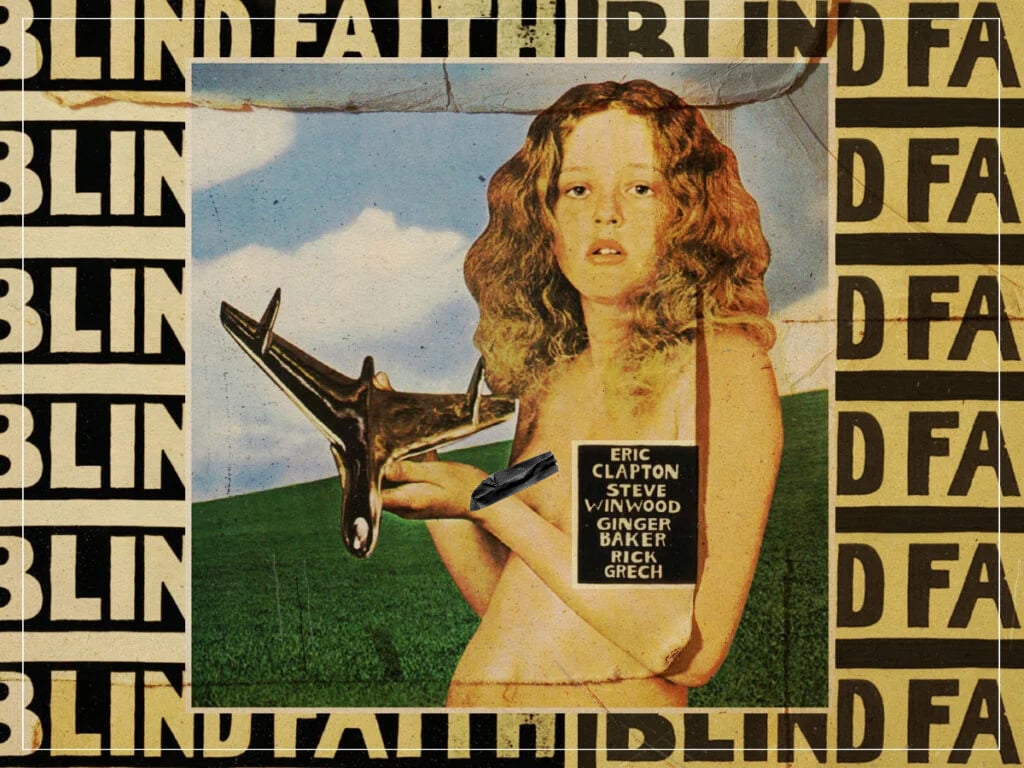
The Cover Uncovered: The unsettling topless image fronting Eric Clapton’s ‘Blind Faith’

Amid the various musical projects Eric Clapton had going on in the late 1960s and early ’70s, Blind Faith is often forgotten. Clapton’s one-album supergroup with Steve Winwood, Traffic’s Ric Grech and Cream’s Ginger Baker seems to get lost either side of his performance on The Beatles’ ‘While My Guitar Gently Weeps’ and the formation of Derek and the Dominoes.
And maybe it’s best that way. Aside from Winwood’s decent blue-eyed folk-blues single ‘Can’t Find My Way Home’ and Clapton’s pseudo-religious ode to Procul Harum’s ‘In the Presence of the Lord’, Blind Faith’s self-titled album doesn’t offer much of interest. It ends with the remarkably indulgent Ginger Baker track ‘Do What You Like’ – which he does for about 15 minutes. Clapton may just have had a point in not wanting the Cream drummer to join the band.
More than any of its songs, though, it’s the front cover of Blind Faith for which the LP is remembered the most. Bob Seidemann, a New York-born artist and photographer who hailed from San Francisco, was commissioned by Clapton to create the cover image.
Seidemann had shared am apartment with Clapton when he moved to London at the musician’s behest, and the two had formed a close friendship. He was already well-known at the time as a key artist of the late ’60s counterculture, having collaborated with musicians from the San Francisco Bay Area like Janis Joplin, her band Big Brother and the Holding Company, and the Grateful Dead.
Yet this experience wasn’t helping Seidemann come up with a cover idea for his friend’s new band until, in his own words, “out of the mist, a concept began to emerge”. The concept the creative hive inside his mind had somehow concocted was that of a “spaceship” being held by a young girl at “the beginning of the transition from girl to woman”.
The spaceship was supposed to symbolise the technological accomplishments of human creativity, and the young girl supposedly represented, well, “the fruit of the tree of life”. What exactly Seidemann meant by that would have remained rather cryptic had it not been graphically illustrated in the disturbing artwork he was about to create.

Did she have to take off her clothes?
The answer to that question is, of course, no.
In any case, the young girl was the part of the image Seidemann seemed to be particularly interested in. And he found what he was looking for while commuting on the London underground. “She was wearing a school uniform, plaid skirt, blue blazer, white socks and ballpoint pen drawings on her hands,” he described in an advert for the artwork. As if that wasn’t creepy enough, he added, “It was as though the air began to crackle with an electrostatic charge”.
Apparently Seidemann was besotted. When he approached his prospective model, it only got more disturbing. She asked him, “Do I have to take off my clothes?” He gladly answered, “Yes,” and pushed to meet the girl’s parents. It turned out, unsurprisingly, that she was in her early teens. Not right for the cover photoshoot. Because she was too old.
Instead, Seidemann noticed her younger sister, who was, in his words, “glorious sunshine”. From his warped perspective, she was perfect for the role of a nude model holding a spaceship. For the promise of receiving “a young horse” in return, the child and her parents agreed to the shoot.
And so, the album cover image shows a Mariora Goschen, aged just 11, in front of the stock background blue cloudy sky and a green hillside, holding a small model spacecraft. Even worse, the shape of the spacecraft suggests phallic connotations.
As a final artistic embellishment, Seidemann entitled the image ‘Blind Faith’, which inspired Clapton to use this expression as the name for both the band and the album. Clapton was a big fan of the artwork and pushed shocked record company executives to sign off on using it.
Nevertheless, the image naturally created a storm, generating a horrified reaction across the music industry. It was banned in the US, as Blind Faith’s American record label replaced it with an image of the band and text from a flyer advertising one of their concerts.
Sinister rumours circulated about the girl in the image, including that she had been sex-trafficked by the band. But no, for the artist himself, Seidemann, this cover art was no more or less than “an image in the mind of one who strove for that moment of glory, that blinding flash of singular inspiration”.
For all the work Seidemann may have created before or since Blind Faith’s album cover, this controversial piece is what he will be remembered for. Unsettling and morally questionable at best, the image serves as a reminder that during the era of free love, female empowerment and civil rights, women and girls were still subjected to the wonts of predatory male artists around the music industry.
