


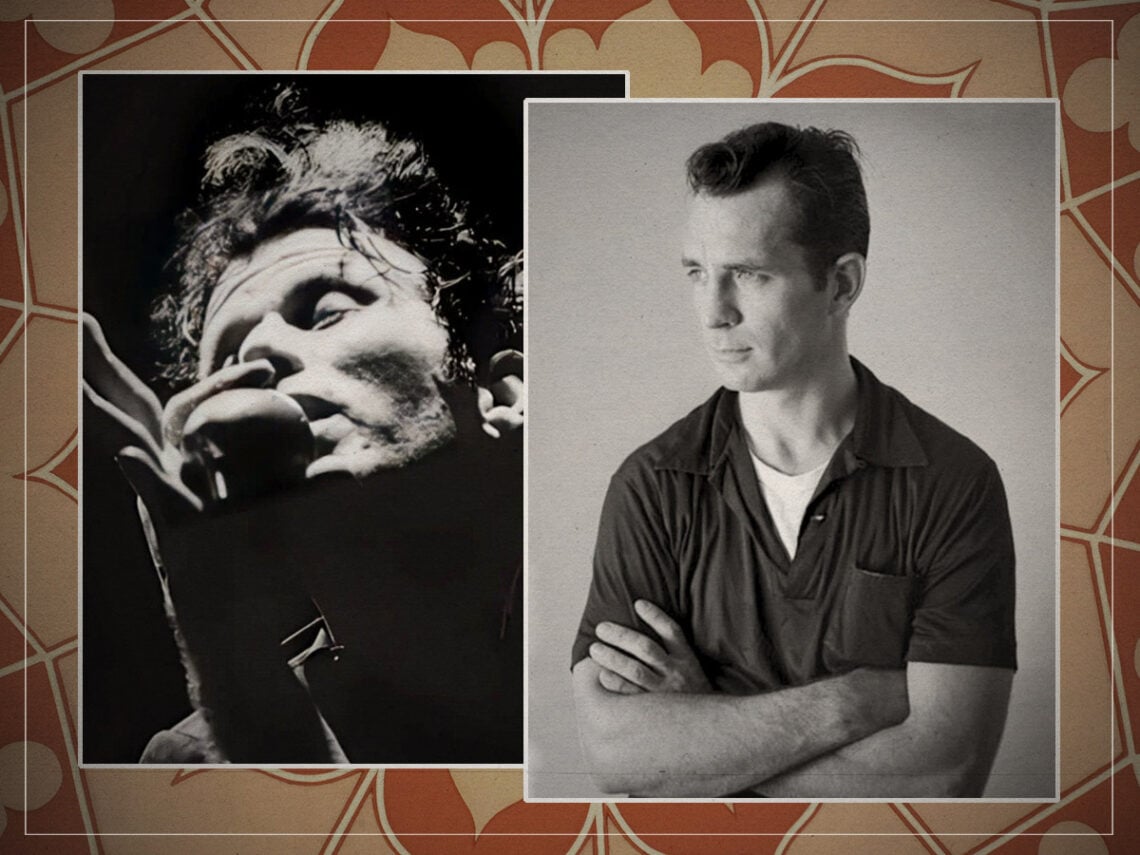
Tom Waits’ dreams of Jack Kerouac: “He was screaming something”

Tom Waits’ music is the stuff of brilliant nightmares, but he’s not averse to singing about dreams, either.
On Alice and Blood Money, both released on the same day in 2002, he makes references to spending time in Dreamland. On Franks Wild Years in 1987, he sang, “You’re innocent when you dream”, while on ‘Franks Theme’ from the same album, he suggested that you should “dream away the tears in your eyes, dream away your sorrows. Dream away all your goodbyes, dream away tomorrow”. Two years earlier, on maybe his best album, Rain Dogs, and certainly his most recognised hit, ‘Downtown Train’, he said that all his dreams “fall like rain”.
On his heartbreaking masterpiece of the downtrodden (couldn’t that just describe half his discography, though; which one to pick?) ‘Small Change’ from the 1976 album of the same name, he sings how “the dreams ain’t broken down here”. There are some images that Waits returns to time and again in his stories and songs. He often sings about rain and trains, about crows and freakshows, and about God and the devil. Moreover, he sings so often about dreams that when he sang the line, “I lived on nothing but dreams and train smoke” on ‘Pony’ from his late career magnum-opus Mule Variations, you believed him without a shadow of a doubt.
But what does Tom Waits dream about? Diamonds on your windshield, or else balancing on a blade of grass? Who’s to say. Starving in the belly of a whale? It’s quite likely. Bats in the belfry, golden promises and breaking hearts? Well, probably. Receiving a Christmas card from a hooker in a Minneapolis prison cell? You couldn’t argue against it. Getting off work to see his baby from the Jersey side? It’s a fairly safe bet, but we couldn’t say for sure.
But one thing we can be sure he dreams about with absolute certainty is Jack Kerouac. When asked if he ever met the greatest of the ‘Beats’ in 1979, Waits replied in the negative but added, “I used to dream about him. I remember one dream I had very clearly. I was in the kitchen in this apartment somewhere out in the Midwest. There was a party, and I was sat on the floor in this kitchen, and Kerouac came banging through the door. He was dragging this Mexican girl along by the hair, and he threw her up against the refrigerator and started slapping the shit out of her. He was screaming something, and she was screaming. And then I woke up.”
Though he admitted that by 1979, his obsession with Kerouac had “evened out” a little, the Massachusetts-born writer still remained his hero. Another of Waits’ early heroes, Bob Dylan, had similarly been taken with Kerouac and has said of reading the exhilarating On the Road in 1959 that “it changed my life like it changed everyone else’s”.
It certainly changed Waits’, and he was perfectly placed to get on the road himself, seeing as he liked to tell anyone who would listen in his early years that he was born in the back seat of a taxicab with his mother on the way to the hospital. “I guess everybody reads Kerouac at some point in their life,” he later said. “Even though I was growing up in Southern California, he made a tremendous impression on me. It was 1968. I started wearing dark glasses and got myself a subscription to Downbeat. I was a little late. Kerouac died in 1969 in St Petersburg, Florida, a bitter old man.”
“I think the reason that a lot of musicians like him is that he’s a very musical writer,” Waits added to his ongoing conversation about Kerouac years later. And it’s no wonder Waits was especially so taken with the revolutionary writer. The sense of freedom that unfurls with every un-scrolling of On the Road, or else the oppressive nature of The Dharma Bums or The Subterraneans and all the free-flowing, madcap movement, larger-than-life characters living in their smaller-than-life stories, and all the images which build up in the whole damned lot of them are so in tune with the way Waits works and tells a story.
In an interview for the 2005 biographical documentary No Direction Home, Dylan quoted the passage from On the Road where Kerouac wrote that “the only people for me are the mad ones; the ones who are mad to live, mad to talk, mad to be saved”, and suggested that he related entirely to the sentiment and felt the same way about life, as well. When Waits sang “We’re all mad here” on a song of the same name in 2002, he was, of course, quoting a far older text, but must surely have known that he has not only been travelling down the same mad road as Kerouac for all these years but that he is one of his heroes’ best and maddest musical offspring of all.
