


‘Together For Palestine’: A powerful evening led by Palestinian voices

The first thing I saw the morning after Brian Eno’s ‘Together For Palestine‘ was a video of leaflets fluttering to the ground in Gaza. Dropped by the Israeli army, there were warnings to those still left, starving, injured and fearful, in their homeland, telling them to evacuate. But where are they supposed to go?
Helplessness is the word for that, and it’s something felt by the people of Palestine as well as the rest of the world watching on. As governments continue to willfully ignore the situation, many refusing to call it what it is, which is a genocide, people are left feeling like there is nothing they can do to enact real change. That’s the point where music and artists have always stepped in.
The music world reacting in a time of injustice is nothing new. Charity gigs have a long history, and as Brian Eno’s curated ‘Together For Palestine’ begins at Wembley’s OVO Arena, it’s impossible to ignore the stadium next door and the history of shows like Live Aid. This is not that, though. It’s smaller, nicher, and there is very limited playing of the hits, opening up so many questions: what crowd do shows like this need to draw in? What should the mood be? How much rattling of the charity bucket should there be? Should the crowd even enjoy themselves?
Eno’s occasion fails in a few places but succeeds in many more. Undeniably and inevitably, it was a deeply moving occasion. Beyond the celebrity cameos, it was the presence of people like Stephen Kapos, a Holocaust survivor who was questioned by police for laying flowers during a Gaza protest this year, or journalist Yara Eid, who gave a speech on the hundreds of fallen journalists, including her own soulmate, that silenced the room with incredible impact.
Only at an occasion like this could Francesca Albanese, the UN special rapporteur on the occupied Palestinian territories, gain perhaps the biggest applause of the night, not mincing her words as she calls out governments for turning a blind eye while Israel “continues to destroy and kill, and to occupy land in Palestine”.
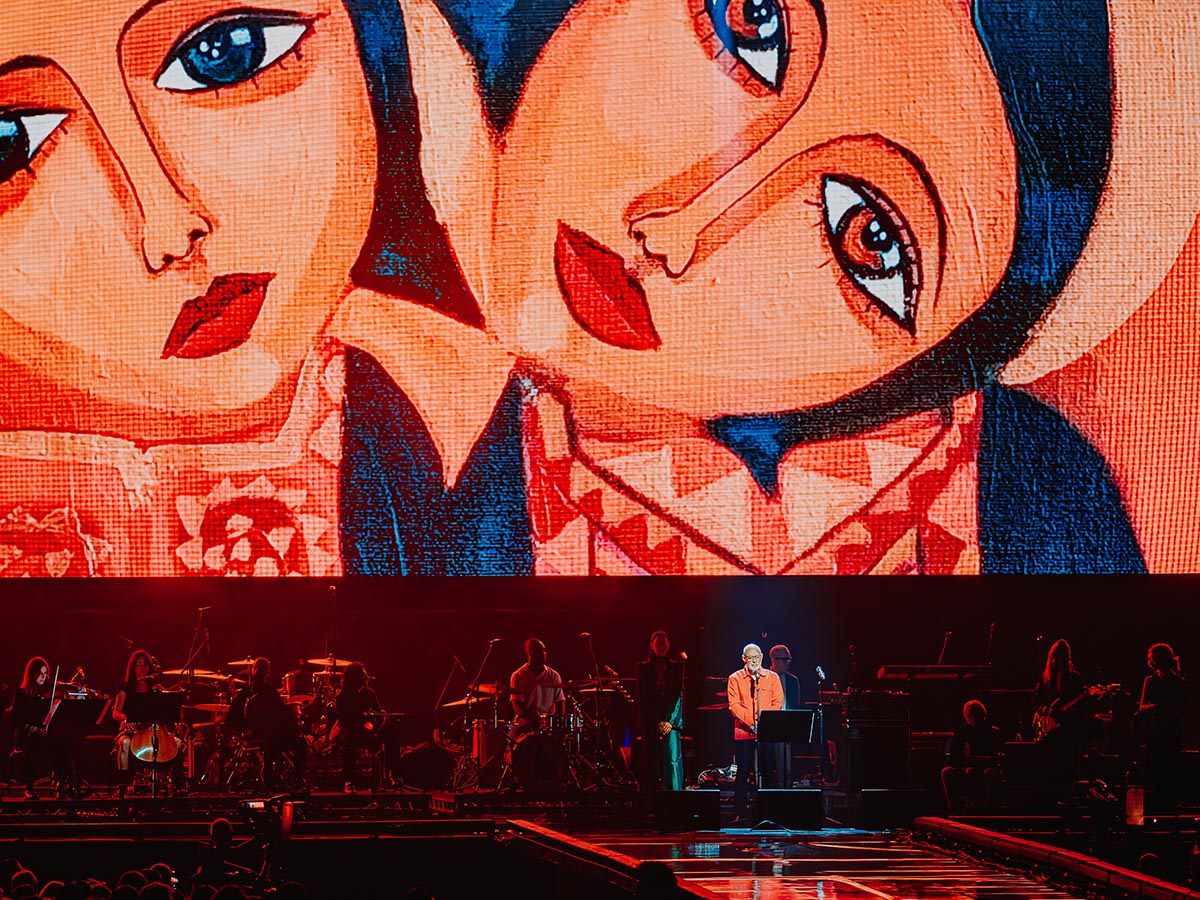
But as for the celebrities, the names that helped to shift the tickets, there’s often a sense of awkwardness as they read from a teleprompter at the back of the room. There are poignant moments, especially delivered by the likes of Riz Ahmed and Benedict Cumberbatch performing Palestinian poetry, or by Laura Whitmore speaking as a mother rather than a public figure.
But on the flip side, moments like Louis Theroux and Amelia Dimoldenberg’s painfully robotic, scripted interaction feel soulless, as if even on this occasion, they’re still scared to slip up, say the wrong thing or say too much.
Realistically, at an occasion like this, the music was beside the point. It felt odd that some artists were merely on the lineup to say a quick statement, like Pink Pantheress and Rina Sawayama, who did an introduction but never performed themselves, likely to the upset of some ticket holders. But really, that’s not what this is about – evidence beautifully by Eno’s decision to platform Palestinian musicians and music more so than carting out a cast of Western artists keen to play the white saviour.
Unlike the rousing ‘play the hits’ energy of a show like Live Aid, ‘Together For Palestine’ took a different approach. There were some huge moments, like a surprise performance from Gorillaz, the video reunion of Portishead and appearances from Neneh Cherry and Paul Weller. But there was no Freddie Mercury ‘Ey-Oh’ moment for the history books, meaning that simply the camaraderie and togetherness will be recorded instead.
By 10pm, Jameela Jamil announced that £1.5million had been raised, and that’s what it’s all about. With a sold-out arena and countless more people tuned in on a live stream, the point of an occasion like this is to be unignorable and make it clear that the people will not ignore what is happening.
Curated in a deeply honouring way and packed full of important voices, Eno rightfully let Palestine lead this important night.
