


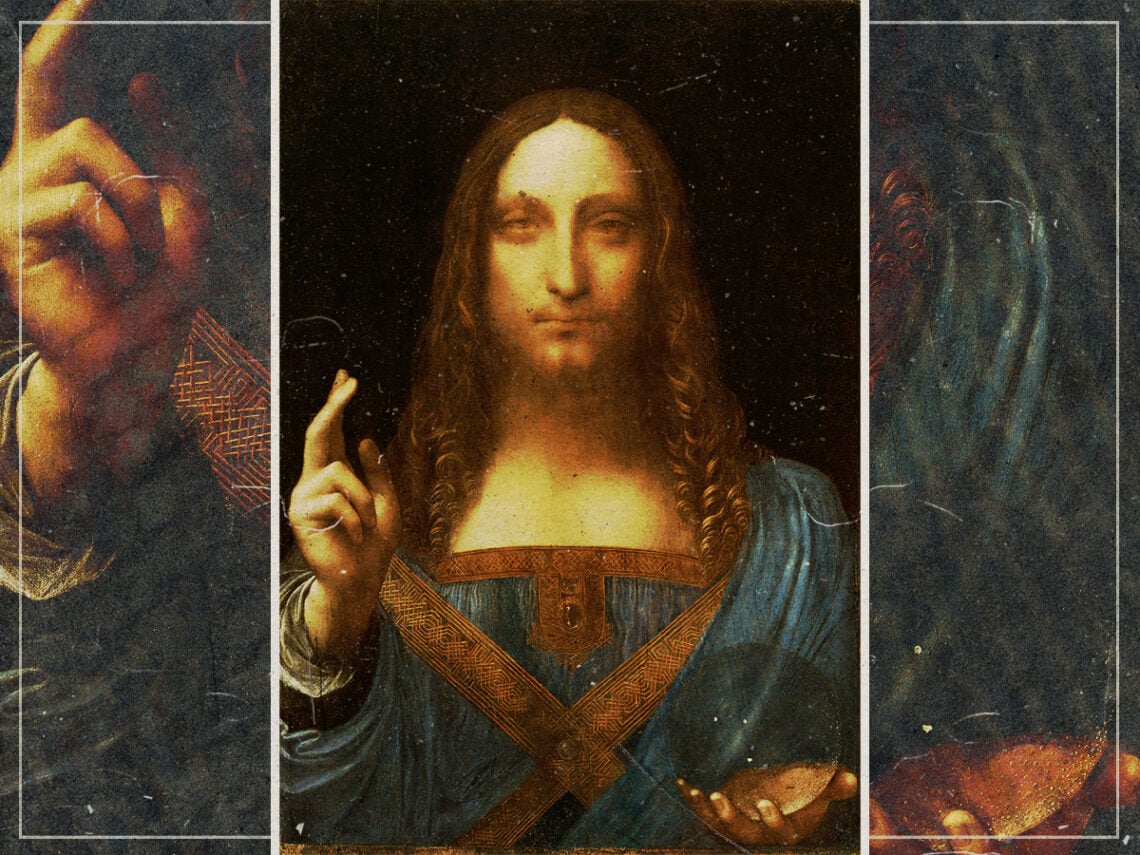
How thumbs proved that the most expensive painting in history was fake

In Leonardo da Vinci’s Salvator Mundi, Jesus Christ wields a transparent orb in his left hand, his right held loftily in a blessing. There’s nothing seemingly untoward about this depiction, except that some experts believe the arms were painted at a later date. And, again, there’s nothing particularly untoward about that – except that line of thought cast a shadow of doubt that resulted in the painting being considered a fake.
Christie’s Auction House alleged it was simply “discovered, masquerading as a copy” at a random auction in America in 2005 (a painting of Christ as the Salvator Mundi was never recorded during da Vinci’s lifetime). Dianne Modestini, an expert conservationist of the old masters, was charged with the restoration job. Part of the reason the painting had been assumed to be a copy was it had been overpainted with a very heavy hand, muddying the colours and darkening it, so Modestini set to work with some acetone to remove it delicately.
It was naturally a massive undertaking – a specialist was called in to prise off the panel infested with woodworms – while Modestini used infrared photography as part of her efforts. The infrared photos showed an earlier layer of a thumb had been painted over. For the da Vinci believers, this was considered evidence he had done the painting but repositioned the thumb as he worked.
Hilariously, the errant thumb hidden under a layer of paint caused significant controversy. As Modestini got to work repainting its most worn-away areas, she had done an insultingly good job, meaning her restorations overtook the “original”. In a typical biting art world barb, one expert called it a “masterpiece by Modestini”.
Critic Martin Kemp was at least more direct with it, saying both of the original’s thumbs were “better than the one painted by Dianne”. Still, it was good enough for the National Gallery, who showed it in 2011 and authenticated it as da Vinci’s.
Curious and keen to weigh into the topic, in 2021, computer scientist Steven Frank and his wife, art historian Andrea Frank, used convolutional neural networks (CNNs) to try and determine if the work was a forgery. Their system portions the works into tiled segments to be processed by the CNN, which can detect a fake with 97% accuracy. The verdict came down to the hands. They concluded the head was likely to have been done by da Vinci, but the hand and arm were clearly done by someone else. Many discussions have been about which of da Vinci’s students might have taken up the task.
In yet another snag, this discovery happened years after the Saudi Crown Prince, Mohammed Bin Salman, had hung it in his luxury yacht. He’d bought the painting for a staggering $450million in 2017, which is apparently justifiable when you’re looking at a lost work of one of the most talented Renaissance artists in history. When you find out it was probably only done under his supervision, shelling out that much for a painting with a dodgy thumb probably doesn’t feel great.
