


Off the grid: Three art installations in unusual places around the world

The idea that art can only belong to the pristine white walls of a gallery or behind glass shields in museums has never been further from the truth. Sometimes the most powerful works appear where you least expect them, and take this expression quite literally. For centuries, we’ve seen how people interpret art differently, depending on the context it is placed in: a sculpture might not have the same impact when placed in a public garden versus in a private collector’s exhibition room. This proves just how intrinsically connected objects and their contained spaces are.
When art breaks out of traditional viewing establishments, it invites people to interact with it in less-restricted ways, free of the labels that exhibition spaces inevitably carry. Without the formal etiquette of galleries – the hushed voices, the slow, contemplative meandering – viewers can encounter the work more spontaneously, sometimes even by surprise. The context adds its own narrative, turning the artwork into a living, breathing part of the environment.
One famous example is Jeremy Deller’s It Is What It Is, a relic of a bombed car from Baghdad, which he toured around with in the US. Not only did he take a conventionally non-artistic object and turn it into a political symbol, but also, by choosing to tour it around the US, compared to leaving it in a museum, people were able to receive it differently. Many argue that it got people to engage more actively with the sculpture, and consequently the Iraq War, leaving a greater lasting impression.
There’s also a quiet defiance in placing art where it’s not expected. It pushes against ideas of exclusivity, questioning who art is for and where it’s allowed to exist. When artists install works in unexpected locations, they open up space for new kinds of engagement, outside the rules of the art market or institutional control. One doesn’t need to buy a museum ticket or tune into the pretentious analytical mindset that we all sometimes adopt when in art galleries, afraid of social perception. On the contrary, in such disruptive moments, art becomes an experience woven into daily life and an excited, unexpected surprise.
What all these works share is a deliberate, meaningful relationship with where they’re placed. Prada Marfa only works because it’s isolated; it wouldn’t have caused the same commotion if it had popped up on Fifth Avenue. The Steilneset Memorial draws power from standing exactly where the tragedies happened, serving as a visual reminder, akin to a memorial, and Kusama’s Pumpkins actively intend to disrupt the landscape with their brilliantly colourful absurdity, sitting at the edge of the sea.
So let’s take a look at some of the most striking examples of unexpected artworks placed in seemingly random (but actually very thought-out), non-artistic spaces.
Three unusually placed art installations
Red Pumpkin

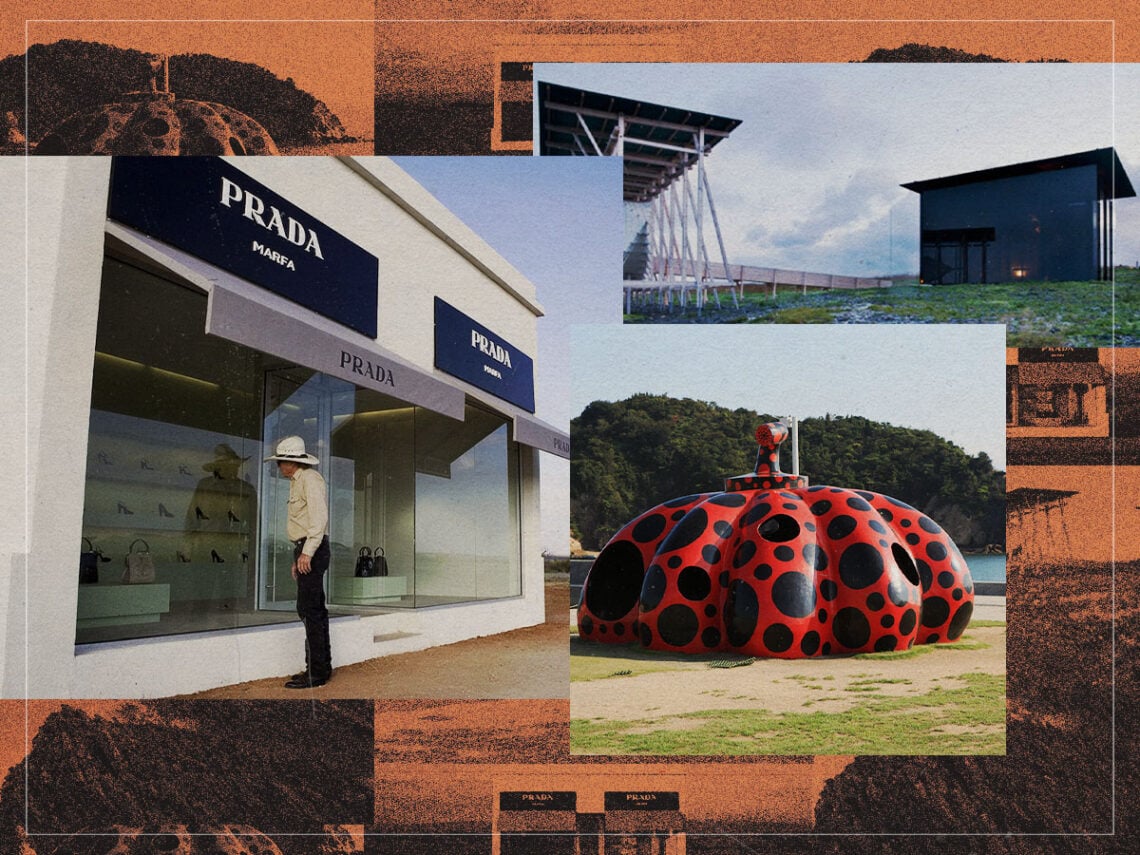
Take a ferry to Japan’s Naoshima island, often called ‘Art Island’, and you’ll be greeted by something huge, red, and covered in polka dots: Yayoi Kusama’s Red Pumpkin. This 14-meter-tall sculpture became an icon of the island: a playful and comical installation that has come to symbolise this place.
Kusama, the most successful female living artist, is famous for her travelling exhibitions, which have spanned every corner of the globe, selling out millions of tickets. But two of her works, Yellow Pumpkin and Red Pumpkin, have never moved.
Actually, that’s a bit of a false statement, as, unfortunately, the yellow one was destroyed by a typhoon in 2021 and was never rebuilt.
Regardless, visitors can even step inside the sculptures, experiencing Kusama’s whimsical world from within. Her pumpkins are pure absurdity, attracting adults and children alike; their plump, caricature-like forms are a cheerful rebellion against the rugged natural landscape around them, making them an unexpected yet delightful visual experience for visitors.
The Steilneset Memorial

In the icy, remote landscapes of Vardo, Norway’s northernmost region (a place basically no one has heard of or been to before), artists Louise Bourgeois and architect Peter Zumthor created a starkly modern memorial to commemorate a centuries-old horror. The Steilneset Memorial art installation honours the 91 men and women, accused of witchcraft, who were burned or tortured to death there in the 17th century.
Commissioned by Norway’s Tourist Routes programme and inaugurated by Queen Sonja herself, the installation stretches 400 feet along the coast. Inside, a corridor of 91 small windows, each holding a softly glowing lightbulb, akin to a never-ending candle, marks the victims. Their stories are remembered on plaques, a chilling reminder of how the witch hunt of the 17th century was so rampant that it even tore this small fishing village apart.
What makes this site so striking is the contrast: a sleek, contemporary structure housing a tragic memory, which leaves all visitors to contemplate on the backdrop of the North Sea.
Prada Marfa

Arguably, the most peculiar of them all is the Prada Marfa. Imagine driving along a lonely stretch of Route 90 in rural Texas, a trip that can take multiple days, when suddenly you come across a sleek Prada boutique, complete with handbags and shoes from the 2005 Fall/Winter collection. But the door doesn’t open, no one is greeting you at the door, and you can’t even get in…
This is Prada Marfa, a “pop architectural lang art project” invented by Scandinavian artist duo Michael Elmgreen and Ingar Dragset. Although Prada did loan the items, it’s a permanently sealed fake shop meant to decompose eventually into its surroundings — at least, that’s what they hope for, but how it’s going to work successfully is unclear.
The crazy part of this installation is just how remote it is; realistically, not that many people will see it per year, and people certainly won’t travel all the way to rural Texas to pay homage to it. This mystery was exactly the intention of the artists. As Dragset put it, “it would exist more as documentation and a rumour”.
The installation pokes fun at consumerism by dropping a glaring symbol of wealth in one of the poorest areas of the US. The idea that Prada Marfa is intended to decompose is also oxymoronic, given how much waste and energy big fashion houses produce. But here’s the kicker: the night it was unveiled in 2005, vandals broke in and looted everything. Turns out, leaving expensive goods inside a fake Prada store in the middle of nowhere was, unsurprisingly, not the brightest idea.
