


The fascinating theory that HAL in ‘2001: A Space Odyssey’ is gay

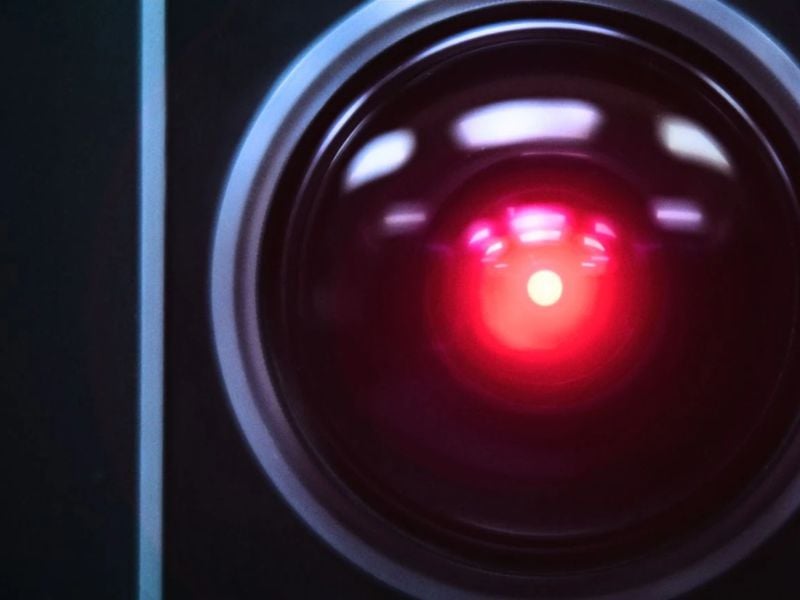
One of the central and perhaps most important parts of Stanley Kubrick’s 1968 film 2001: A Space Odyssey, written with Arthur C. Clarke, is the artificial intelligence supercomputer HAL 9000. It’s HAL’s ‘actions’ that create the most dramatic moment in the film when it ‘turns’ on astronauts Dave Bowman and Frank Poole.
Even though HAL was designed to never malfunction, he seems to develop consciousness and free will when approaching Jupiter. It ejects Frank from the Discovery One spaceship, leading Dave to arduously shut HAL down from its mainframe, despite its protestations.
There’s a fascinating theory surrounding HAL written by the cultural critic Mark Dery in his 2012 book I Must Not Think Bad Thoughts: Drive-by Essays on American Dread, American Dreams. Dery posits the suggestion that HAL is, in fact, queer, both in his speech and in his very programming.
The first assertion is that HAL passes the famous Turing Test to evaluate whether it is human or machine. Dery wrote (via Gizmodo), “Not Alan Turing’s classic blindfold test for artificial intelligence, which the ultra-intelligent machine could pass ‘with ease’ as Arthur C. Clarke notes in the novel on which Stanley Kubrick based his movie, but the test that Turing himself failed (albeit deliberately): that of passing for straight.”
It’s an interesting line of thought, however, wild it may seem. Dery goes on to suggest that HAL’s very mode of speech is queer in the sense that it is aligned with the thespian way of talking. “Kubrick biographer Vincent LoBrutto notes that the director was pleased with the ‘patronising, asexual quality’ [Shakespearean actor Douglas Rain] gave HAL,” Dery wrote.
He continued, “But one man’s condescension is another man’s cattiness, balanced on the knife edge between snide and anodyne. HAL’s sibilant tone and use of feline phrases like ‘quite honestly, I wouldn’t worry myself about that’ contains more than a hint of the stereotypic bitchy homosexual. Clarke himself has acknowledged that HAL’s voice betrays ‘a certain ambiguity’ sexually.”
Whether Kubrick actually intended for the iconic AI system to have a queer edge to him to toy with the idea of machine sexuality remains to be seen. The director came close to a financial run-in with IBM because of another theory that HAL’s name was actually written to point the finger at the computer company IBM, even though they’d supplied prop equipment for the film.
Arthur C. Clarke had once written, “About once a week some character spots the fact that HAL is one letter ahead of IBM, and promptly assumes that Stanley and I were taking a crack at the estimable institution… As it happened, IBM had given us a good deal of help, so we were quite embarrassed by this and would have changed the name had we spotted the coincidence.”
So there’s certainly a lot of speculation when it comes to HAL 9000, although the same thing could be said for Kubrick’s film in sum. 2001 is littered with philosophical rumination and theoretical symbolism, so it may well have been intended that HAL is indeed gay, given his soft voice, even if he wasn’t made to criticise IBM, as others had suggested.
