


‘Their Bones Are Their Money’: Decoding Tim Robinson’s capitalist nightmare

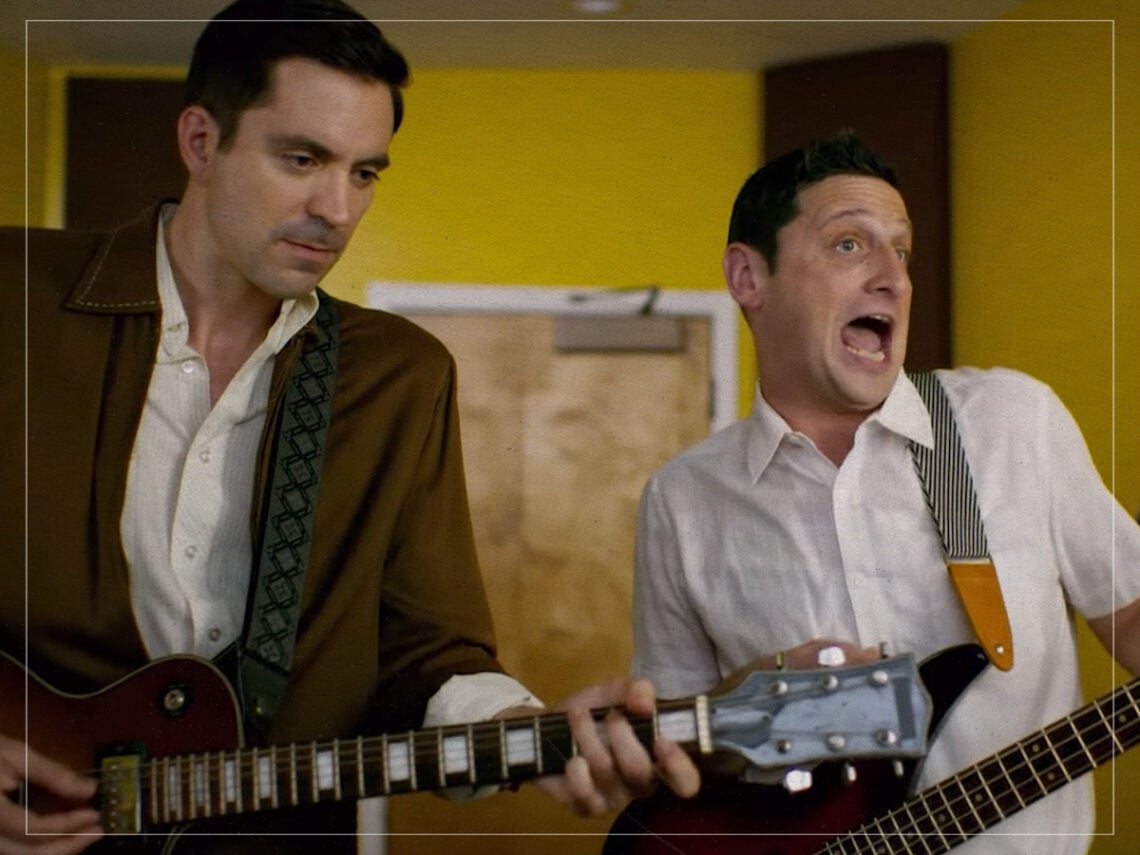
It was a sunny day in 1954 when Rhys Coiro swanned into a Nashville studio hoping to emerge as an esteemed songwriter simply known as Billy. That auspicious day, the Sunset Studios executive producer, looking surly and slicked-back like a real piece of shit behind the mixing desk, had hopes of finding the next great country star.
Instead, he would be presented with an entirely new proposition. Tim Robinson, not hoping to be known as Billy but also not ruling it out, would transform music as we know it alongside his faithful, significantly taller frontman. Together, they would weave a tale of death and rebirth that delved into the fiscal abandon of modern capitalism in a manner that was many years ahead of its time.
‘The Day Robert Palins Murdered Me / Their Bones Are Their Money’ begins as a normal bluesy murder ballad. The tale is as familiar as folk music itself. Gunslinger moves into town, comes across another gunslinger in a classic case of an ‘occupational hazard’, and recounts his death at the hands of said gunslinger from beyond the grave.
It’s perhaps grislier and darker than most songs of the era, but otherwise, it is a classic example of genre exploitation. Even the melody is as Margherita as a rolling country rumble in G can get.
However, the monumental twist in this familiar loveless tryst is that Robert Palins happened to slay his nemesis on the same day that the skeletons came back to life. In that moment, Billy and his band subverted the old traditional murder ballad by widening the scope of Palins’ pistol from just another sorry gunslinger to society as a whole.
The slicked back piece of shit producer asked for something ‘spooky’, and he ended up getting the spookiest thing of all: the wanton curse of rampant modern capitalism’s wicked ways.
Decoding the anti-capitalist underbelly of ‘Their Bones Are Their Money’
Throughout the song, as the stately frontman, Coiro takes on the position held by the powers that be. He maintains the familiar rhythm and motif. In this manner, he represents the inane way that everyday violence is reported in the press. His narrative is, quite frankly, not that spooky at all – it’s commonplace to the point of being banal. It’s a distraction to the real news struggling to be heard. What loss is another gunslinger? We never learn the victim’s name; or that of his bereaved sweetheart – it is cut off by the rapture of Robinson’s far graver news.
By design, like the powerful status quo, Coiro attempts to stifle this rupture. Despite the discreet and radical transition in the track’s narrative, the melody remains the same, the composed, conservative show rumbles on, supressing the message that capitalism has way more victims amassed in a way more violent manner than the measly death of a subpar gunslinger who was always destined to die beneath brown clouds anyway.

In a profound musical masterstroke, Palins’ piss poor murder is subsumed by the song’s far more shocking critique of capitalism. The skeletal uprising articulates a form of ontological bankruptcy. They seemingly spring forth from the great beyond in a manner entirely unrelated to the gunslinger’s death, simply for another shot at partaking in economic function. They endeavour to pull people’s hair up but not out, just to once more enter the rat race.
Equally, you could ask whether we’re even dealing with the undead here or the uprising of a buried underclass, stripped of all substance by calculated economic oppression. Either way, Robinson’s capitalist critique proves perversely spooky. The so-called ‘skeletons’ of society are literally their own currency. They have to commodify their very being to be economically viable, but in doing so, they inherently become unstable.
If your skeleton and your worms are literally your only exchangeable wealth, then any expenditure fundamentally weakens you. It sounds absurd when sung in a jaunty voice by a bassist playing up to the image of a crackpot prophet, but is it not absurd that we live in an age where a new pair of shoes costs you your feet? The song takes the old idiom of ‘it costs a leg and arm’ to a prescient, cost-of-living-crisis extreme. Even in 1954, the song foresaw the current gig economy.
In the neoliberalist age of extremes, self-exploitation is a necessary means of survival, but also one that self-cannibalises its subjects down to their collateral corpse, and, of course, their worms, also. As the song proclaims, “In our world, bones equal dollars”. It’s enough to make you yell “Exactly“, as though you were thinking that this whole time, too.
But time has not revealed all the secrets of this deeply prophetic masterpiece. It remains unclear why the skeletons pull hair up but not out for another shot at life. Is it a metaphor for how working-class surgeons no longer partake in critical medicine but instead perform hair transplants for the wealthy – the only way to earn enough bones and worms to transition from the undead underclass to the living upper classes?
Or maybe it’s just more absurdity that mirrors how death is temporary but debt is eternal in this sorry world where milquetoast tales of murder are sinisterly presented in a bid to override the urgent message of a bassist breaking free from the accepted narrative of familiar suppression with a tale far graver than anything uttered in country music before or since.
