


Hacked, looted and burned to the ground: the worst festival of all time

When it comes to terrible music festivals, popular culture has a number to pick from. There are some famous cases, Altamont, Spike Island, Woodstock 1999, Fyre Festival, and even the original Woodstock of 1969. In addition, almost every music lover has had their fair share of terrible festival experiences, from being drenched in the rain the whole weekend to dud drugs. Given the contemporary appetite for tales of such horrendous logistical and human instances as the above, it’s remarkable that a festival lodging a solid claim to being the worst of all time is not more well-known. The bonanza in question? Erie Canal Soda Pop Festival, more commonly known as the Bull Island Rock Festival.
The festival took place on Labour Day weekend in 1972, long after the counterculture had peaked in 1967, with the 1969 Manson Murders and disasters of Altamont and Woodstock still fresh in the memory. Despite this, the hippie spirit had now implanted itself into the culture, with the era’s musicians remaining incredibly successful due to immense demand. The early 1970s was a particularly indulgent time for those who ascribed to the countercultural ethos, with a type of nihilism permeating everything they did due to the perceived failures of the 1960s and a broader view that the future looked bleak, owing to The Cold War and dire socio-economic circumstances at home.
Where did this spiritual successor to Woodstock take place? On Bull Island, near Griffin, Indiana. It’s a strange chunk of land technically in Illinois, but on the Indiana side of the Wabash River, something that would play a role in how this disaster panned out.
Months before Bull Island, the promoters Tom Duncan and Bob Alexander held the successful small extravaganza, the Freedom Festival and Ice Cream Social, at the Bosse Field stadium in Evansville, Indiana. It boasted big acts such as the Grateful Dead spin-off, New Riders of the Purple Sage, Ike and Tina Turner and Edward Winter. Due to its triumph, the pair naturally thought they should plan a much more expansive festival.
In the aftermath of Bull Island, Duncan and Alexander explained they sold 30,000 advance tickets for $20 and $25 and had estimated the maximum number of attendees to be 55,000. Accordingly, they could not believe their eyes when an estimated 200,000 – 300,000 showed up, over four times more than what they’d planned for. Like with Woodstock and Altamont, things would quickly descend into chaos. It was one of the worst moments of the hippie period. We’ll come to that in a second.
The Bull Island festival was originally organised to be held in Chandler, Indiana, not far from Evansville. However, court rulings stopped it from being held anywhere in the overarching Hoosier State. Bob Alexander told Classic Rock in 2022: “All we ever set out to do was to have a great show and make a lot of money. We’d spent over $700,000, so our position was that we had to do this festival some way. Come hell or high water, the people were going to have an event.”
Not long before the concert was due, Duncan and Alexander decided on Bull Island in Posey County, the southernmost, southwesternmost, and westernmost in the state. This little patch of land jutting out from the state seemed perfect. Interestingly, it’s because the Wabash River changes course that island is situated on its eastern side but is part of Illinois. This meant it was out of the jurisdiction of the Indiana courts. Due to the last-minute choice of location, the local government of White County, Illinois, situated in Carmi, were astonished when the festival appeared on its turf. It could not prevent the concert or what was to unfold from happening or what was to unfold.
As Labour Day approached, Duncan and Alexander realised that a much larger mass of people than 55,000 were to attend their festival. Logistically, a nightmare occurred, setting a precedent for the weekend.
As the island was accessible by only two roads, the traffic was jammed for 20 miles (30 km), an insane stretch by anyone’s books. Due to the peculiar municipal situation of Bull Island – part of Illinois but only accessible through Indiana – at this point, there was no substantial police support or crowd control. More police would arrive and be stationed outside the festival, but it was a lawless party inside, with every drug, from weed to heroin, readily available. In the years since, the coordination between the two state’s police forces has been universally described as woeful.
Law officers were on hand at the beginning of the weekend when the mass of people was simply trying to get into the festival. Still, in another indicator of the day, it was merely three county Deputy Sheriffs from White County, Illinois, tasked with policing the entire crowd. Indiana State Police Trooper Ed Lunkenheimer, one of those later on the scene, told Classic Rock: “It was like an invasion. They were bound for Bull Island, come hell or high water. We’d never seen that mass of humanity. Ever.”
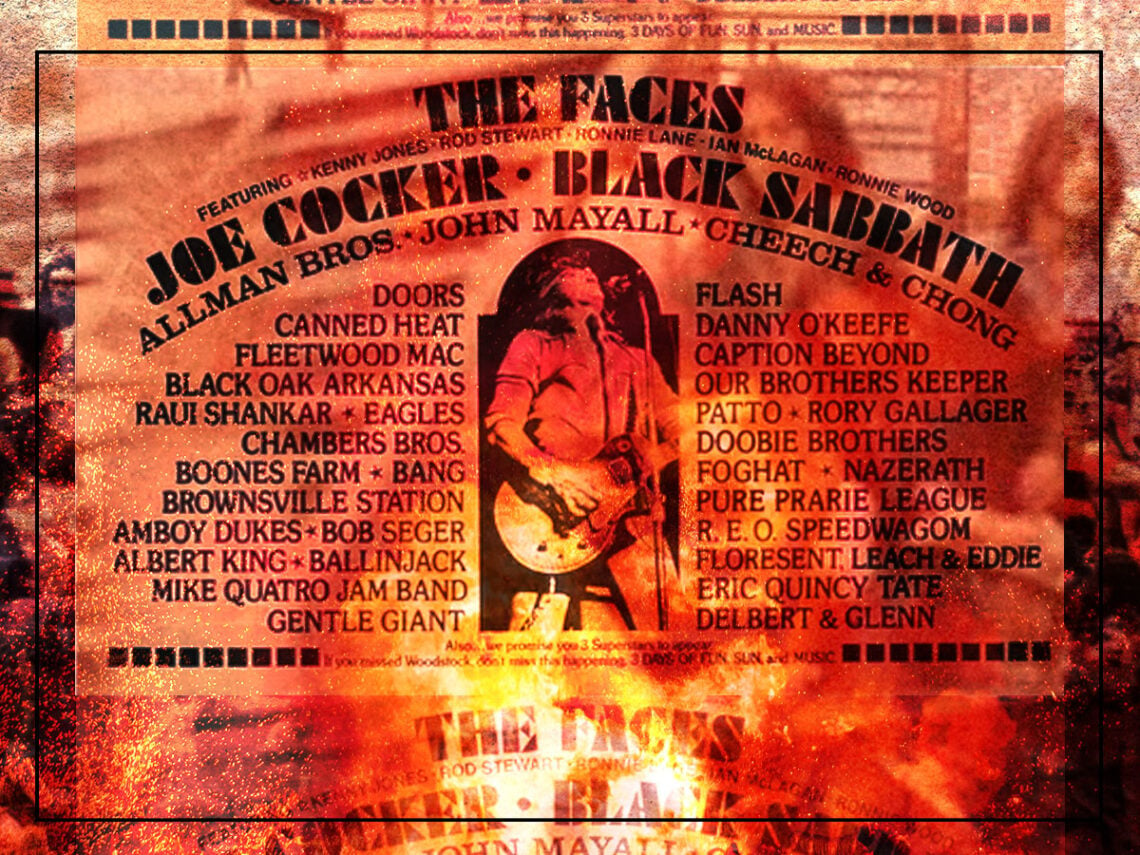
The pair of organisers should not have been surprised at the number of attendees; the advertised lineup was mammoth. It included Black Sabbath, Joe Cocker, Canned Heat, The Allman Brothers, Cheech and Chong, The Doors, the Eagles, Fleetwood Mack, John Mayall, Nazareth, Ravi Shankar, and more. However, only some of those scheduled to perform did so. The most prominent of these were Albert King, Canned Heat, Cheech and Chong, the Eagles, Foghat, Rory Gallagher and Santana. Elsewhere, the excitement caused by not settling on a location till late made the word of the festival spread like wildfire; on paper, it was an exciting happening.
Over the three days, the festival gradually descended into a hellish scene. Much like Woodstock 1999, food and water were in short supply, having a significant hand in people resorting to their base selves. Demonstrating this Hobbesian state of nature that played out, a truck that delivered food was hijacked, looted and burned by a group of attendees. Elsewhere, when some vendors were accused of hiking their food and drink prices, an enraged mob turned over several RVs and mugged the vendors. Additionally, torrential rain battered the festival, ramping up the misery.
That wasn’t all. On Sunday evening, a group of famished festival-goers killed a local-owned cow on the island but had no means of butchering it. It was due to the chaos, as well as the hazardous stage area, where electric outlets were exposed to ten inches of water, that the acts started to pull out. In a grim reflection of the terror of the Bull Island Rock Festival, three attendees drowned in the Wabash River, and a 20-year-old overdosed on heroin. Then, in one final primal act, the remnants of the crowd destroyed the stage by fire.
Unsurprisingly, in the wake of Bull Island, Duncan and Alexander were subjected to numerous lawsuits. These came from the owner of the island, the Internal Revenue Service, the State of Illinois, the State of Indiana and the looted vendors. Ultimately, the court found them in contempt of court and fined them thousands of dollars.
So what happened to the two organisers of this hellish weekend? Nowadays, Alexander presides over Palm Springs’ Motion Picture Hall of Fame. After the entire debacle, Duncan was done. He concluded rock festivals are not “morally right” and retired to Arizona.
Watch an informative clip on the festival below.
