


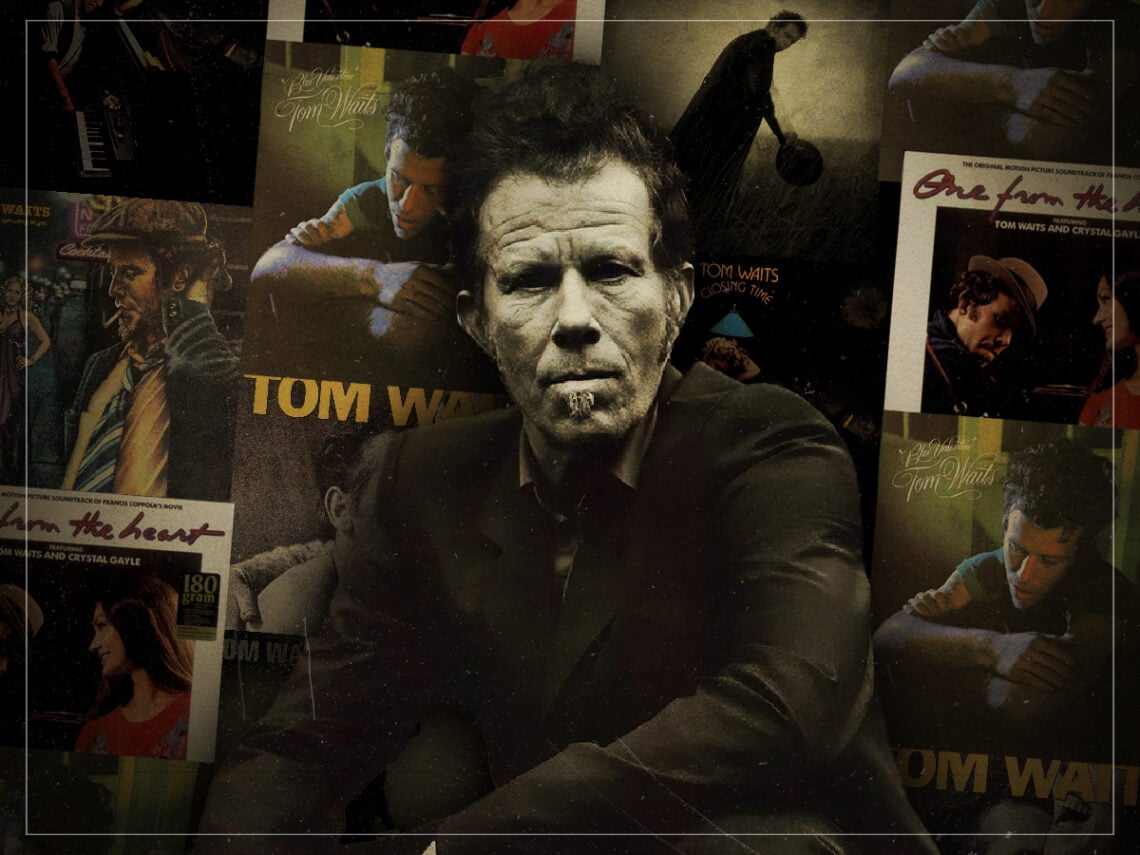
Exploring the world of Tom Waits through his five best songs

The other day, I was moved to peer out of the window at some commotion unfurling on the street below. The curbside racket was revealed to be two drunken homeless men grovelling over a trolley. As I feasted on the cacophony of growls, grunts, and clanging aluminium, I thought to myself one thing: ‘I wish Tom Waits would release some new music’.
Waits is the poet in the gutter, the songsmith with the drunken piano, and the artist who never wants to grow up. He’s lived his life in fits and starts. He’s walked every alley that the urban dispossessed have ever ambled. He’s perched in the nookiest of crannies and poked about in the cranniest of nooks in cities all over the world. And he’s done it all with a hat so jaunty it seems to defy gravity and a cigarette with a magnetic attraction to his bottom lip.
A million artists have created themselves and then worlds to reside in thereafter, but Waits is pretty much the only one who seems to have popped out of a bottle already fully-formed. It’s as though a whisky lover had cherished a liquor flagon a bit too fondly, inadvertently providing the magic rub to summon him. Embalmed in the miasma of society’s underbelly, he has rigorously captured the dive bar world of outcasts a few stories below the gaudy Highrise universe of pop.
Against the odds, he has made a success of this. Mule Variations even managed to surpass the one million records sold mark, meaning Waits finally hit a wicked, blinding homerun out of never swinging from the hip or even thinking about wandering towards the safe bases of commercialism.
From the get-go he has set out to illuminate the dingy, to cherish the grubby, and to honour the otherwise odious, strewn in this fractured beast we call society. This is why he has been a star. Descriptions like strange and avant-garde are actually misfits when it comes to his work. In truth, he’s always just one street to the west of what we call normality.

His weirdness is a reality stranger than fiction. We all live in fractured cities, with burnt-out hopes, broken homes, starved wallets, and old beat-up cars. Waits is just one of the few willing to present this. He refuses to airbrush the world, finding beauty in everything.
This was all borne from a strange childhood, presided over by his strange Spanish-teaching father, “a tough one, always an outsider”, who mysteriously walked out on the family when Waits was ten. Like father like son, Tom was also an outsider, but this moment drove him further afield. He dabbled in daft crime. By his teens, he was a self-professed “amateur juvenile delinquent” and a “rebel against the rebels”.
This meant that while others were swapping tokes over hippy records, Waits was scuffing his shoes poring over the pages of the wayfaring beats like Jack Kerouac and other back-alley purveyors. Soon he would drop out of school and take up a job in Napoleone’s pizza where his only goal was to ensure that Ray Charles was always playing on the jukebox. He wanted to be just like him, except not blind.
While Charles played on, Waits observed life as though he was studying an Edward Hopper painting. By the time he got behind a six sheets to the wind piano whose keys wheezed out cigarette smoke, the songs he would creak out were vignettes from the pizzeria’s condensation-streaked windows. Tales like Tom Frost calling long distance to ‘Martha’ from a phone box in the street.
This beauteous song is one of the finest ever written. It’s love on a broken heel for the disenfranchised. It’s an anthem that delves into the bittersweet truth that life moves on. Holding this sentiment together is Waits’ stunning vocal performance, as he pushes a voice – that is all too often simply credited as gruffly unique without much comment on its astounding quality – to its imperfect limits. This might be the story of Frost’s fictional phone call, but anyone who has loved and moved on can bathe in its sepia-toned nostalgia. The song holds together the masterpiece Closing Time, standing as the timeless cornerstone of one of the greatest albums of all time.

It didn’t sell well. But The Eagles picked from it with their cover of ‘Ol’ 55’ and this allowed Waits enough wiggle room to continue his drunken musician lifestyle. So, he went searching for the heart of Saturday night. It would seem he only went and bloody found it. Once more, this anthem captured the world around him. The counterculture dream had faded into an oblivion that made it seem like it never really existed in the first place, and in ‘74, Waits’ weekend anthem wearily mused on that mystery.
Now, the couples who cavorted at Woodstock were entering their suburban years, leisurely cruising around the city, looking for some mild weekend reverie. In the titular track for his second album, ‘(Looking for) The Heart of Saturday Night’ he watches these Oldsmobiles drift on by. Waits himself seems to be puffing away on a corner, singing the sights with a sigh. He saw timeless worlds in this bittersweet mundanity that were matched by his wearied music.
It was here that he began his collaboration with the legendary producer Bones Howe. “I told him I thought his music and lyrics had a Kerouac quality to them,” Howe recalled, “and he was blown away that I knew who Jack Kerouac was. I told him I also played jazz drums and he went wild. Then I told him that when I was working for Norman Granz, Norman had found these tapes of Kerouac reading his poetry from The Beat Generation in a hotel room. I told Waits I’d make him a copy. That sealed it.”
You see, Waits didn’t just want to capture the scenes of the city, he wanted to paint them with a considerable swish of beat artistry. Thus, his world took a jazzy turn with this second outing. It sold marginally better than his debut which barely sold at all. Once more, he had to open for Frank Zappa, once more he was hated by his audience. Waits described it as “a nightly experience in horror.”
Nevertheless, the tobacco-scented singer doubled down in his literary bunker, perched upon the perilous ash heap of dashed dreams. This was his favourite spot. “You almost have to create situations in order to write about them, so I live in a constant state of self-imposed poverty,” he said.
So, with his defiant drift to obscurity already in motion, Waits’ world became more postmodern. The inspiration of his heroes like Kerouac, Robert Frank, and Tennessee Williams became more tangible within his songs.
He’d soaked up all the scenes he had witnessed, so he went downtown and sermonised the sagas of human comedy that laugh outside the law. ‘Christmas Card from a Hooker in Minneapolis’ is an opus on this front. Here he wheels off a letter of good tidings from a lover of old only for the twist to reveal that things are worse than she is letting on and she’s actually writing from jail in need of money to pay a lawyer, but she’ll “be eligible for parole, come Valentine’s Day.”
Naturally, these were lean years for Waits. He was finally dropped by Asylum for failing to fit any notion of commerciality into his work. But around the same time, Waits found a muse beyond the streets. While working on the soundtrack to the Francis Ford Coppola film One from the Heart, at Wally Heider Studios in Hollywood, Waits waltzed in one day and swooned so hard for the employee Kathleen Brennan that his hat was almost finally toppled from his head. He would’ve been knocked off his feet had his boots not acquired enough sticky liquor to glue to the carpet like the wrapper to a warm toffee.
“Kathleen was the first person who convinced me that you can take James White and the Blacks, and Elmer Bernstein and Leadbelly – folks that could never be on the bill together – and that they could be on the bill together in you,” Waits once said when discussing how much of a force she was for his creative output that followed.
Adding, “You take your dad’s army uniform and your mom’s Easter hat and your brother’s motorcycle and your sister’s purse and stitch them all together and try to make something meaningful out of it.”
All of a sudden, all the worlds of wonder that inspired Waits, from the bookshelf, record collection, dive bar, street corner, and fishing vessel off the coast of Argentina, existed in the same song. Everything was a mad, manic and true reflection of our berserk reality. With Rain Dogs, he visited every corner of our cities, from the Cubans dancing downtown to tattooed sailors by the bay, this Carnivalesque tale of gonzo imagination in a city of assimilation saw him reach wild new heights. But before that, he went ‘Underground’.

Swordfishtrombones was the first record in the wandering trilogy of shuffled sounds and sights that he made swiftly off the back of being booted out of Asylum. “There’s a big dark town, it’s a place I’ve found, there’s a world going on underground,” he grumbles like a forest monster. Nobody else would sing about a strange subterranean civilization and this originality granted Waits a new audience of folks disenfranchised from the mainstream.
As the writer, Jon Ronson said: “When I was around 15, when the bullying was at its worst, a guy from my class called Will Davis invited me back to his house and he played me this album he’d just got. It was Swordfishtrombones by Tom Waits, and the first song on it was like a beacon.”
He continues, “It’s so strange, it seems like it’s coming from another dimension, but also what it’s about, ‘There’s a world going on underground’. And I just thought that’s what I want to do.” That is, in essence, what Waits has done. He has dug beneath the everyday and found a weird sanctuary there. And it would seem that from his own bullied childhood, he has offered up these oddball tales for all of us to cherish.
However, they are not only tales to cherish… they are also cautionary. And when Waits finally found himself basking in the munificent harvest of his none-too-arduous labours, he looked back at his life and what could’ve been with another smorgasbord called Mule Variations. Therein lies a track that could’ve been on Closing Time, just with a few more cigars staining his voice this time around: ‘House Where Nobody Lives’.
The mellowed epic ties together his discography. It is a poem in song, filled with the colours of life, all its bittersweet hues, and the erosion of time. His world is a weird one, but it’s one where we all live, or at least we used to. It might have even inspired this writer to overwrite this time out, but at least it is an ode to Waits, who urges us to live a little.
