


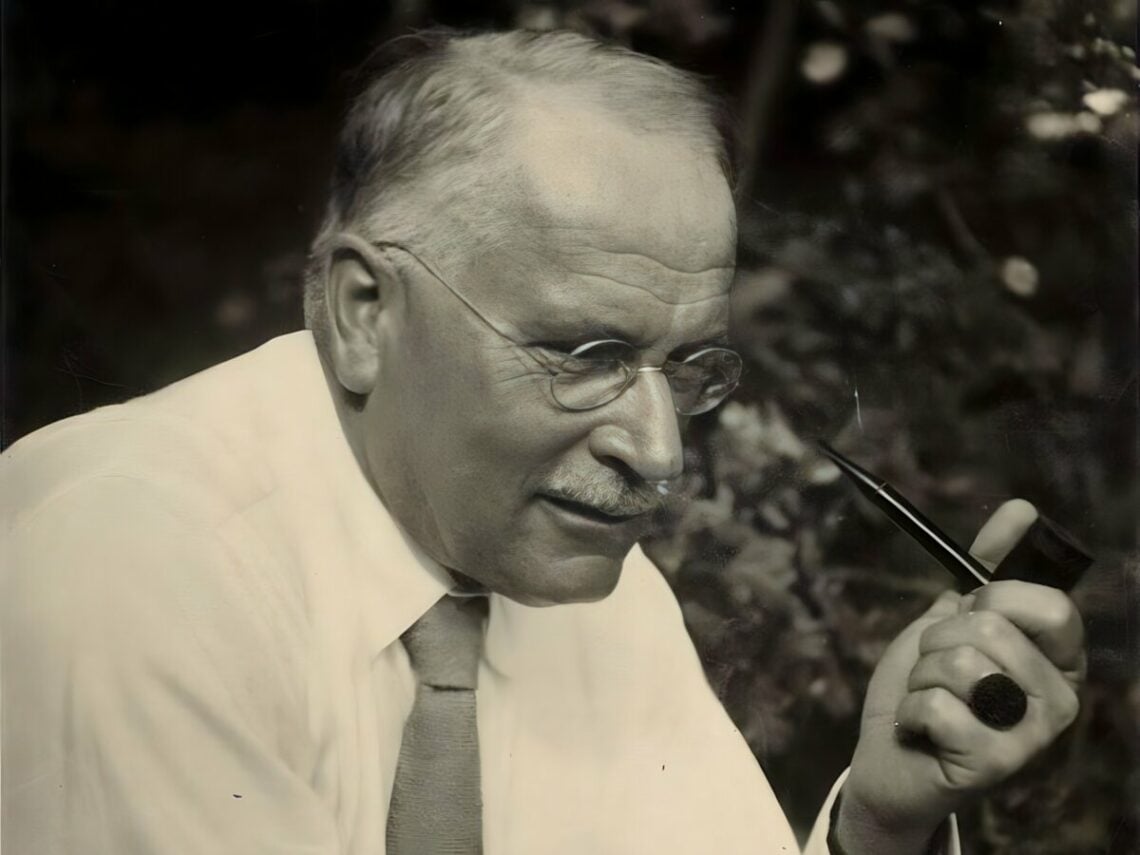
The wide-reaching impact on Carl Jung on culture

While Sigmund Freud is undoubtedly the most influential man associated with the mind’s inner workings as the founder of psychoanalysis, he is closely followed by his one-time associate, Carl Jung. Notably, the Swiss psychiatrist and psychoanalyst founded analytical psychology and, alongside the former, established a joint vision of the human mind that provided the basis of much of the school of thought moving forward. Not just significant in the world of psychology, Jung’s work has had a tremendous impact on anthropology, archaeology, literature, philosophy, and more.
The founder of key concepts such as Anima and Animus, Archetype, Complex, Extraversion and Introversion, Persona, Psychological Types, Shadow, Self and Synchronicity, it’s indicative of the reach of Jung’s work that these are now authoritative and vital parts of the broader human conversation. Whilst people may not agree with everything Jung asserted, there is no doubt that the modern world would be very different without his work.
Whilst his work had the most impact on psychology and all its relevant schools of thought, it is a testament to his work that its effect can be found across popular culture. This means that even someone unaware of the man or his work will be familiar with aspects of his concepts, even if only in name, which is a remarkable feat.
One area that Jung has had a transformative effect on is literature. Thanks to his position as an intellectual polymath whose works encompassed the span of human history, drawing on everything from mythologies to politics, Jung’s reach has been read by millions. One of the most prominent and influential authors he directly affected was Siddhartha and Steppenwolf author Herman Hesse.
The German writer became embroiled in intense controversy after appealing to his fellow intellectuals not to fall into the trap of nationalistic fever and hatred during World War I. Hesse’s life fell down around him, including losing friends, being attacked by the press and receiving hate mail, but this wasn’t all; Hesse’s life would soon take another dark turn. In March 1916, his father died, and in tandem with his son Martin’s severe illness and his wife Maria’s schizophrenia, Hesse was forced into the depths of a psychological crisis. He left military service and began receiving psychotherapy, one of the era’s newest advancements.
Retrospectively, this has been highlighted as a turning point in Hesse’s life and career. He became obsessed with the burgeoning psychoanalysis, and after being taught by a student of Jung’s, Joseph Lang, he came to know Jung himself. This association pushed him to new creative heights, including his novel Demian, written in September and October 1917 and published under the pseudonym Emil Sinclair in 1919 following the war’s end. A Bildungsroman – a genre focusing on the psychological and moral growth of the protagonist from childhood to adulthood – Demian is awash with Jungian archetypes and symbolism, thanks to being psychoanalysed by both Lang and Jung. This led him to identify the psychological problems he experienced as a youth, including internal conflict between his carnal instincts and the strict moralism of his parents.
Another author whom Jung directly impacted was the respected Canadian novelist and intellectual Robertson Davies. 1972’s second work in his ‘Deptford Trilogy’, The Manticore, follows the aftermath of the mysterious death of the character Percy Boyd Staunton, which is retold via a series of conversations between Staunton’s son, David, and a Jungian psychoanalyst.
In a letter, Davies explained his motivations behind heavily drawing on Jung, “There have been other books which describe Freudian analyses, but I know of no other that describes a Jungian analysis”. He added: “I was deeply afraid that I would put my foot in it, for I have never undergone one of those barnacle-scraping experiences, and knew of it only through reading. So, I was greatly pleased when some of my Jungian friends in Zurich liked it very much.”
Elsewhere, one of the most well-respected and influential novelists of the past 30 years, Olga Tokarczuk, the mind behind works such as Drive Your Plow Over the Bones of the Dead and The Books of Jacob, wrote 1995’s E.E. by heavily pulling from Jung’s doctoral dissertation, On the Psychology and Pathology of So-Called Occult Phenomena. Unsurprisingly, the book blends psychology with the paranormal, the latter of which Jung had a noted interest in.
Art is another area that Jung made an impact on. Perhaps the most influential figure he impacted was the American Expressionist Jackson Pollock. From 1938 to 1941, Pollock underwent a course of Jungian psychotherapy for his alcoholism by Dr. Joseph L. Henderson and then. Dr. Violet Staub de Laszlo from 1941 to 1942. The former managed to get the artist on his side by engaging him through art, prompting him to draw to express his feelings. Pollock would then embody Jungian concepts and archetypes in his paintings. Following this period, he created the mammoth masterwork Mural in 1943 and entered his most famous “drip period” at the end of the decade.
One environment that the works of Carl Jung have particularly impacted is music, from the aesthetics to the sonics. The most prominent adherent of his work is David Bowie. A self-professed fan of Jung’s studies and conclusions, Bowie most famously references him in ‘Drive-In Saturday’ from 1973’s Aladdin Sane. A lifelong obsessive with the ideas of creativity and madness, thanks in part to his brother’s mental illness, Bowie explored them on the record, singing in one of the song’s lines: “Jung the foreman prayed at work”. Following this, the line “He’s crashing out with Sylvian” has been suggested by artist Tanja Stark to allude to Jung’s Red Book hallucinations.
Long before he experienced fame, David Bowie would use his art to explore Jung’s concepts. His 1967 song ‘Shadow Man’, from when he was a failed musician, summarises the psychologist’s famous concept of the Shadow. Then, 20 years after this, in 1987, the Glass Spiders from Never Let Me Down were meant as Jugian mother figures. They were so important to this era that Bowie based a worldwide tour with an iconic effigy around them.
Widely influential American prog-metallers Tool were deeply influenced by Jungian concepts on their second album, 1996’s Ænima, with the title a play on Anima and Animus. As some fans of the cultish group will know, the final single from the album, ‘Forty Six & 2’, is claimed by some to be about frontman Maynard James Keenan seeking to evolve himself by analysing and overcoming his Shadow. The veracity of this is debated.
Jung’s impact is so wide-reaching that even global sensation BTS, the South Korean pop band currently dominating the internet, based their 2019 album Map of the Soul: Persona, on Jung’s Map of the Soul, a basic outline of his principles of analytical psychology. The introductory song, ‘Persona’, sees the group’s leader, RM, asking, “Who am I?” as he is confronted by different versions of himself in line with Jung’s concepts, Persona, Shadow and Ego.
Elsewhere, and indicative of his wide-reaching impact on popular culture, Jung’s photograph is included in Peter Blake and Jann Haworth’s era-defining cover of The Beatles’ 1967 psychedelic masterpiece, Sgt. Pepper’s Lonely Hearts Club Band. Representing the intellectual aspect of culture, Sigmund Freud, Karl Marx, and Albert Einstein also appear, again denoting Jung’s cultural status.
As Jung’s work has permeated popular music, it makes sense that film has, too. Jung majorly inspired the consequential Italian director Federico Fellini during his post-Italian neorealism period from the 1960s onwards. He met Jungian psychoanalyst Dr. Ernst Bernhard in early 1960, which led him to read the Swiss intellectual’s 1963 posthumous partial autobiography Memories, Dreams, Reflections and experiment with LSD. Bernhard’s influence would have an instrumental effect on Fellini, inspiring his move from neorealism to dream-centric filmmaking. Thereafter, Fellini would craft some of his greatest movies, with the idea of the Anima and Animus, Archetypes and Collective Unconcious making their way into his celebrated efforts 8+1⁄2 (1963), Juliet of the Spirits (1965), Fellini Satyricon (1969), Casanova (1976), and City of Women (1980).
Elsewhere, one of the ultimate war films, Stanley Kubrick’s 1987 hit Full Metal Jacket, has an underlying theme about the duality of man, a thought Jung pioneered. In one scene, a colonel asks the soldier, “You write ‘Born to Kill’ on your helmet, and you wear a peace button. What’s that supposed to be, some kind of sick joke?” He is then told: “I think I was trying to suggest something about the duality of man, sir…the Jungian thing, sir.” If you were to look much closer, Kubrick’s other movies could be described as containing Jungian tropes, from Barry Lyndon to Eyes Wide Shut.
As the most recent example, Robert Eggers’ 2019 offering, The Lighthouse, starring Robert Pattinson and Willem Defoe, has a variety of elements strongly influenced by Carl Jung. Eggers even described it as “a movie where both Jung and Freud would be furiously eating their popcorn”.
A significant figure for many reasons; these are only the tip of the iceberg of Carl Jung’s impact on culture. Concepts on humanity may seem too removed from pop culture to be found in the inner recesses of music, film or literature, but the truth is, such world-defining studies and thoughts are hard to remove once put out into society. As his works are read by new generations and take on new meaning in the changing world, they will continue to weave themselves ever deeper into the social fabric.
