


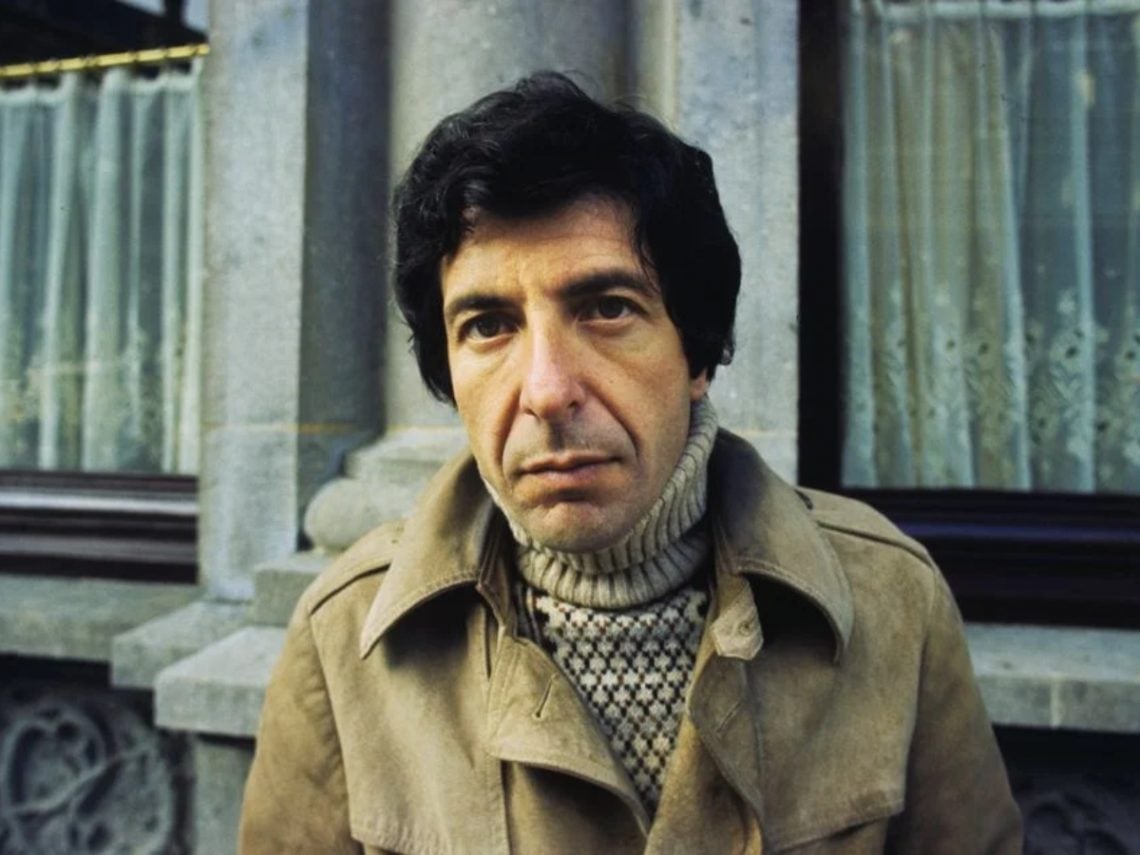
The Werner Herzog movie that heavily features Leonard Cohen

If you’ve ever found yourself caught in the spellbinding and surreal expanse of Werner Herzog‘s Fata Morgana, you’ll know it feels akin to being lost in a desert mirage – disorienting yet eerily enchanting. This 1971 film is a cornucopia of haunting images set against the backdrop of an existential quest, but its real magic is woven into the soundtrack with the heavy infusion of the melancholic melodies of Leonard Cohen.
Herzog shot Fata Morgana in the unforgiving landscape of the Sahara Desert, a place synonymous with desolation and mirages, hence the title. With its poignant blend of mythical tales, desert landscapes and aeroplane wreckages, the film is a cryptic meditation on civilization’s impermanence. Fata Morgana gives form to Herzog’s notion of elastic truth, oscillating between documentary and hallucination.
Scoring this stark visual tapestry is the music of Cohen, whose work transforms the film into an existential exploration. Songs such as ‘Avalanche’ become like characters in the narrative, their themes echoing throughout the barren landscapes, whilst the haunting ‘Suzanne’ scores a particularly dreamy tracking shot. The auditory mirage complements Herzog’s visual one and results in a hauntingly surreal and unforgettable cinematic experience.
In a setting as stark as the Sahara, Cohen’s mournful vocals and poetic lyrics add a touch of humanity to the otherwise abstract viewing experience. His music connects intimately with the viewers, bridging the gap between the alien Sahara landscapes and our shared human experience. Cohen forms the emotional undercurrent, allowing the viewer to find resonance amidst the desolate sands.
Production-wise, Herzog’s making of Fata Morgana was as much a journey as the film itself. Shot over 18 months with scarce resources, Herzog and his crew overcame numerous obstacles, including political instability and harsh weather conditions. Equipment had to be abandoned at treacherous borders, the production crew had guns pointed at them, and Herzog even spent several nights in a “rat-infested” jail.
The director has been very open about how they had no sense of intention or structure regarding the film – in an ode to that spirit of the 1970s, they just went on in the desert to see what would happen. However, the resulting film, an avant-garde mirage of visuals and sounds, emerged as an affirmation of Herzog’s unyielding spirit.
Fata Morgana is, in essence, a mesmerising exploration of life’s paradoxes, a poetic convergence of desolation and beauty, solitude and connection. With Cohen’s music as its beating heart, the film navigates the terrain of existential angst and transcends into a spectral illusion that lingers long after the screen fades to black. So, as you venture into this desert dreamscape, remember: in Fata Morgana, the mirage isn’t merely a trick of the light – it’s the echo of the voice of Cohen, serenading the sands.
