


The Week in Number Ones: Ghost, Lewis Capaldi, and David Bowie hit big

Welcome back to The Week in Number Ones, where all the biggest movers from the US and UK charts get condensed into one article. Last week, we plugged our ears and suffered through the certifiable torture that is David Guetta’s Bebe Rexha team-up ‘I’m Good’ and wondered why the hell anyone would want to remind themselves of Eiffel 56’s ‘Blue (Da Ba Dee)’. We also dove into the summery Nicky Youre hit ‘Sunroof’ and looked at how Steve Miller changed the UK Charts with ‘The Joker’.
This part of the article can be about literally anything, so you know what I want to talk about today? That’s right: the Mariah Carey grunge album. Long story short, Carey was frustrated by the adult contemporary style she was pigeonholed into in the early 1990s. Mariah wanted to rock, more so than anybody else could have imagined. So what does she do? If you guessed “create an entire band around her desire to play alt-rock and record an album full of tracks,” you would be correct.
The band in question was Chick, a little-known major label alt-rock act fronted by lead singer Clarissa Dane, and the album was called Someone’s Ugly Daughter. The band are basically a poor man’s Hole, right down to having a single titled ‘Malibu’ (to be fair, Chick’s ‘Malibu’ did come out first). Carey’s name doesn’t appear anywhere on Someone’s Ugly Daughter, and the album tanked completely, wallowing in obscurity before Carey revealed her involvement 25 years later.
Interest in Someone’s Ugly Daughter has become huge, especially considering the album isn’t available on any streaming services. Carey recently revealed that she had rediscovered the album’s original mix that features herself on lead vocals and is planning to release the album. I just love that, in what sometimes seems like the darkest of timelines, we happen to be in the universe where Mariah Carey made a secret grunge album. That’s enough to lift your spirits for a little bit.
This week, we ponder what makes Lewis Capaldi so sad about his new number one single ‘Forget Me’. We also congratulate Ghost on their first Billboard Hot 100 single and dive into the plastic soul of David Bowie and his 1975 number one John Lennon collaboration ‘Fame’. As we round up all the best chart news of the modern-day and recent past, all that and more.
Current UK Number One: ‘Forget Me’ – Lewis Capaldi
I don’t know if I’m in a good mood, or maybe something a little spicy was put in my coffee cup this morning, but I like the new number one song in the UK, ‘Forget Me’ by Lewis Capaldi. Even though I’m only 24, my usual assessments of the pop charts tend to indicate my true inner self, which happens to be an 85-year-old man. Most of the newer chart hits either don’t move the needle or act as decent distractions for me and my listening habits.
Safe to say that ‘Forget Me’ is more of a decent distraction, but I’m actually quite into it. That’s especially strange, considering my opinion of Capaldi is that he’s middle of the road at his best and a sorry, whiny bastard at his worst. When ‘Someone You Loved’ had its major chart run back in 2019, I hoped never to hear the song again. The fact that his debut LP was called Divinely Uninspired to a Hellish Extent just isn’t fair: the bad reviews write themselves with a title that is self-aware.
But you know what? It’s time for me to stop being a grumpy son of a bitch and give Capaldi his due: ‘Forget Me’ is a decent song. Not earth-shatteringly good or even on the shortlist for the best singles of the year, but pretty good nonetheless. The backing track, which lies somewhere in between an Imagine Dragons song and an early 2000s easy listening station, isn’t particularly inspired. Still, Capaldi’s strained howl does elevate the song above its more generic elements.
‘Forget Me’ is just a good pop song that fits into Capaldi’s established identity of being unable to get over anything in his life. Why so sad, Lewis? You have another number one song and are (no offence) one of the most unexpectedly huge pop stars in music right now. This is your moment, my guy. Lighten the hell up, won’t you? Or maybe don’t because, obviously, this sadsack approach connects with many listeners.
UK Singles Top Ten (Week of September 22nd, 2022):
- ‘Forget Me’ – Lewis Capaldi
- ‘I’m Good’ – David Guetta ft. Bebe Rexha
- ‘B.O.T.A’ – Eliza Rose/Interplanetary
- ‘I Ain’t Worried’ – OneRepublic
- ‘Super Freaky Girl’ – Nicki Minaj
- ‘Not Over Yet’ – KSI ft. Tom Greenan
- ‘Ferrari’ – James Hype/ Miggy Dela Rosa
- ‘Doja’ – Central Cee
- ‘Under the Influence’ – Chris Brown
- ‘Hold Me Closer’ – Elton John & Britney Spears
Current US Number One: ‘As It Was’ – Harry Styles
Usually, this column likes to focus on the top of the charts. That’s where all the interest is, after all. The more popular a song is, the higher it tends to be on the chart. Rare is the person who ventures beyond the top 40 to see the rest of the 60 entries on the Billboard Hot 100 on any given week, but sometimes, that’s where the most interesting songs and stories are.
Case in point – this week, Swedish metal gods Ghost have landed their first-ever single on the Billboard Hot 100. In case you haven’t noticed, the American pop chart isn’t exactly a friendly space for Ghost’s signature brand of theatrical goth rock. That kind of stuff is usually reserved for the mainstream rock chart, on which Ghost have racked up an impressive five number one hits. They’ve even had a number one this year with ‘Call Me Little Sunshine’ from their fifth studio album Impera.
But their first pop chart hit isn’t from Impera. It’s actually the 2019 single ‘Mary On a Cross’, a track that mixes the band’s rock sound with more of a synthpop style. Why had Ghost suddenly infiltrated the Billboard Hot 100? The answer is the same for virtually all chart hits these days: TikTok.
Apparently, people are liking the double entendre of “You go down just like Holy Mary / Mary on a cross.” Why? Well, why does anything on TikTok go viral? There are no reasons why. It just gets picked up, kicked around, remixed, reworked, and eventually discarded, just like all other trends. But for a brief moment right now, Ghost are weirdly mainstream, which is pretty cool.
US Billboard Hot 100 Top Ten Singles (Week of September 24th, 2022):
- ‘As It Was’ – Harry Styles
- ‘Bad Habit’ – Steve Lacy
- ‘Super Freaky Girl’ – Nicki Minaj
- ‘Sunroof’ – Nicky Youre & Dazy
- ‘I Like You (A Happier Song)’ – Post Malone ft. Doja Cat
- ‘You Proof’ – Morgan Wallen
- ‘About Damn Time’ – Lizzo
- ‘I Ain’t Worried’ – OneRepublic
- ‘Late Night Talking’ – Harry Styles
- ‘Wait For U’ Future ft. Drake & Tems
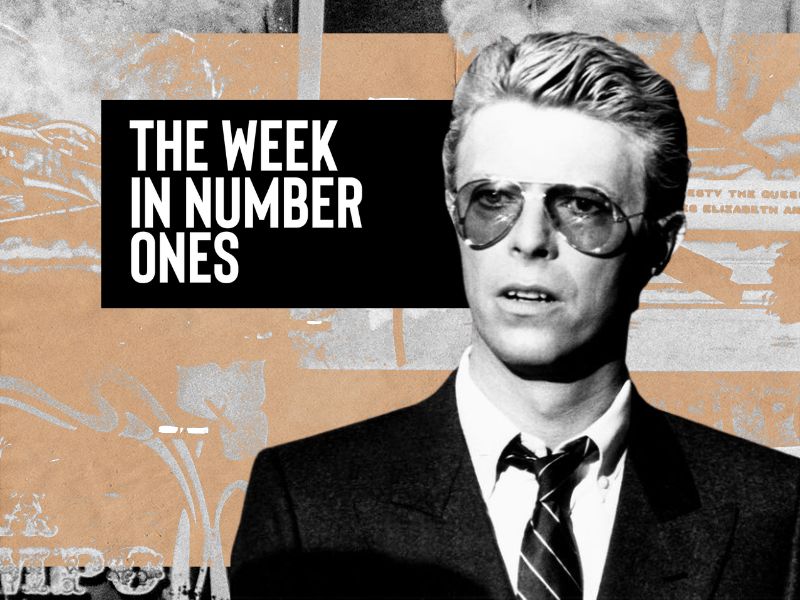
This Week in Number Ones: ‘Fame’ –David Bowie (#1 on the Billboard Hot 100, September 20thth, 1975)
John Lennon didn’t really get going until 1975. By that point, he had already made some of his most acclaimed (and reviled) solo albums and was still very much at the centre of pop culture, but he wasn’t a dominant hitmaker like some of his Beatle bandmates were. Lennon needed some help to get back to the top of the charts, and he found one in a British glam rock icon.
That person was, of course, Elton John. Lennon and John collaborated on the single ‘Whatever Gets You Thru the Night’, the proto-disco rock number that gave Lennon his first number one single in America as a solo artist. Lennon was in his “lost weekend” period, having separated from Yoko Ono and moved out to Los Angeles to engage in debauchery and befriend some of the biggest stars. One of them was another British glam rock icon, one who had full moved away from the genre that made him a star.
David Bowie had been many different people by the time 1975 came around. He was a folk singer, a novelty artist, a one-hit wonder, and finally, a glitzy icon of early ‘70s British rock music thanks to his Ziggy Stardust persona. But Ziggy was now dead, and Bowie was infatuated with a new style of music – Philadelphia soul.
The fact that a Beatle and a glam rocker came together to create one of the definitive songs in soul music is incredibly strange, but Philadelphia soul didn’t need Bowie’s help crossing over to the mainstream. The house band for the premier Philly soul studio, Sigma Sound, was MFSB, and that group had scored a number one hit with ‘TSOP (The Sound of Philadelphia)’ in 1974. So had regional icons like Billy Paul (‘Me and Mrs. Jones’) and The O’Jays (‘Love Train’), both of whom worked with the songwriting/producing team Kenny Gamble and Leon Huff, the heads of Philadelphia International Records. All these figures captivated Bowie and encouraged him to find a new identity within the world of soul music.
There are several other important players in what made Bowie’s transition into soul music so successful. There was his relationship with singer Ava Cherry, who kickstarted and fostered Bowie’s love of soul. There’s producer Tony Visconti, who reunited with Bowie starting with his previous effort, Diamond Dogs. There’s Luther Vandross, the soul icon who helped Bowie arrange the vocals on Young Americans as an unknown local talent. But today, we’re going to point to Carlos Alomar, Bowie’s longtime guitarist, musical director, collaborator, and co-writer of ‘Fame’ along with Bowie and Lennon.
Alomar had cut his teeth as the in-house guitarist at Harlem’s legendary Apollo Theatre before moving on to a career as a session musician. Bowie met Alomar when the latter was booked to play on Lulu’s ‘Can You Hear Me’, a song written by Bowie. Alomar was responsible for bringing in drummer Denny Dias and singer Robin Clarke, along with Vandross, with whom Alomar had been in a group called Listen My Brother. He had soul in his DNA but was versatile enough to work with Bowie in any guise he assumed.
Alomar had created a riff that was to be featured on a cover of The Flairs’ early 1960s hit ‘Foot Stompin’. Bowie demurred, insisting that Alomar slow the riff down and make it funkier for a new original. Lennon happened to be visiting Electric Lady Studios after recently reuniting with Ono, where Bowie and Alomar worked on the arrangement for a new song featuring the riff. Lennon improvised the interjection of “aim!” that Bowie eventually crafted into “Fame!”
‘Fame’ was harder-edged than most of the soul on Young Americans, aligning closer with James Brown-style funk music than the rich tones of Philly Soul. It was another step in the evolution of Bowie’s Americanized attitude throughout the mid-1970s. The sprawl of Los Angeles became his home, but Bowie’s devastating cocaine habit was causing him to lose control in all areas of his life except music. ‘Fame’ was the moment when Bowie, at his worst, was able to pull out some of his best work.
But anybody looking to stick with this version of either Bowie or Lennon would be disappointed. Bowie already began transitioning out of his plastic soul era on his very next album, 1976’s Station to Station. Although ‘Golden Years’ was still very much in the funky R&B style of ‘Fame’, songs like ‘TVC 15’ were pointing Bowie toward his Berlin period. As for Lennon, the reunion between him and Ono, plus the birth of his son Sean, caused him to step away completely from music for half a decade. ‘Fame’ was a moment in time for both artists, one that wasn’t meant to last, but it’s funny to see just how timeless that brief crossover has become for music fans.
US Billboard Hot 100 Top Ten Singles (Week of September 20th, 1975):
- ‘Fame’ – David Bowie
- ‘Rhinestone Cowboy’ – Glen Campbell
- ‘At Seventeen’ – Janis Ian
- ‘I’m Sorry’ – John Denver
- ‘Fight the Power Part 1’ – The Isley Brothers
- ‘Could It Be Magic’ – Barry Manilow
- ‘Run Joey Run’ – David Geddes
- ‘Fallin’ in Love’ – Hamilton, Joe Frank, and Reynolds
- ‘Wasted Days and Wasted Nights’ – Freddy Fender
- ‘Feel Like Makin’ Love’ – Bad Company

Never Miss A Beat
The Far Out New Music Newsletter
All the latest New Music from the independent voice of culture.
Straight to your inbox.