


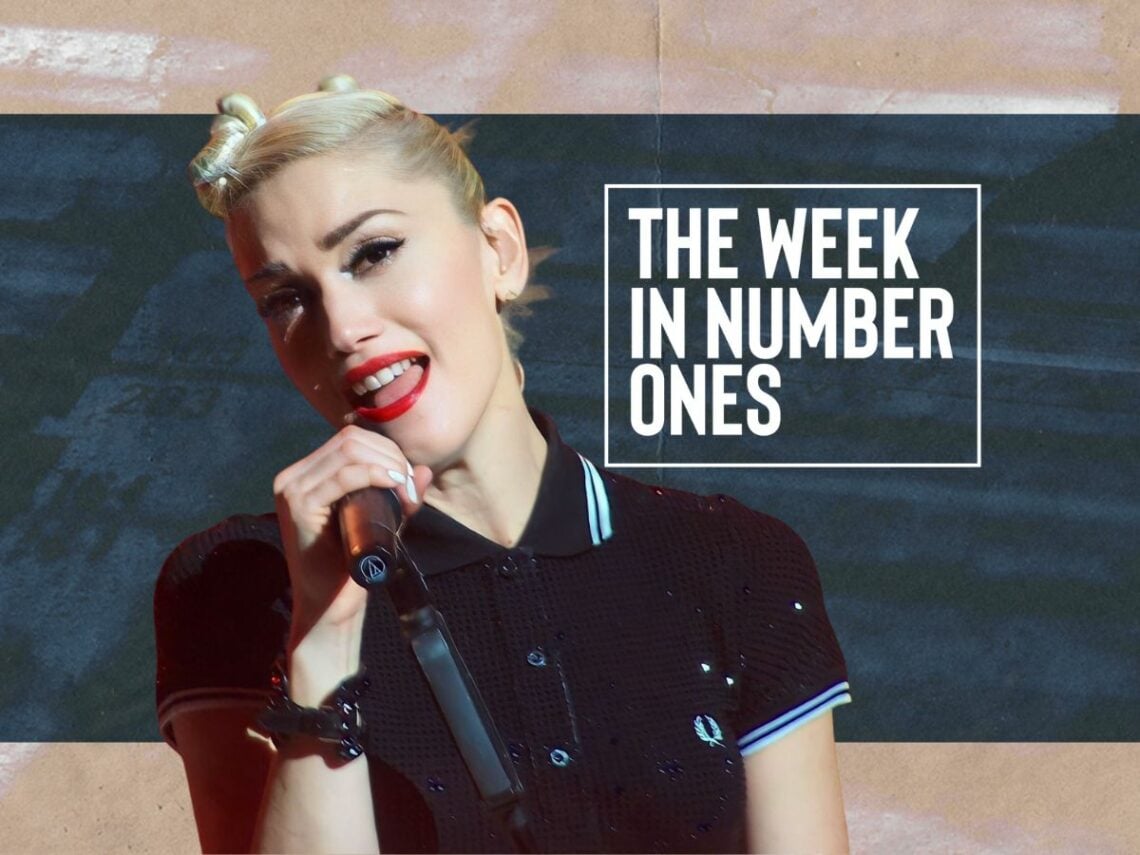
The Week in Number Ones: Coi Leray, Ice Spice, and No Doubt storm the charts

Welcome back to The Week in Number Ones, where all the biggest chart movers from the US and UK charts get condensed into one article. Last week, we took a look at Linkin Park rising from the ashes with a new demo remixed track ‘Lost’, wondered why a ton of Americans bother with modern pop country music, and revisited Queen’s first chart-topper with ‘Crazy Little Thing Called Love’.
Although we mostly focus on singles here, this feels like the right time to pay tribute to one of the biggest number one albums of all time. Pink Floyd released The Dark Side of the Moon 50 years ago this week, and man, has it been a frequent presence on the album charts. In fact, just by chart data alone, Dark Side is probably the most successful album of all time.
When it was first released in 1973, The Dark Side of the Moon went all the way to number one in the US and climbed up to number two in the UK. Then something strange happened: it just never went away. While it ebbed and flowed and occasionally dropped off altogether, Dark Side kept making return trips to the album charts. Pink Floyd had to return to America just a few months after completing a full tour of the country because Dark Side was experiencing its first wave of post-release popularity.
Today, The Dark Side of the Moon has spent a combined 972 weeks on the Billboard album chart. It’s estimated that, to this day, the album sells somewhere close to 10,000 copies every single week. Some 45 million copies of the album have been sold worldwide, making it one of the five biggest-selling albums of all time. Number one songs are usually what artists get remembered for when it comes to the charts, but Pink Floyd carved out their own unique spot in chart history thanks to Dark Side.
This week, we shine a light on nepo-babies thanks to Coi Leray’s ‘Players’, All that and more as we round up the best chart news of the modern-day and recent past.
Current UK Number One: ‘Flowers’ – Miley Cyrus
Where did all the discussion about nepo-babies go? For a short period of time earlier this year, it was all people could talk about. The idea of certain people getting a head start at success because of their genealogy is nothing new, but there seemed poised to be a reckoning for some of the elite of the entertainment industry. And then… I guess everyone stopped caring? Or maybe there was truly nothing that could be done about it. It’s not like any of the nepo-babies have gone away.
Check, for instance, the top of the pop charts. The woman who has been at number one on both sides of the Atlantic for weeks is a nepo-baby: Miley Cyrus. Cyrus is a wonderful case study about the phenomenon of nepo-babies – her father had a number one hit back in the 1990s and featured on the longest charting number one single in the history of the Billboard Hot 100, but now Miley is way more famous than her dad. Cyrus tends to have a pretty high approval rating these days, and she generally makes pretty good music. Even when she doesn’t, she at least makes good music.
But there’s another nepo-baby in the top ten this week that represents the other side of the coin. Over at number seven sits Coi Leray, an upstart rapper who seemingly came out of obscurity and exploded into the pop world. Only that’s not what happened at all: Leray had a hell of a head start over some of her lesser-known peers. Leray’s father is Benzino, the producer and former co-owner of The Source, the original ur-text for hip-hop music journalism.
Did Leray start releasing music on a major label as soon as she could? No, she posted a song or two on Soundcloud first. Would she have gotten signed if she wasn’t the daughter of rap royalty? My guess is hell no. That’s because pretty much everything that Leray has released is contrived, derivative, and just plain bad. Her debut album Trendsetter is one of the more hilariously ironic titles in modern music. If I had to bet on it, Leray will likely only be mentioned as a follower of more talented artists like Doja Cat and Nicki Minaj.
UK Singles Top Ten (Week of March 1st, 2023):
- ‘Flowers’ – Miley Cyrus
- ‘Boy’s a Liar’ – PinkPanthress
- ‘Kill Bill’ – SZA
- ‘Sure Thing’ – Miguel
- ‘Calm Down’ – Rema
- ‘As It Was’ – Harry Styles
- ‘Players’ – Coi Leray
- ‘10:35′ – Tiesto & Tate McRae
- ‘Ceilings’ – Lizzy McAlpine
- ‘Escapism’ – Raye ft. 070 Shake
Current US Number One: ‘Flowers’ – Miley Cyrus
I’ll say it: the American charts have been pretty fucking boring lately. As a red-blooded American, I’m disappointed in my fellow Yankees. We can’t have at least a little bit of a shakeup with the pop charts? Are we all just getting the same ten songs shoved down our throats week after week? Because that’s how I feel listening to this same stupid top ten every seven days.
Of the ten songs at the top of the Billboard Hot 100, a whopping ten out of ten were there last week. A couple of songs switched positions, but for the most part, the top ten is the same bog standard top ten that it has been for weeks. I don’t pretend to know exactly how Billboard tabulates its top ten (because no one knows the exact math), but I thought the streaming age was supposed to herald a new diverse range of artists and singles. I guess that was a pipe dream.
Even worse, there’s barely any difference between the US and UK charts this week. The major difference is that one of the biggest songs in both countries has slightly different credits. PinkPanthress has scored her first major hit with ‘Boy’s a Liar’, a song that I’ve talked about a couple of times in this column. It’s in the top five in both America and the United Kingdom this week, but just from the credits, it could seem as though two different songs are taking those spots.
In the UK, PinkPanthress is credited as a solo artist, and the track is titled ‘Boy’s a Liar’. In the US, the remix track, ‘Boy’s a Liar, Pt. 2’ is the one on the charts, with credit given to both PinkPanthress and Ice Spice. The problem is that listening to either version of the track counts towards its chart position. The UK seems to be acknowledging the original version of the song, while the US is deferring to the newer remix. Wacky times on the charts… as wacky as a stale week like this can be.
Billboard Hot 100 Top Ten (Week of March 4th, 2023):
- ‘Flowers’ – Miley Cyrus
- ‘Kill Bill’ – SZA
- ‘Boys a Liar, Pt. 2’ – PinkPanthress & Ice Spice
- ‘Creepin’ – Metro Boomin, The Weeknd, and 21 Savage
- ‘Last Night’ – Morgan Wallen
- ‘Die For You’ – The Weeknd
- ‘Unholy’ – Sam Smith & Kim Petras
- ‘Anti-Hero’ – Taylor Swift
- ‘Cuff It’ – Beyoncé
- ‘I’m Good (Blue)’ – David Guetta & Bebe Rexha
This Week in Number Ones: ‘Don’t Speak’ – No Doubt (#1 on the UK Singles Chart, March 1st, 1997)
Today, it’s easier than ever to get a song on the charts. While the field of potential pop hits is more crowded than ever, the actual criteria for a song to qualify for the charts is remarkably simple: be a freely-available song. As long as you’re not boosting your sales with merch bundles or not completely rounding out your sales with advertiser’s money, your single has the chance of appearing on either the Billboard Hot 100 or the UK Singles Chart.
It wasn’t always this way, however. There are a couple of strange anomalies that have popped up over the years. The UK Singles chart famously (and still technically does) allow EPs on the chart. Most of these releases get shifted over to the album charts these days, but acts like The Specials have managed to land EPs on the singles chart. For a brief period in the 1960s, EPs were so popular that the UK Record Retailer chart had a specific chart for them.
Billboard, on the other hand, has been notoriously stingy with what they allow on their singles chart. When double A-sides became all the rage in the 1960s, Billboard didn’t change its policy regarding them until 1969. The chart has had a mess of a time trying to figure out how to properly tabulate streams in the modern era, but it seems as though they’ve at least gotten a handle on it in the modern day. But Billboard‘s biggest misstep came in the 1990s when the definition of a “single” was put to the test.
By the end of the ’90s, the single format, as it had been known, was largely dead. With traditional vinyl sales being superseded by CDs, the traditional double-sided single became a financial liability for most record labels. Partly because of tradition and partly because that was how the Billboard Hot 100 worked, though, labels continued to produce singles even though radio play and album sales were much bigger money makers. If a song didn’t have a traditional commercial single release, it wouldn’t be eligible for the Hot 100.
That wasn’t really a problem until 1995, a time when an increasing number of non-traditional songs began gaining massive popularity. When Friends originally premiered, it was so popular that its theme song was getting radio play without a traditional single available to record buyers. For eight weeks, The Rembrandts’ ‘I’ll Be There For You’ topped the Billboard radio play chart and probably would have been a number one song on the Hot 100 had it been available to buy at the time. Instead, the song didn’t get a real commercial single release until it had already peaked, and the commercial single topped out at number 17 on the Hot 100.
While The Rembrandts proved that the Hot 100 was a flawed chart, it took ska pop darlings No Doubt to highlight how out-of-step the charts really were. In 1995, the band released their debut album, Tragic Kingdom. After issuing two singles in commercial formats for ‘Just a Girl’ and ‘Spiderwebs’, the band’s US label, Interscope, decided not to release the band’s third single, ‘Don’t Speak’ as a commercial single in the US. Promotional copies were sent out to radio stations, but fans couldn’t find the CD version of the song because it didn’t exist.
That soon became a foolish move when ‘Don’t Speak’ became one of the most popular songs of 1996. During the back half of that year, ‘Don’t Speak’ saw so much radio play that it went to number one on the Billboard Airplay chart for a then-record 16 weeks, double the amount of time that The Rembrandts had at the top without a commercial single of their own. Versions of ‘Don’t Speak’ were available in countries outside the US, but for American audiences, only import copies were available. In the most technical of terms, ‘Don’t Speak’ became the biggest album cut of all time up to that point.
By the start of 1997, ‘Don’t Speak’ was making a legitimate run to the top of the UK singles chart. When March came around, the track was the number one song in the country. Chances are that ‘Don’t Speak’ would have also been a number one song in America… had Billboard recognised it as a single. The fact that they didn’t is a glaring and embarrassing fault in the way that the chart functioned. For a short while, Billboard couldn’t put the biggest song in the world at number one because of outdated conventions.
Astoundingly, Billboard dragged its feet in recognising so-called “album cuts” as singles eligible for the Hot 100. Songs like Sugar Ray’s ‘Fly’, The Cardigans’ ‘Lovefool’, and Natalie Imbruglia’s ‘Torn’ all spent extended periods at the top of the Airplay chart without being eligible for the Hot 100. Finally, it took The Goo Goo Dolls to make a real change. Their song ‘Iris’ was originally released as a promotional single for the film City of Angels and was also featured on their album Dizzy Up the Girl. But since there was no commercial single available, the song couldn’t chart on the Hot 100.
While the debacle behind ‘Don’t Speak’ was embarrassing, the situation around ‘Iris’ became untenable. ‘Iris’ spent a record 18 weeks at the top of the Billboard Airplay chart, and it would have almost certainly gone to number one on the Hot 100 as well. While ‘Iris’ was still dominating the Airplay chart, Billboard officially changed its rules, allowing promotional singles to be eligible for the main chart. It was a long time coming, especially since Billboard had to see their faults become obvious when ‘Don’t Speak’ hit number one in the UK back in 1997.

Never Miss A Beat
The Far Out New Music Newsletter
All the latest New Music from the independent voice of culture.
Straight to your inbox.