


‘The War Game’: Peter Watkins and the nuclear holocaust

Throughout film history, many important works have been sufficiently radical in their visual and political approach to attract the wrath of the powers that be. However, nobody has done it quite like Peter Watkins, whose 1966 pseudo-documentary, The War Game, managed to not only piss the BBC off but also the British government. An incredibly effective rally against the growing concern caused by the stockpiling of nuclear weapons, Watkins’ masterpiece is more relevant than ever before.
Commissioned by the BBC as a part of The Wednesday Play series, The War Game was so controversial that it was pulled from the broadcast schedule and only received a television broadcast almost 20 years after it was made. Building on the intensely volatile sociopolitical conditions of the ’60s, Watkins imagines a state of emergency in the UK following a Chinese invasion of South Vietnam and rising political tensions between East and West Germany.
During a conversation with Metro, Watkins explained the real reasons behind the film’s banning: “I think that one of the reasons why it was banned, though this has never been discussed publicly, is simply because The War Game indicates some of the directions that TV might have taken ten years ago by developing a whole… I don’t know how to put this… but a whole wave of subjectivity and feeling, and force of feeling, instead of this so-called objectivity that flattens everything into zero.”
The filmmaker added: “I think that because The War Game works so much against the objectivity rule and was passionate and committed, that it broke just about every rule upon which every Western TV network stands. I think that’s also why the film had to be banned. I’m dammed sure that’s why the BBC banned it – not necessarily because of the political implications of its subject matter, but because it threatens the very image of TV itself.”
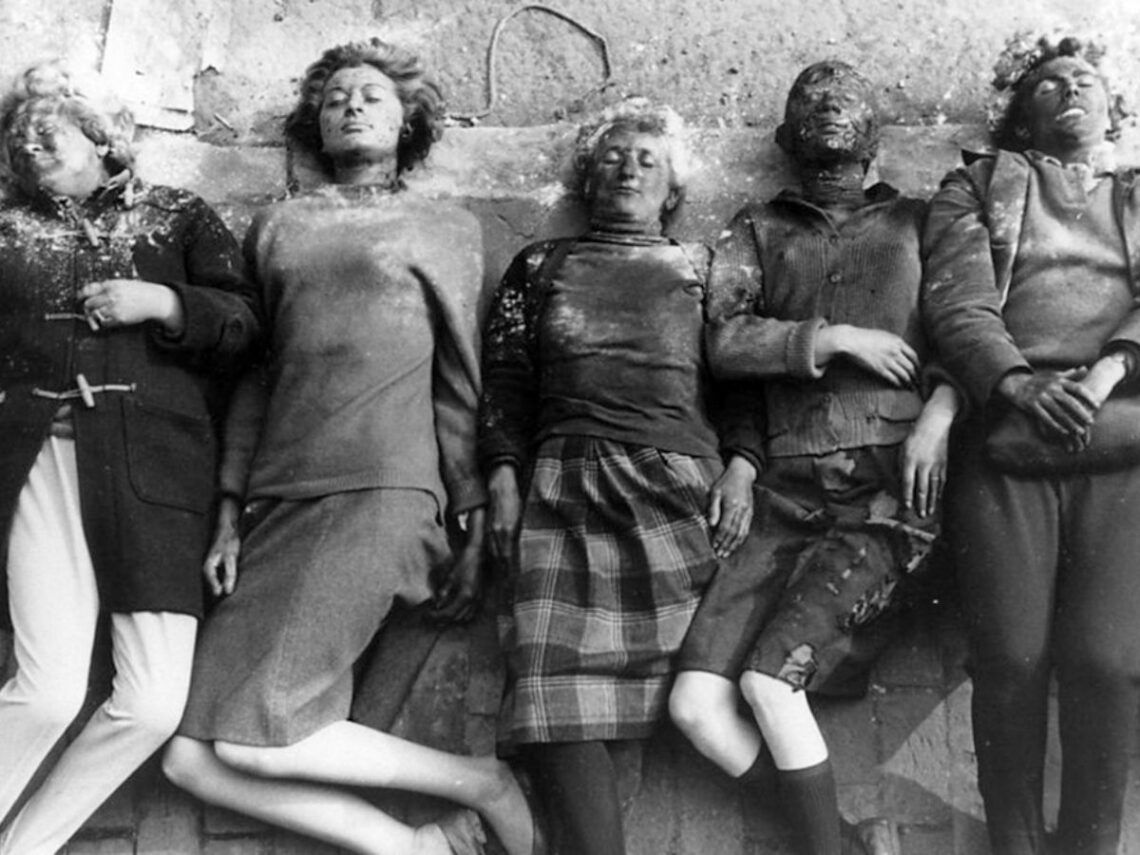
Designed as a standard videojournalism report about an unravelling crisis, The War Game presents a terrifyingly plausible reality where the future of the world has been wiped out by weapons of mass destruction. Debates around the irreversible consequences of a nuclear holocaust have been intellectual exercises for many pro-war scholars and politicians, but Watkins completely turns it around, presenting shocking images of the masses who would instantly succumb to the grotesque devastation.
Interweaving absurd arguments from religious leaders and war strategies, interviews of the common people filled with fear and anger, and nightmarish visions of radioactive children without futures, Watkins creates a spectacle that is difficult to process. Although many old masterpieces maintain a retrospective distance in the minds of modern audiences, The War Game is a much more immediate and visceral warning of a future that seems to be just around the corner.
Watch the film below.
