


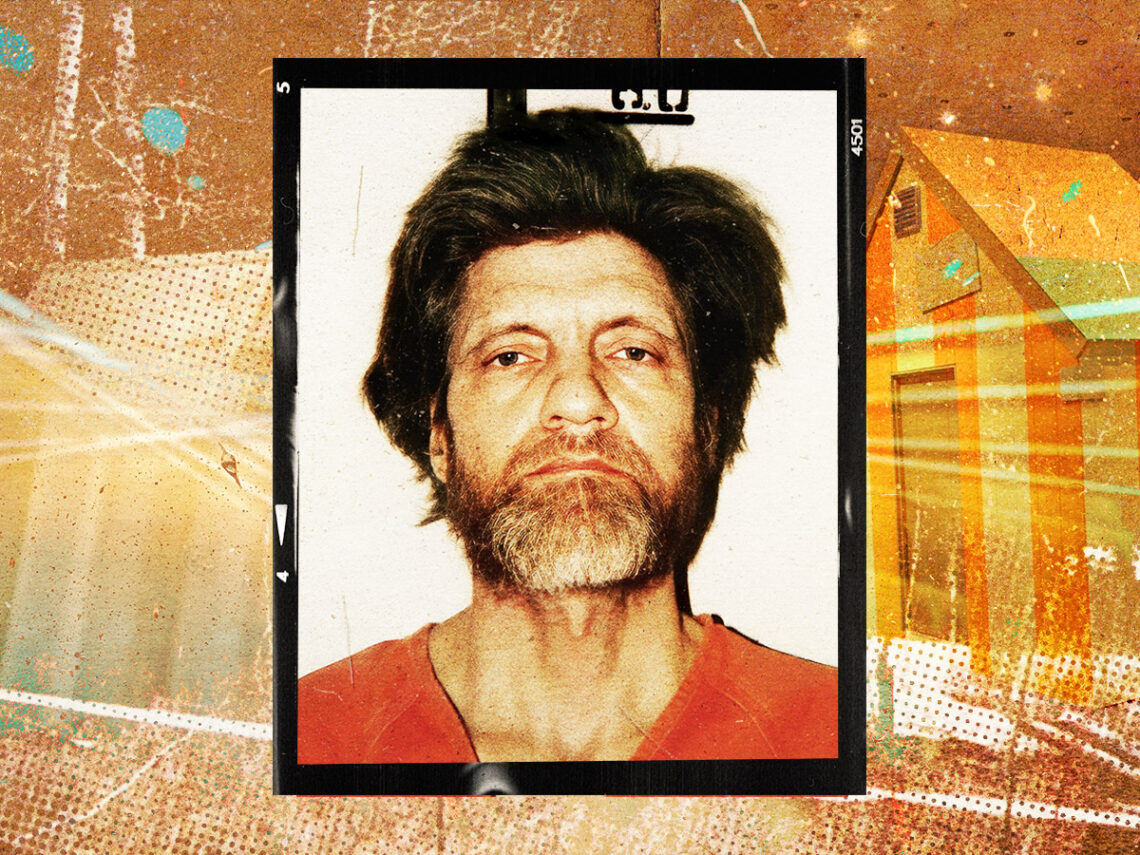
The Unabomber’s Cabin: How Ted Kaczynski became an unlikely muse for artists

The audacious plan to instigate the collapse of the modern social order was largely unsuccessful for the Unabomber, Theodore J. Kaczynski. The FBI gave him his infamous nickname to stand for University and Airline Bombing – a decision that arguably immortalises him in the eyes of the public, making his manifesto outlive him. Kaczynski’s turbulent acts were in the name of destroying society’s technological foundation and the wilderness’s protection, but his terrible convictions led him to kill three people and injure 23 more.
However, the modern social order was left unchanged. Many passed him off as a ‘sicko’, but the Harvard-educated mathematician believed technology would spell civilisation’s end. This parallels the growing friction between humans, robotisation and artificial intelligence today and concludes that his efforts to destabilise the system were ineffective, despite toiling away for nearly two decades making bombs in his tiny shed in the Montana wilderness.
Kaczynski’s influence on the art world was unexpected, with his typewriter even being exposed at the Guggenheim Museum in 2018. In Kaczynski’s manifesto ‘Industrial Society and its Future’, he warned of the dangers of technology and its psychological and environmental detriments. As a result, his manifesto inspired environmental artists to recreate his message visually. Some, albeit controversially, believe he was ahead of his time and therefore looked up to Kaczynski as an underdog or a misunderstood hero. The issues he raised, such as climate change and AI overpowering the natural world, are amplified today, leading artists to reuse his manifesto to keep his legacy alive.
Kaczynski’s notorious cabin was auctioned off and obtained by the Newseum in Washington and used for an exhibition. In 2020, it was given back to the FBI. It was displayed for the ‘FBI Experience’, a dystopian show about the inner workings of the organisation – a thinly veiled advertisement for the FBI.
Nonetheless, Richard Barnes was among the first artists to record and interpret Kaczynski’s symbolic cabin. Barnes pleaded with the FBI to visit the cabin soon after Kaczynski was apprehended. His photographs, called ‘Unabomber Cabin, Sacramento, CA’, breathe surrealism, as this wooden, aged hut sits in a sterile warehouse. An uncanny metaphor of Kaczynski’s beliefs standing out and not aligning with the society that he fled from. The electrical wires of the fluorescent lights hang down from the ceiling, tormenting the cabin with the technology it tried to destroy.
In his Unabomber series, Barnes also created gelatin silver prints with the cabin floating in space, surrounded by darkness. Kaczynski’s isolation is characterised by the monochromatic colour palette and the cabin slightly being blurred into the background.
Later, Daniel Joseph Martinez reimagined Barnes’ dystopian perspective on Kaczynski. The installation, called ‘The House That America Built’, is a colourful recreation of the cabin, split in two. The two halves of the house are tilted away from each other as if a cartoon bomb had just blown them up. Inspirations from Martha Stewart also inhabit this house, as the house is painted in orange, yellow, and periwinkle hues. An unlikely link to Ted Kaczynski, however, Martinez noted: “Kaczynski and Stewart’s simultaneous incarceration in federal prison and their similar family backgrounds—both are second-generation, Ivy-league educated, Polish Americans—Martinez links a domestic terrorist with a domestic hyper-capitalist.”
The incarceration and alienation of Kaczynski for his anarcho-primitivist actions led him to be interpreted by artists as either a misunderstood genius or a perverted and violent insurgent. Either way, the surrealism of his cabin in that FBI warehouse symbolised out-of-place extreme environmentalism in modern society. His cabin is alluring to artists wanting to explore his ideology, shortcomings, and some of the logic in his manifesto that applies to today’s ecological crisis.
