


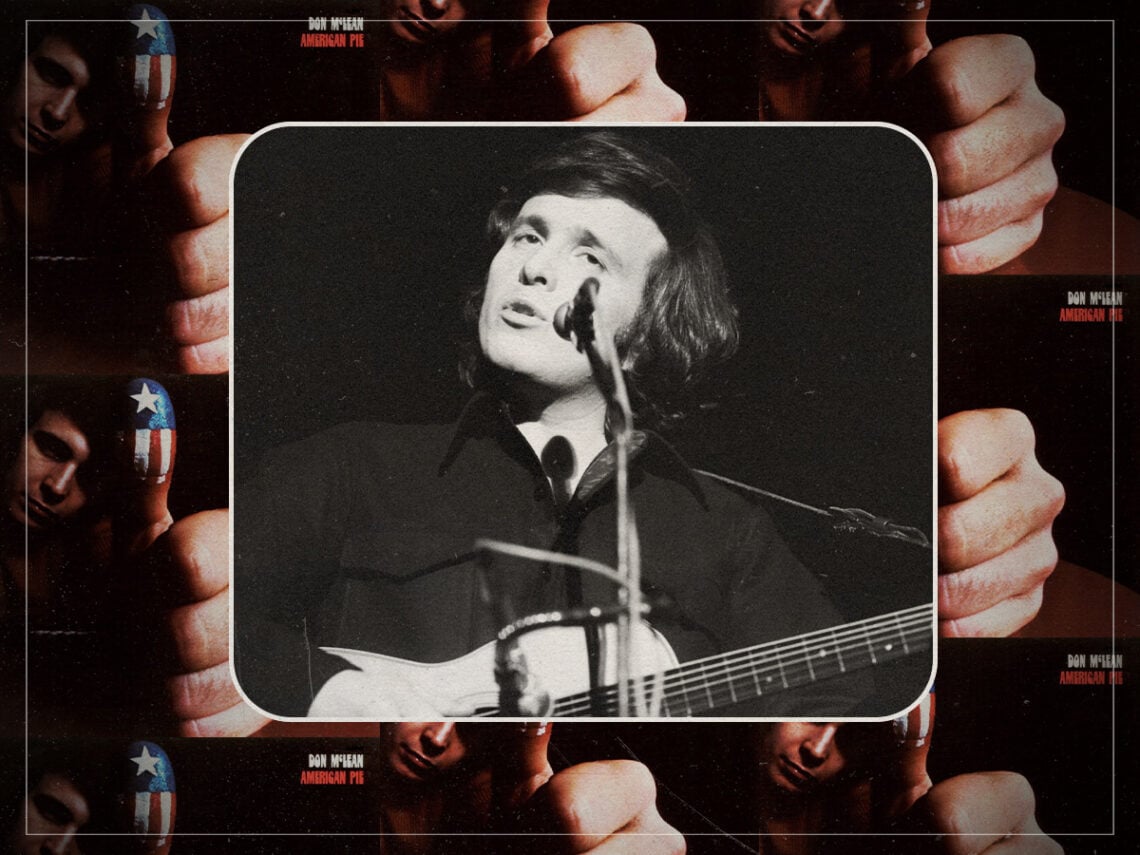
The two classic song Don McLean considered the antithesis of ‘American Pie’

“A long, long time ago, I can still remember how that music used to make me smile…”, sang a wistful 25-year-old Don McLean on ‘American Pie’ in 1971, referring to the rock and roll of Buddy Holly, with McLean’s smile famously cut short in 1959 when the former, along with The Big Bopper and Ritchie Valens, tragically died in a plane crash, and the music died with them.
Aside from acknowledging that he first learned about Holly’s death on February 3rd, 1959, when he was 13 and folding newspapers for his morning paper route (hence the line “February made me shiver / with every paper I’d deliver”), McLean has famously always avoided responding to direct questions about the song’s cryptic lyrics.
While we’ll perhaps never know the identity of every jester and king mentioned in the verses, we don’t need to know names to piece together the themes of this sprawling single. Stretching far beyond the opening lines that mourn the death of his childhood music heroes, ‘American Pie’ also reflected the deep cultural changes and profound loss of innocence of a generation.
Between the 1959 plane crash and the turn of the 1970s, the cultural mood was darkening as the musical vanguard passed away from the pure, unadulterated joy of early rock and roll. It has also been speculated that the song contains numerous references to post-World War II American political events, such as the assassination of John F Kennedy, which many view as the moment the country’s optimism truly began to fracture.
The lyrics and notes were eventually auctioned privately on April 7th, 2015, selling for $1.2million, and in the sale catalogue notes, McLean revealed the broad meaning in the song’s lyrics: “Basically, in ‘American Pie’ things are heading in the wrong direction. It [life] is becoming less idyllic. I don’t know whether you consider that wrong or right but it is a morality song in a sense.”
In a separate interview with Classic Rock in 1997, he suggested, “It was about an America that was coming apart at the seams. I was trying to create this American song, but not like ‘This Land Is Your Land’ or ‘America the Beautiful’. I wanted to connect with the parts of America that mattered to me.”
Released all the way back in 1910, ‘America the Beautiful’ is a hymn of pure aspiration that presents an idyllic landscape of “amber waves of grain” where God sheds grace on the nation. It is a song of un-dissonance, and as such, it is not surprising that in the wake of all that happened between 1910 and 1971, McLean felt the “patriot dream” described in the song hadn’t worked out too well.
There was certainly more kinship between McLean and Woody Guthrie, whose 1940 single ‘This Land Is Your Land’ was written as a protest against the forced optimism of the patriotic song ‘God Bless America’. Guthrie’s original version included verses about high fences, private property, and hungry people standing in line at the Relief Office; however, the two songs diverge in their final outlook. Guthrie’s work is ultimately rooted in reclamation and a warm, folk-driven sense of optimism that the land belongs to the people and can still be saved, while McLean’s ‘American Pie’ is more of a cultural autopsy, shaped by the blow of losing his musical north star at the age of 13.
While borders could be redrawn and land taken back, McLean knew that Buddy Holly was somewhere he could never return from.
