


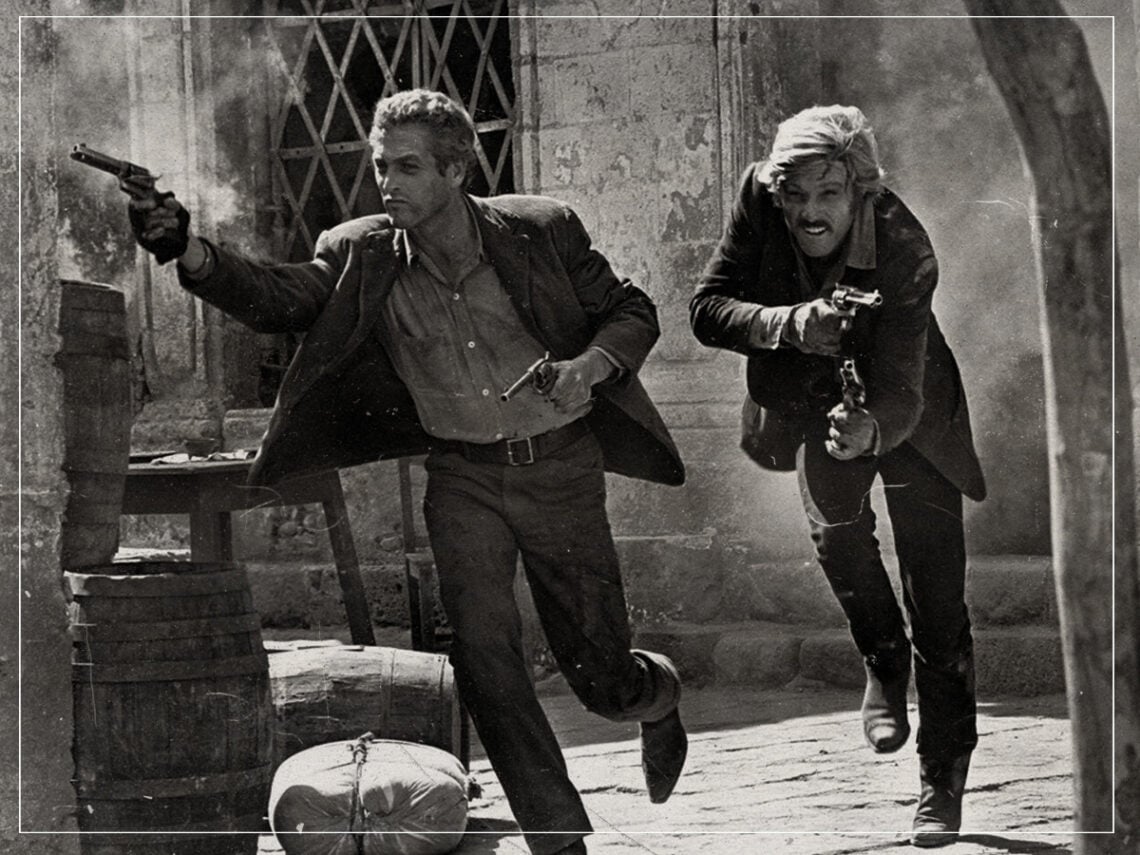
The true story behind ‘Butch Cassidy and the Sundance Kid’

Butch Cassidy and the Sundance Kid is one of the most iconic cowboy movies in history. Released in 1969, it was the last of its kind as Paul Newman and Robert Redford delivered a western epic as the genre started losing steam. But it seems they saved the best story till last as Hollywood told the tale of the real-life Butch Cassidy and his Wild Bunch.
The film, boasting one of the most famous cinematic endings, sees Butch Cassidy, the outlaw protagonist, and his sidekick, the Sundance Kid, die in a blaze of glory shoot-out in Bolivia, sent in 1908. That’s supposedly how the real-life criminal died, but his family believe that the man behind the myth lived for decades longer as the true story became increasingly lost to time and retellings.
Robert LeRoy Parker, better known as Butch Cassidy, was born in 1866 in Utah. His family was part of the movement of Mormon pioneers who moved to the States, meaning while Parker grew up in a religious household, his upbringing was strict and isolated. As a teenager with a wild streak, he ran away from home and became an apprentice at a butcher’s, earning him the nickname Butch.
Cassidy’s adopted surname was added in honour of his mentor. While working at the butcher’s, he met Mike Cassidy, a cattle thief who taught him the craft of crime. At first, he started small. His first crime found him breaking into a shop and stealing a pair of jeans and a slice of pie. Clearly still holding onto his religious guilty conscience, he left an IOU at the till with a promise to pay next time.
But really, Cassidy was a cowboy at heart. He worked on ranches, raced horses to make money, and travelled around looking for new jobs or ways to make a quick buck. Slowly, his criminal activity grew and grew until, in 1889, Cassidy and some of his cowboy criminal acquaintances robbed their first bank. They stole $21,000, which is equivalent to $684,000 today.
He used the money to buy a ranch in Wyoming, close to the Hole-In-The-Wall, a remote pass in the mountains where outlaws would hide out. It was here that the Wild Bunch were formed and would meet at a log cabin called Robbers Roost. Slowly building up with Cassidy’s closest friends whom he met either during prison stints or knew simply through their mutual criminal activity, it included Harry Alonzo Longabaugh, also known as the Sundance Kid.
With strength in numbers, the gang turned to robbing trains instead of banks. They targeted the Union Pacific Railroad, scoring a loot so big that it caused a national manhunt for the criminals. After a string of robberies and gunfights, they were the most famous criminal gang by 1899. With the police on their tail, the gang split up in different directions, but Butch Cassidy and the Sundance Kid stuck together.
In 1899, Cassidy taunted the police even more. He offered to negotiate an amnesty with the Utah governor, proving just how notorious and riff the gang were. The governor, Heber Wells, convinced Union Pacific to drop all criminal charges against him. Then, in August of that year, Cassidy robbed the railroad blind again as a kick in the teeth. The manhunt for the outlaw was back on.

By the start of the 1900s, every corner had a wanted poster with the Wild Bunch’s picture on it. Members were still on the run, but their crime spree only spread, stretching to Montana, Texas and St. Louis.
Another well-known figure in the 1969 film is that of Etta Place. While the movie version of the Sundance Kid shows him to be the sweeter and more sentimental of the two, Harry Alonzo Longabaugh was just as cunning of a criminal. His partner, Etta Place, is perhaps the biggest mystery of the entire tale. There is no real record of her origins or her fate, only a handful of eyewitness accounts that claim she was beautiful, well-spoken and an excellent shot with a riffle.
While in the film, Cassidy only dreams of escaping to a criminal’s paradise, in real life, they actually did. In 1901, Cassidy, Longabaugh, and Place boarded a steamboat in New York and headed to Buenos Aires to once again evade the law. They bought a ranch in Cholila and lived in relative domestic bliss for four years, but their reputations eventually caught up with them, forcing them to sell the ranch.
After this, Etta Place left them and went back to the States. The dream team of Butch Cassidy and the Sundance Kid once again stayed together as they headed to Bolivia and attempted to live an honest life. Fans of the film will know that it didn’t last long.
It was in Bolivia where the duo met their fate. After once again having their cover blown following a robbery, a mass of soldiers, the police chief, the local mayor, and some of his officials all descended on the pair’s lodgings. While in the film, the pair charge out of the building with guns blazing, attempting to take on the police but instead being mowed down by the army, the real-life story is a lot hazier.
In reality, it’s thought that a gunfight between the two outlaws and the authorities raged on for hours. At around 2am, there was supposedly a lull in the violence when the mayor heard a man scream three times inside the house. Then, two successive shots were fired from inside the house. The next morning, two bodies were found with multiple gunshot wounds. The body assumed to be Longabaugh had a bullet hole in his temple, and from the position of the two bodies, it was suggested that Butch Cassidy shot the Sundance kid to put him out of his misery after being severely injured. From the look of the scene, it seemed that Cassidy then shot himself, dying next to his loyal sidekick.
However, the Bolivian authorities had no way of identifying the men. There has never been a DNA match to connect the two real-life criminals with any bodies buried in the area as historians still cannot find their graves, leading to rumours that the pair may have survived the infamous shoot-out after all.
