


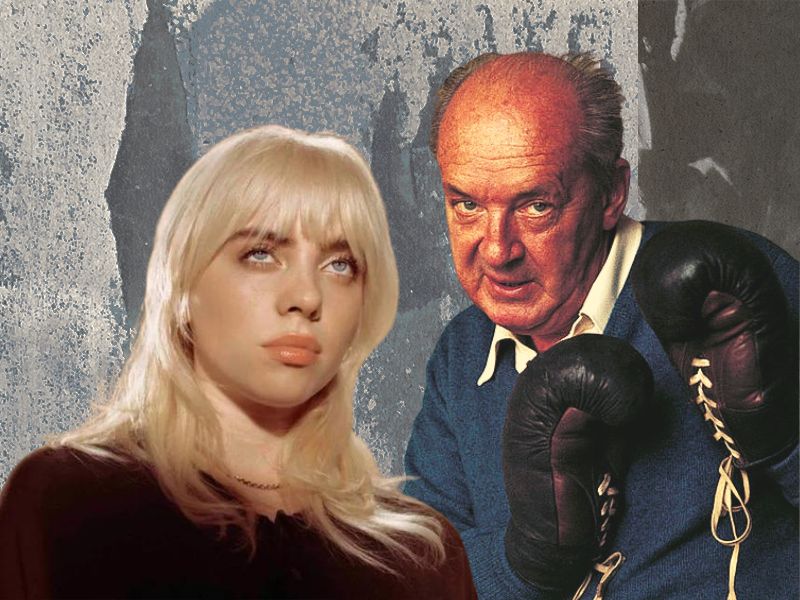
The strange tie between Billie Eilish and Vladimir Nabokov

“It was love at first sight, at last sight, at ever and ever sight,” the Russian writer Vladimir Nabokov once wrote. Keen-eyed Billie Eilish fans might have had their interest piqued by the presence of a couple of ‘evers’ in the mix there, however, aside from the profundity that both artists proclaim with their ad infinitum remarks, the tie that binds them is actually far more tangible.
“Our imagination flies—we are its shadow on the Earth,” Nabokov also wrote, and that is far more in line with the creative kinship between these disparate souls. You see, it wasn’t just the way that they both boldly waded into the human spirit and spoke of their unbridled findings therein that bind them—it is the way that they experienced the creative process of reflecting their mindful exhibitions to the masses.
Synesthesia is a condition defined by Frontiers in Psychology medical journal as “a rare experience where one property of a stimulus evokes a second experience not associated with the first.” There are at least 60 known variants of the condition, including people who see music as colours, words evoke tastes, sights evoke sounds, sounds look like shapes, numbers smell funny, and so on and so on. Thus, Donald Trump might look like a completely unrelated phallic shape and so forth.
Speaking about her experience, Eilish said: “I don’t know why it exists, but my brother has it, I have it, and my dad has it. It’s a thing in your brain where you associate random stuff to everything. So, for instance, every day of the week has a colour, a number, a shape. Sometimes have a smell that I can think of or a temperature, or a texture. And it means nothing.”
However, it can’t be escaped when it comes to her creative output. As she continues: “But it inspires a bunch of stuff. All of my videos, for the most, part have to do with synesthesia. All of my artwork, all of my—everything I do live. All the colours for each song is because those are the colours for those songs specifically.”
Thus, this is part of the reason why much of her work is minimalist. Eilish doesn’t often throw in a needless middle eight or break the musical texture of a song for the sake of something new. In her view, that would be like painting a realist seascape and suddenly making some of the waves orange.
This determining factor gives her music a pleasing uniformity. That is not to say it is a shade of grey—and, in fact, just because she sees things a certain way that doesn’t mean it translates in the same way for everyone else. However, it renders her work carefully considered and plucked from a place of creative flow, as though she is soaring through a musical colour scheme and casting a shadow back down on the track, to lend Nabokov’s motif.
“It’s called colour hearing,” the writer told the BBC in 1962 regarding his own experiences. “Perhaps one in a thousand has that. But I’m told by psychologists that most children have it, that later they lose that aptitude when they are told by stupid parents that it’s all nonsense, an A isn’t black, a B isn’t brown—now don’t be absurd.”
Nabokov would also hear these colours within language, writing: “The long ‘a’ of the English alphabet has for me the tint of weathered wood, but a French ‘a’ evokes polished ebony. This black group also includes hard ‘g’ (vulcanized rubber) and ‘r’ (a sooty rag being ripped). Oatmeal ‘n’, noodle-limp ‘l’, and the ivory-backed hand mirror of an ‘o’ take care of the whites. I am puzzled by my French ‘on’ which I see as the brimming tension-surface of alcohol in a small glass.”
Interestingly, much like the Eilish family, it would seem that synesthesia was passed on to his son. Perhaps even more compelling when it comes to the genetics of this condition is that Nabokov’s wife also saw letters as colours, and while their own-coloured letters didn’t calibrate, their son Dimitri seemed to blend the palette.
Aside from this fascinating titbit, Dimitri also explained how it seemed to affect his father’s writing: “Perhaps the most significant domain in which synesthesia may have affected Vladimir Nabokov was that of metaphor. When he describes an object, be it a chance item or an important prop, odds are that his description will have not only a touch of originality but also a colour.”
In both cases, this way of experiencing the world was intrinsic to their creativity. When things align, it gave their muse the green light to bolt ahead and produce a palette of expressionist language and sound.
