


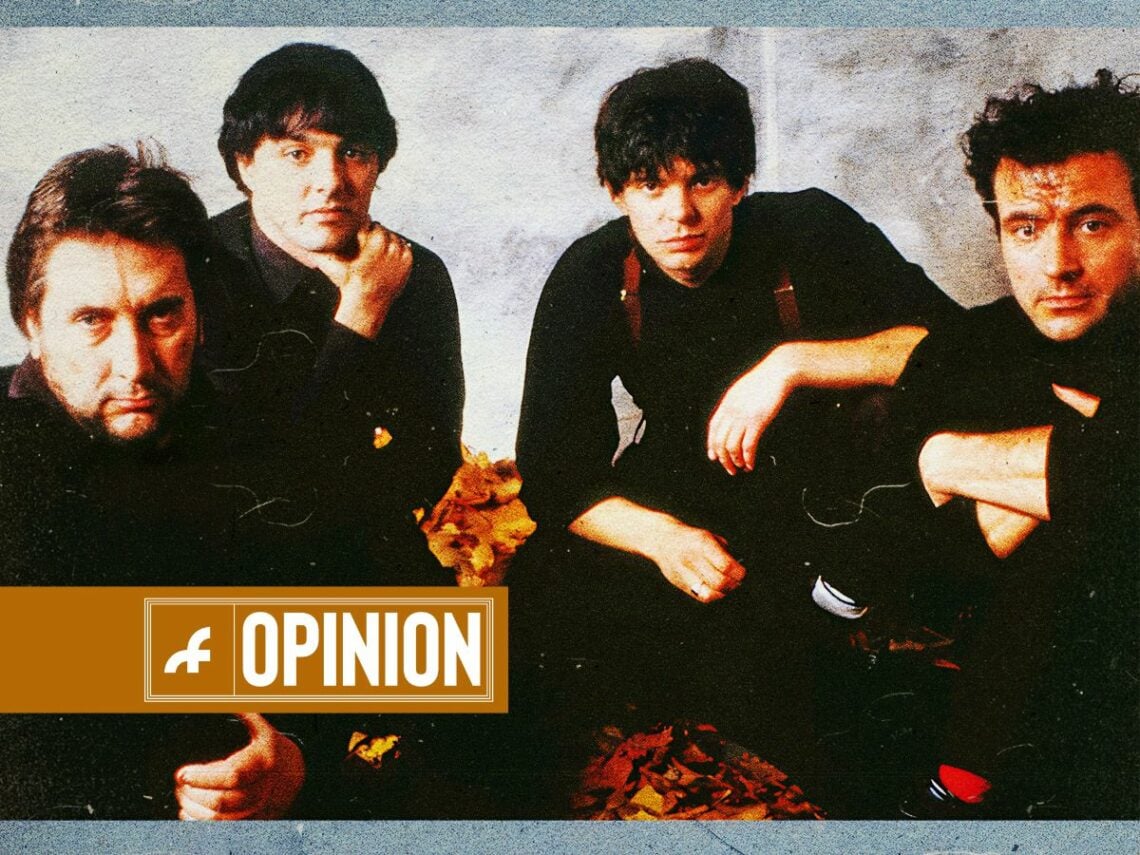
Would The Stranglers be cancelled in the modern day?

In the modern day, the word “cancel” seems near-ubiquitously proceeded by “culture”, and for good reason. With the swelling reality of social media, forthright opinions and arguments are only a few taps away. Twitter is packed to the rafters with the promotion of prevalent causes: some noble, some misguided and some frankly ridiculous. Today, I harken back to the late 1970s punk explosion with a modern eye as I ask the question: “Would The Stranglers be cancelled in the modern day?”
First of all, it’s important to note that art should leave space for the eye of the interpreter to fill. With this in mind, one can understand why conjecture is never far from artists. This is true even for those who do not welcome it, but when material intends to shock, parody or inspire, the furnace roars.
For all its primitive aggression aimed at societal norms and isolated instances of violence, the punk movement is retrospectively admired for its ongoing artistic impact and inspiring countercultural motive. However, when Sex Pistols first reared their disdainful heads in 1976, parents across Britain recoiled with disgust that only grew as their children began to dress in chokers, chains and ripped jeans.
These rags and accessories were, of course, a construct of the late fashion designer Vivienne Westwood. The illusion created here posed these youngsters as unforgiving reprobates, which admittedly wasn’t far from the truth. But when it came to The Stranglers, what you saw was what you got.
Forming as a pub rock band in 1974, The Stranglers dressed in ill-fitting, rarely washed rags and leathers, or “prison clothes”, as frontman Hugh Cornwell described them. However, this wear and tear was nothing to do with Westwood. “We definitely weren’t like the others,” Cornwell added in his 2023 interview with Classic Rock. “We didn’t dress up.”
Incidentally, the original and, in some ways, most authentic British punk group was a crucial influence on Sex Pistols and The Clash. “None of us were really punk,” Cornwell professed. “But it was an opportunity. Who cares what they call us? This is our chance to get in through the door. The necessity of adopting a pose appealed to our provocative nature.”
“Steve [Jones] and Paul [Cook] used to come to all the shows, asking questions about how we did things,” Cornwell added. Meanwhile, John Mellor, a lesser-known singer of the pub rock band 101ers, was another early Stranglers fan. “He was in tears backstage after one gig. He said, ‘I want a band like yours.’ The following week he changed his name to Joe Strummer and was in The Clash,” Cornwell recalled.
If The Stranglers’ music didn’t quite fit the punk model, their attitude and early artistic vision certainly did. Instead of poking holes into the tweed chest of the establishment, Cornwell and his merry men sought to wallow in squalor, channelling Piero Manzoni’s knack for turning excrement into art.
With such vile points of rumination as sewers and brown rats, the species from which The Stranglers’ 1977 debut album Rattus Norvegicus derives its Latin name, this group were evidently on a mission to disgust from the outset.
In 1977, the Rattus Norvegicus single ‘Peaches’ became The Stranglers’ first top-ten hit, propelled by JJ Burnel’s funky bassline, but it wasn’t to everyone’s taste. The BBC swiftly censored the song, citing “coarse language and innuendo”, and had the suggestive French derivation “clitares” replaced with “bikini”, “oh shit” with “oh no”, and “what a bummer” with “what a summer”.
Beyond obvious profanity, the song was the first of several, including ‘Princess of the Streets’ and ‘Nice ‘N’ Sleazy’, that earned The Stranglers a reputation as “male chauvinists” at the time. “People would go: ‘I’m not sure about the lyrics to ‘Peaches’; a bit sexist,'” Cornwell recalled. “The ones who said that had no sense of humour.”
This reaction only served to intensify the censor-baiting material. “It was like we discovered we had this ability, and we were using it. ‘Oh, we can wind people up. Great. Well, let’s wind them up a bit more,'” Cornwell recalled of the band’s attitude heading into their second LP, No More Heroes.
From a modern perspective, the band’s most concerning title is ‘I Feel Like a Wog’, which appeared on No More Heroes. Of course, any song with such a word in the lyrics, let alone the title, would call for immediate cancellation in the modern day, but Cornwell defends the “misunderstood” lyrics: “I feel like a wog people giving me the eyes, but I was born here just like y-y-you….”
“The word was everywhere in those days – Westernised Oriental Gentleman,” Cornwell outlined. “It was like a swear word. I was using it for shock effect, but it was to put across a feeling. A lot of people obviously misunderstood it. But a couple of black guys came back after one show and said: ‘We get it.’ That made me feel good.”
As Cornwell outlines here, a word can’t be racist, only the person using it. Naturally, some words have become akin to expletives that must be avoided unless career suicide and castigation are on the to-do list. However, as with many things in life, context is key and, all too often, ignored.
Cornwell’s most blatant attempt at winding people up on No More Heroes was ‘Bring on the Nubiles’, which contained the pleasant lyrics, “There’s plenty to explore, I’ve got to lick your little puss, and nail you to the floor/Bring on the nubiles… lemme-lemme fuck ya-fuck ya.” Cornwell wasn’t quite so prepared to defend such content from a modern perspective, admitting, “We definitely couldn’t get away with that now.”
Nevertheless, it doesn’t take a brain surgeon to see that The Stranglers were satiating a wicked sense of humour and a “provocative nature”. This music intended to ruffle feathers, but from a more artistic point of view, the sexist and salacious lines were exaggerated to the point of parody. The band was well aware of what one should or shouldn’t say; that’s the basis of the joke.
“What a laugh. If anything’s going to wind people up, this is going to. And it was entertaining for us: fun and really harmless,” Cornwell concluded. “People might say: ‘How can you say that’s harmless?’ But we weren’t trying to upset people. We were in the sweet shop, and we were helping ourselves. We’d realised that we could upset people, so let’s go to town, let’s really upset them.”
So, to answer the titular question directly, The Stranglers, a band chastised by pockets of society in the late-1970s, would most certainly be cancelled in the modern day. Record labels wouldn’t touch that dicey music with a barge pole, and such prudence would be justified. Whether The Stranglers’ early material should be cancelled is another matter entirely.
The fact that cancel culture exists as a phrase is indicative of cancellation becoming rife to the point of saturation. As we scrupulously pick at the seams of history and contrive to cast a past world under modern light, we often miss the point of art and history altogether.
If something in the past is deemed unsavoury, history books should, by all means, be added to but never wiped. In the case of The Stranglers, Cornwell’s above discourse attests to the band’s innocence in the case of ‘I Feel Like a Wog’. As a relic of the past, the song needn’t be erased but rather beheld in its context as a comparison point.
With regard to the alleged sexism in tracks like ‘Nice ‘N’ Sleazy’ and ‘Peaches’, I feel compelled to note the distinction between irony and malice. In spite of many commendable societal changes over the past couple of decades, the Western world appears to be losing its sense of humour, perspective, and ability for rational, independent thought. This unnecessary symptom of societal progress is counterintuitively fueling polarity but also disrespecting cases more worthy of contempt.

Never Miss A Beat
The Far Out Punk Newsletter
All the latest Punk content from the independent voice of culture.
Straight to your inbox.