

All this way for that: Tales from the most disappointing heritage sites
Read More


The world is brimming with places that come with such a mysterious history that they have been the object of fascination for generations. Göbekli Tepe, Stonehenge, and the Egyptian pyramids are all some of the most famous sites that come with a confounding backstory, and due to humanity’s natural propensity to investigate and question, these places will continue to be met with curiosity and scrutiny until their full story is told, if this eventuality ever occurs.
Whilst these places are famous because of their importance in the grand scheme of civilisation’s development, there exist many other much smaller but no less captivating sites that have also been the source of much questioning since they were uncovered. In the United Kingdom, no place fits into this category better than The Shell Grotto, Margate. A location plucked straight from Alan Moore‘s From Hell, Neil Gaiman’s The Sandman, or a Dan Brown romp, it is a great mystery in itself why this subterranean wonder is not more well-known outside of the southeast of England.
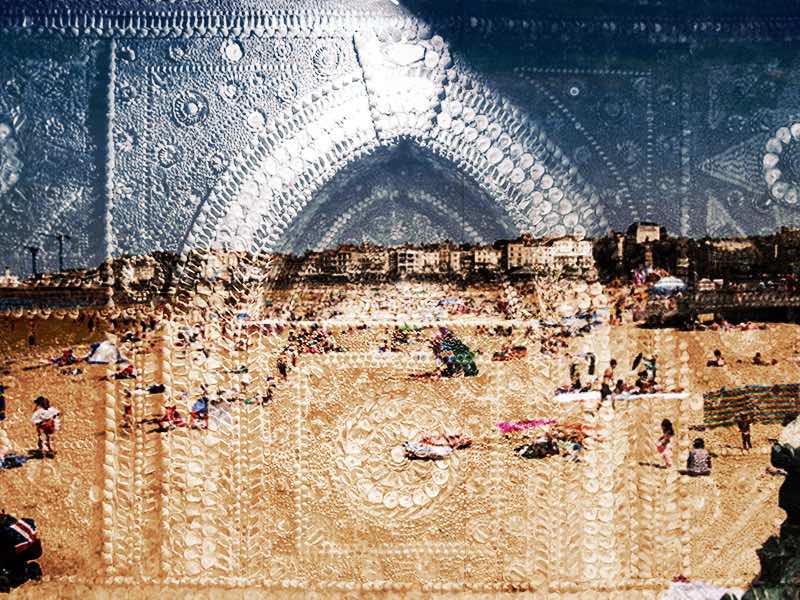
The Shell Grotto is an ornate subterranean passageway in the form of a shell grotto, a feature that was popular in many British country houses in the 17th and 18th centuries. This is no country house, though, and is much more remarkable, with almost the entirety of the walls and roof adorned with mosaics that consist of 4.6 million shells, covering an estimated 2,000 square feet. Comprised of the shells of mussels, cockles, whelks, limpets, scallops, and oysters, to have sourced such a great amount of shells suggests that this was a job that took a long time and the participation of many people.
It was first discovered in 1835 by James Newlove when he was digging a pond, and ever since, people have questioned its origins. Open to the public, everybody holds their own different ideas on why it exists and what function it was intended to have, making it all the more bewitching.
Interestingly, The Shell Grotto was opened to the public only two years after it was discovered, and since then, nobody has been able to conjure a definite reason for its existence and who made it. Likely, it will always stay this way, as ironically, the 19th-century gas lamps that were used to light it meant that radiocarbon dating is useless, and other dating methods have proved fruitless.
Composed of an Altar Chamber, Rotunda, Dome, and Serpentine Passage, there are mystical elements to The Shell Grotto, and unsurprisingly, these have piqued the interest of those who think that perhaps the world isn’t as rudderless as Richard Dawkins’ world might have us believe. The mosaics are in a variety of styles, but with stars, suns, flowers, and other more primal aspects being so prominent, it is easy to understand why some accounts of The Shell Grotto are rather mystical.
Accounts of The Shell Grotto’s construction are placed anytime in the past 3,000 years, reflecting just how confounding it is. The folly of a rich person in the 18th or 19th centuries, a meeting place for sea witches, a prehistorical astronomical calendar, and a connection to the Knights Templar and Freemasons are just some of the most popular hypotheses in existence.
However speculative it is, the most engaging discovery in connection to The Shell Grotto occurred in 2007. A domed cave under the historically significant Palatine Hill in Rome was found complete with shells, mosaics, and marble in similar patterns to those found in the Rectangular Chamber in The Shell Grotto, which has led some to believe that Margate’s primary wonder could have been the work of Phoenicians who were founding one of their colonies away from their home in Carthage, Tunisia.
One of the most intriguing locations on this tiny island, the fact that The Shell Grotto doesn’t feature more heavily in popular culture is peculiar as it’s begging to be featured in a book, TV show, or film. You would have at least thought that Agatha Christie or Arthur Conan Doyle would have drawn on such a space, as its blackened walls have seen things we wouldn’t believe.
