


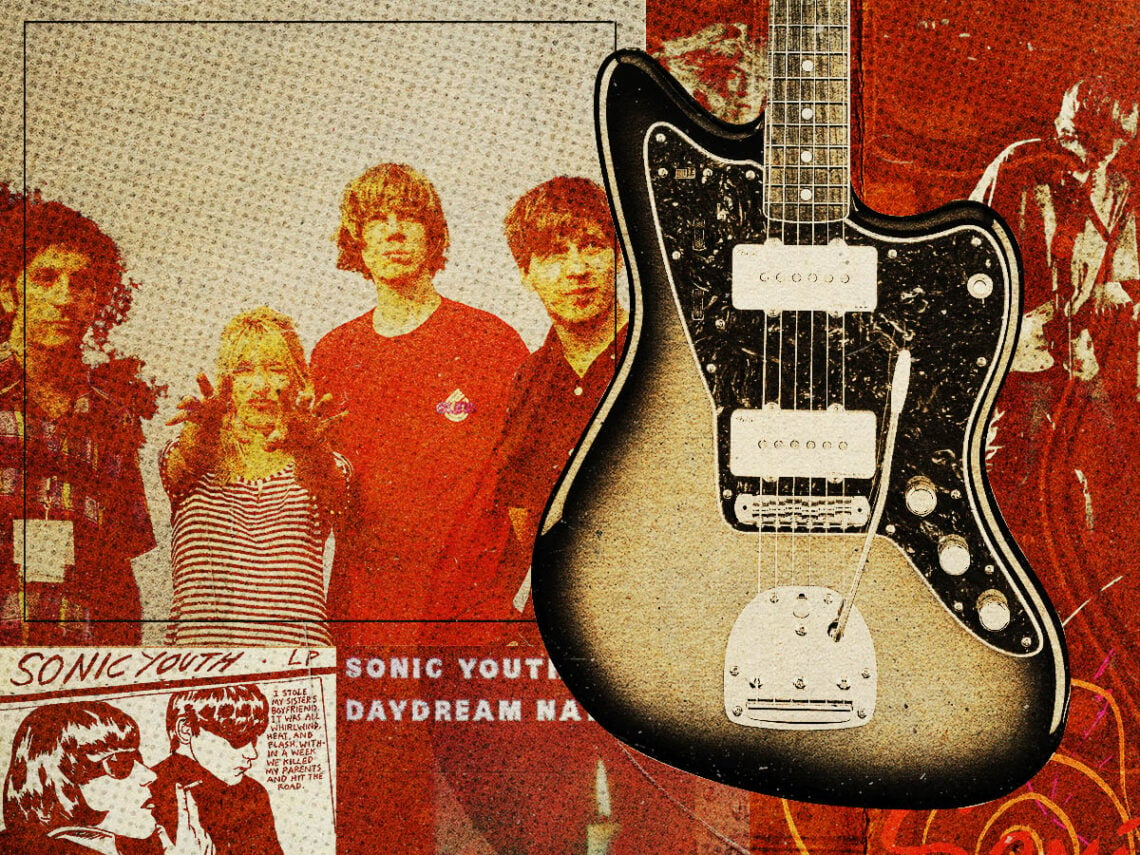
The story of Sonic Youth, the Fender Jazzmaster and alternative rock’s main weapon

Fender offset guitars have been a key weapon of alternative rock since it sprung up from the underground in the 1980s. Many prominent figures in the genre have used these models, with late Nirvana frontman Kurt Cobain undoubtedly the most prominent, using Jaguars, Mustangs and the iconic hybrid, the Jag-Stang. Whilst the likes of J Mascis of Dinosaur Jr and My Bloody Valentine leader Kevin Shields also had a tremendous impact on popularising the offset, most of its present ubiquity in rock can be traced to one band, Sonic Youth, and its twin guitarists, Thurston Moore and Lee Ranaldo.
Whilst we can’t leave Kim Gordon out of the picture, the Jazzmaster’s and its relatives’ dominance was largely down to her two bandmates. Through their blistering dovetailing performances, Moore and Ranaldo’s use of the Fender Jazzmaster would make the masses realise the brilliance and versatility of the American company’s other models outside the standard Stratocaster and Telecaster. It reflects how closely tied to the Jazzmaster that Moore and Ranaldo are that in 2009, Fender released their Signature models.
Moore’s is a green model complete with two Seymour Duncan Antiquity II Jazzmaster pickups and no tone knob, with Ranaldo’s a blue version in the style of his trusty ‘Jazzblaster’, a modded take on the instrument complete with a pair of Fender Wide Range humbucking pickups. Ranaldo’s model is also without a tone knob, with both finished in satin nitrocellulose lacquer, allowing the detailed grain of the alder body to be viewed in all its glory.
Ironically, Sonic Youth’s popularisation of the Jazzmaster and offsets did not occur through a concerted effort. The New York alternative rock pioneers first bought their Jazzmasters as they were cheap. Plus, one of their heroes, Tom Verlaine of Television – the first band to really spread the gospel of twin guitars – used one.
“The charity shop guitars were just falling apart,” Thurston Moore told Guitar in 2020. “Their shelf-life was limited, especially with the way we were treating them. As soon as we had a little coin, I remember going up to 48th Street in Manhattan, where Manny’s Music was and all these iconic stores. We were stepping it up a bit, but not too much. Lee pointed at a Jazzmaster and went, ‘That’s the kind of guitar [Television’s] Tom Verlaine uses.’ That was a selling point right there.”
He continued: “Nobody was playing Jazzmasters on the scene at that time. We got a couple for next to nothing. They were considered to be a country and western guitar, or some old fogey 50s jazz guitar. We began to modify them when we realised we were hitting these unnecessary switches. We were like, ‘Man, all we need is a toggle switch between the two pickups and a volume knob. We’ll keep the tone knob on its brightest end.’ That’s it. We started digging out all the electronics and soldering them back together again.”
Elsewhere, Lee Ranaldo told Fender of the Jazzmaster: “We liked it immediately because it was similar to the Jaguar, and then when we discovered that longer scale that it has, somehow we both immediately gravitated towards that”.
The band’s guitar tech, Nic Close, then recalled a discussion with Ranaldo during his interview for the job. “I said, ‘I know you guys are using a lot of Mustangs and Jazzmasters, and I know those things have a lot of crazy circuitry,'” Close explained. “Lee said, ‘Oh, no, we just rip all that out.’ I don’t know who the first person to rip the electronics out of a Jazzmaster for Sonic Youth was. When I walked in, it just seemed obvious. How could it be any other way? At least for Sonic Youth. I assume they ripped the stuff out themselves early on.”
Clearly, Sonic Youth’s innovation wasn’t confined to their alternative tunings and musical decisions. It also manifested in how they approached their guitars’ composition, with their approach to simplifying the electronics a tremendous step forward for themselves, other players and Fender. Significantly, in a move that is now common for most who buy new Fender Jazzmasters direct from the source, for Ranaldo’s guitars to improve functionality, they removed the wobbling Jazzmaster bridge and replaced it with a Mustang one, with a couple of winds of electrical tape around the male part, meaning it’s locked in.
“It was basically a matter of economics that we chose that guitar,” Moore explained in Guitar. “But the aspects of it were so intrinsic to what we were interested in. We were already noding guitars, and the fact that the Jazzmaster had all this real estate behind the bridge to work with was really good. That’s a whole other instrument right there – a real high register electric guitar string sound. I have a long reach so the Jazzmaster fits my body like no other guitar. There’s nothing else I feel as comfortable with.”
After Sonic Youth captured the imagination with albums such as 1986’s Evol, 1987’s Sister, and the following year’s masterpiece, Daydream Nation, the Fender Jazzmaster and other offsets would become the weapons of choice for the now flourishing alternative rock scene, with bands who had risen in their wake such as Nirvana, My Bloody Valentine, and Ride all utilising them. The relationship is so symbiotic that the likes of J Mascis, Kevin Shields and Swervedriver’s Adam Franklin continue to fly its flag, whilst some of the best of the new guard, such as Nick Cogan of Drug Church, exemplify why it is still such a perfect instrument for alternative rock.
