


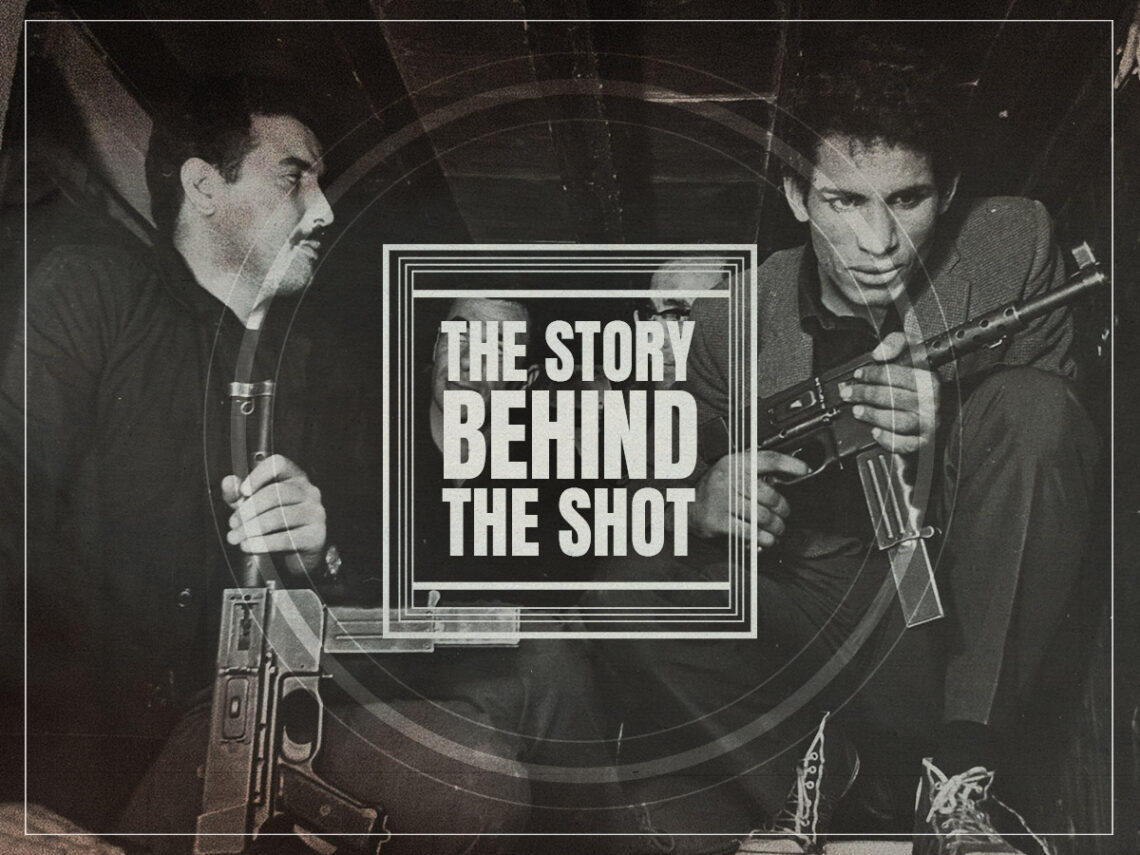
The Story Behind The Shot: The complexities of resistance in ‘The Battle of Algiers’

Nearly 60 years after its release, The Battle of Algiers remains one of the most important political films ever created. Tracing the struggle of the Algerian Front de Liberation National (FLN) against French colonial forces in the capital city of Algiers, it is a masterfully shot and carefully considered exploration of oppression, colonialism and the revolutionary violence it inspires. The film was originally intended to follow a singular European journalist, played by Paul Newman, as he figures out his inner turmoil at France’s colonial regime, sidelining the stories of the Algerian people.
However, director Gillo Pontecorvo and co-writer Franco Solinas took the advice of FLN representative Salah Baasi. They centred the struggles of the rebels more closely, knowing that every artistic decision was simultaneously a political decision and adjusted accordingly.
After travelling to Paris and Algiers to interview eyewitnesses and study, the filmmakers decided to shoot the entire film on location in a black-and-white newsreel style, emulating cinéma verité and marking it as an Italian neo-realist masterpiece. The newsreel effect was so convincing that American releases had to note that “Not one foot of newsreel was used”. The filmmakers also recruited non-professional actors from the city, including FLN chief Saadi Yucef as the lead character, El-Hadi Jafar. This not only created a more realistic portrayal of the revolution but also helped them forge solidarity with their fellow Algerian comrades.
Through a wobbling handheld camera and minutely orchestrated riots and atrocities, Pontecorvo captures the brutal reality of a colonial regime without glamorising the violence or demonising the native people. There is a symmetry to the attacks of both the regime and its detractors that a liberal audience might view as a balanced critique of the situation.
In one scene, the audience is made complicit in a violent revolutionary act that follows the bombing of Algerian civilians by French military and settler forces. The FLN enlists three Algerian women to plant bombs at various hangouts in the French Quarter. Shrugging off their native dress to adopt a stereotypical European look, they set off with time bombs in their Jane Birkin-esque basket bags.
However, where these women might have been presented as femme fatales or terrorists, instead, we are forced to witness the grim responsibility these women face. Through the use of handheld cameras, zoom shots and close-ups, we are forced to look through the eyes of the women. Where the film has refused to give agency to the French before, denying them close-ups and presenting them as distant and aloof, the French are suddenly in focus. It is the first time that they are given any particularity: a close-up of a toddler eating ice cream, a young couple waiting for a flight, and men and women of all ages laughing, eating and living.

The audience is implicated in the actions of the resistance, but the women in no way derive pleasure from the act. We can see the doubt and pain flicker across their faces as they avert their gaze from their fellow humans, who happen to be their oppressors. One woman has to bring her child part of the way with her. If they are held up, they forfeit their lives. It is not an easy task.
The camera forces us to look directly at the violence, at bodies among the rubble. We, too, carry the weight of the act, especially as we have been witness to the horrors enacted on the Algerian people and were, a scene prior, cheering for their victory. However, the filmmakers are still undoubtedly on the side of the resistance, refusing to compromise on the humanisation of the Algerian people. Thanks to the portrayal of the pain of these women and a refusal to look away from the brutalisation of colonised people, this act of resistance is presented as a painful necessity in the step towards freedom.
It is a shocking and, at times, difficult-to-watch scene that forces the audience not only to empathise with the French but also to question why this display of violence might be considered more shocking than the violence enacted on the Algerian people. Why might we, as an audience, find it easier to gaze upon the broken bodies of Algerian children carried from the rubble than the bodies of the French? Why is one normalised and the other shocking?
The rest of the film, through its unflinching newsreel style, makes it undeniable that the Algerian people deserve dignity. The entire film, even this scene, turns the dominant narratives of colonialism on their head, aligning the viewer with the oppressed instead of the coloniser. It is a film that points its neo-realist lens at the roots of the violence and the systems that are to blame.
In another scene, the head of the FLN, Ben M’Hadi addresses the brutality of the violent resistance. When asked if it was cowardly to use the women’s baskets to kill innocents, he responds, “Isn’t it even more cowardly to attack defenceless villages with napalm bombs that kill many thousand times more? Obviously, planes would make things easier for us. Give us your bombers, sir, and we will give you our baskets.”
Thus, the purpose of the basket bombing scene is made clear. Without colonialism, violent resistance wouldn’t exist. A message and film that is still just as powerful many decades later.
