


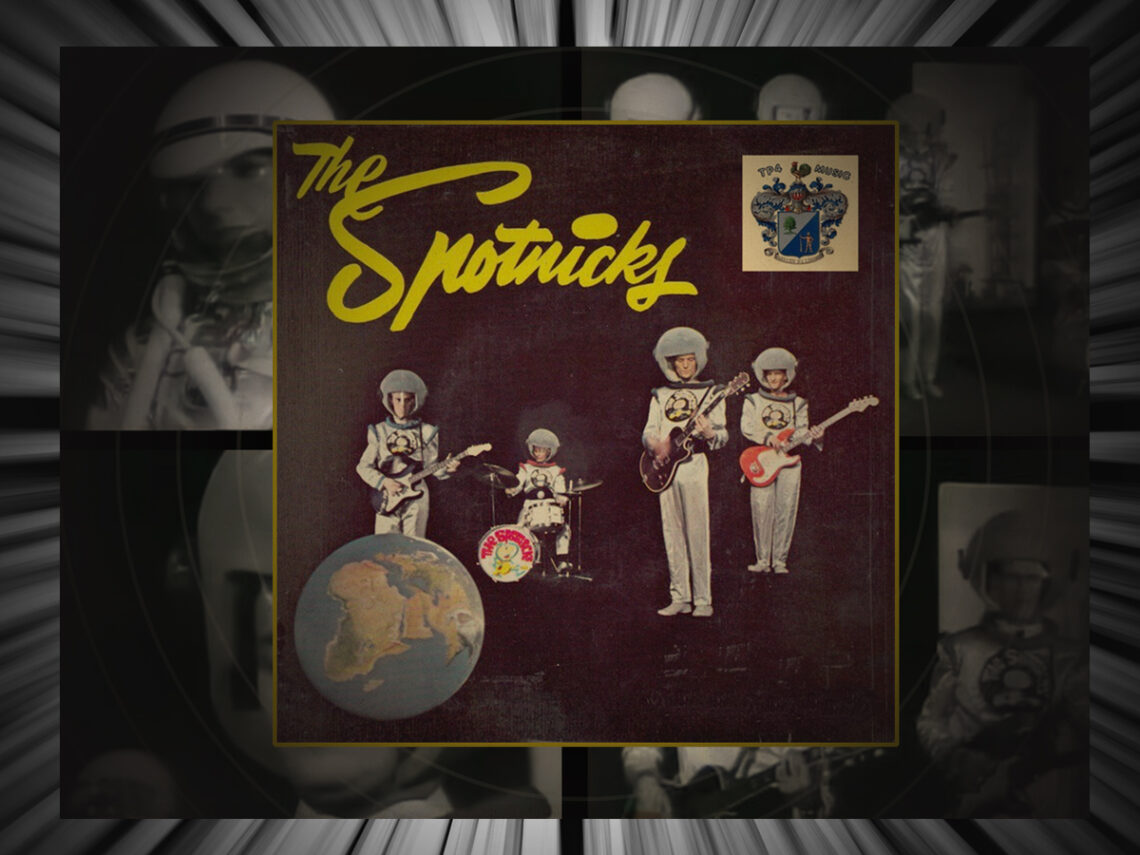
The Spotnicks and ‘The Rocket Man’ before ‘Rocket Man’

Part of the reason that the 1960s has such a hallowed place in culture comes from how, at the time, people were absolutely fascinated by the future.
That’s not to say that everyone had a unified idea of what that future would actually be like, far from it; however, as a generation born after World War II came of age, everything seemed to stir from its period of enforced stability. The 1950s had been almost entirely spent steadying the ship and rebuilding from the horrors of a decade earlier. The 1960s seemed, at least at the start, to be about building on that foundation to a brighter tomorrow.
The most captivating vision of this brighter tomorrow was arguably space. Now, the fascination with intergalactic travel was obviously a by-product of the Cold War, an international dick measuring contest the Yanks were holding with the Russians to see who was top dog on the world’s stage. Their quest to see who could reach the moon first had a knock-on effect in the early years of the decade, leading to a cultural fascination with the endless sea above.
Now, the obvious examples of these come from later in the decade when Neil Armstrong, Buzz Aldrin and Michael Collins actually went to the moon in 1969’s Apollo 11 mission. That’s when David Bowie released ‘Space Oddity’ and a few years later came Elton John’s classic ‘Rocket Man’. However, the early 1960s were also a goldmine for kitschy, space-themed novelty records, including one that nabbed Elton John’s title nearly ten years before Sir John got to it.
Who were The Spotnicks?
Ploughing much the same furrow as The Tornados were with their classic instrumental ‘Telstar’ were The Spotnicks. As if to prove just how (pun very much intended) universal this fascination with space was, the outfit was neither American nor Russian, but instead originated out of Gothenburg, Sweden. While the likes of The Tornados absolutely scored a hit by releasing a song that chimed with the times’ fascination with space, The Spotnicks (as you can probably tell by the name) based their entire existence around a charmingly kitsch, B-movie interpretation of space travel.
The band first formed in 1956 as The Rebels, a duo consisting of guitarist Bo Starander and bassist Björn Thelin, who would provide the foundation of the group for decades to come. The band started as a fairly standard 1950s rock ‘n’ roll outfit, changing their name to Rock-Teddy and the Blue Caps, then The Frazers. However, their big break came in 1961 when they secured a record deal. Their new management wanted a new look for the project, and the Russians had just sent up Sputnik 1. The Space Race was well and truly on, and needed bands to match apparently.
With a vowel change to keep any litigious commies at bay, the newly christened Spotnicks immediately became one of the biggest instrumental acts in Europe, rivalling the ever-beloved Shadows for sheer popularity. You’ve got to hand it to them, though; if The Shadows were Fred Astaire, The Spotnicks were Ginger Rogers. Except rather than backwards and in heels, Everything The Shadows did in suits, The Spotnicks did in space suits. Very impressive, I’m sure you’ll agree.
While not all their songs were inspired by the Space Race (their highest charting hit in the UK was a version of the holiday classic ‘Hava Nagila’), their biggest hit absolutely was. The band put together a version of the Soviet folk march ‘Polyushko-Polye’ and retitled it ‘The Rocket Man’ to huge success. They might have been somewhat overshadowed by Elton John giving one of his biggest hits basically the same name barely a decade later, but The Spotnicks kept on trucking in one form or another until 2019.
Say what you want about them, they had more longevity than the actual Space Race itself, and that’s got to count for something.
