


‘Out Among the Stars’: The sorry tale of Johnny Cash’s forgotten masterpiece

At the start of the 1970s, Johnny Cash was arguably the biggest name in country music and the most important artist working in the genre since Hank Williams Jr. By the start of the 1980s, though, his star had fallen, and Cash was seen as something of a relic from a bygone age.
The music industry had changed, and so had the kind of records that were selling. Disco was in, hair metal had exploded, and nothing short of total excess would do. There wasn’t as much room in the cultural landscape for someone who sounded so of the earth, so grounded and stripped back and bare anymore like there had been before.
Though his singles and albums were still making relatively respectable showings on the country charts through the end of the 1970s (though nothing like his previous success of the 1950s and ’60s), he wasn’t getting close to landing on the mainstream charts anymore and his popular television series, The Johnny Cash Show, had been axed as part of the “rural purge” of prime-time programming.
Coinciding with the changing markets, expectations from audiences and his own commercial decline, Cash had also returned to his self-destructive ways. The stories of his addictions and reliance on alcohol, amphetamines and barbiturates over the years are legendary.
In 1965, he accidentally started a California forest fire, which burned through several hundred acres and nearly killed him while under the influence of drugs. In the years that followed, he was picked up by police a few times on drug-related busts and suffered his fair share of concert cancellations when promoters and venues found out about his behaviour. Other accounts describing his erratic behaviour have him stopping a recording session mid-song because he felt compelled to paint his brown boots black, and crashing countless cars and trucks.
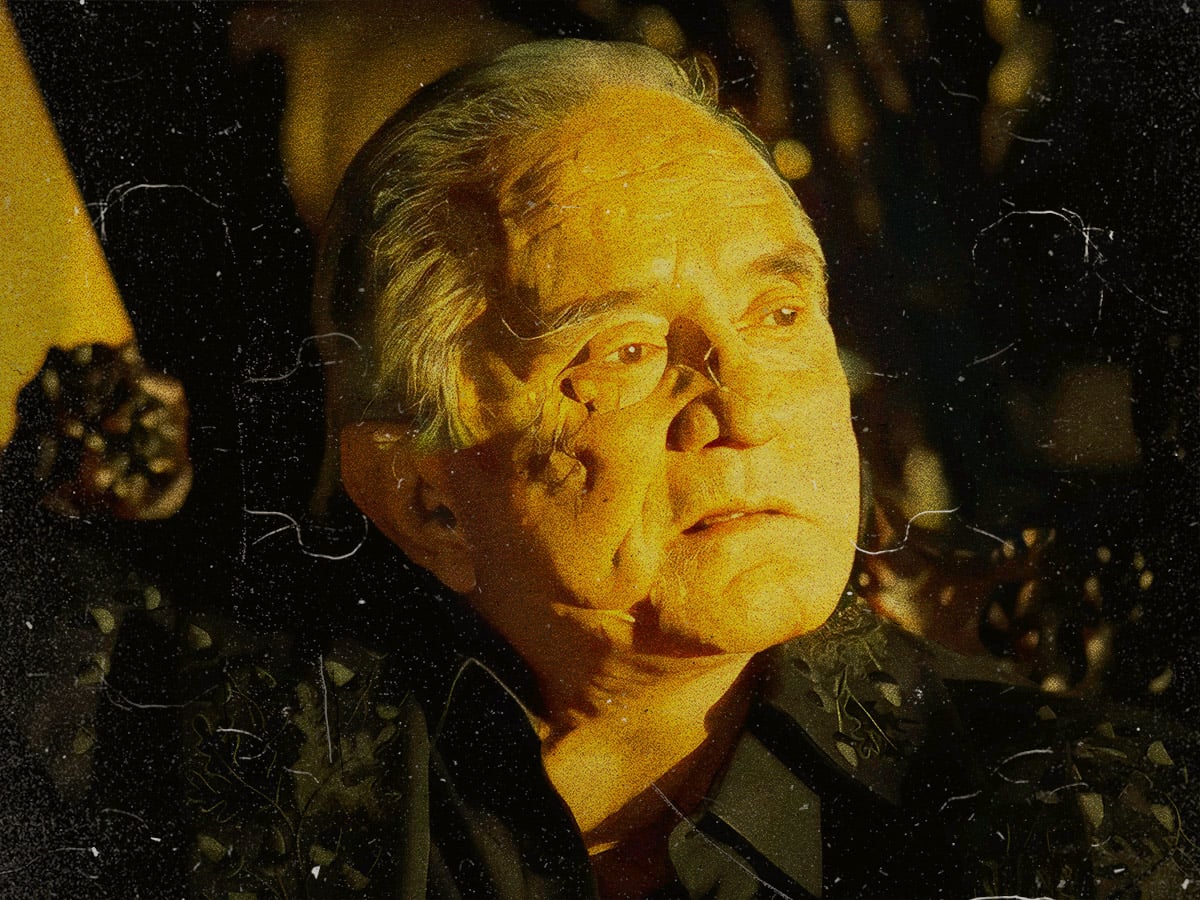
His label, Columbia Records, were more than willing to turn a blind eye to any manner of behaviour from Cash as long as his records were allowing them to print money, but when the hits stopped coming, so too did their support of one of their most important artists. When Cash delivered them an album to be titled Out Among the Stars in 1984, Columbia didn’t even bother to release it.
Cash was at a low ebb, personally and professionally. He had tentatively begun work on the album in 1981, but the sessions didn’t go far, and before long, he hit rock bottom and found himself in rehab. While his personal problems could previously be offset by professional success, by this time, he didn’t know where he fit into the contemporary country scene at all. The genre had fractured further, with half of the music being released following the wider 1980s trend of excess, excess, excess, growing out of the countrypolitan style and into the more pop-focussed “urban cowboy” movement, while the other half rebelled against all that in what was becoming known as “outlaw country”.
Cash, always an outlaw but one who had dominated the charts in his time, was torn between the two new country modes and in the end, ended up pleasing the fans of neither of them. The recording sessions for his Out Among the Stars displayed his difficulty in picking a side in this new world, as he worked with both countrypolitan super-producer Billy Sherrill and outlaw extraordinaire Waylon Jennings at the sessions, attempting to both bridge the gap and stay true to his own creative vision at the same time.
What resulted was his best album in years, maybe even his best record since At San Quentin, from way back in 1969.
The album has got everything that you’d really want from a Johnny Cash record. The titular opener, written by Adam Mitchell, hears Cash’s voice sounding as good as it ever did, with all of those wonderful, rich earthy tones and deep textures that make his voice so warming and moving on full display, and he sings a classic nuanced and contemplative Johnny Cash story of a downtrodden youth who has made some bad decisions and found himself in some even worse situations. It’s no wonder that Cash could relate to lyrics such as “how many travellers get weary bearing both their burdens and their scars? Don’t you think they’d love to start all over and fly like eagles out among the stars?”

Bob Dylan once said that “Johnny was and is the North Star; you could guide your ship by him”, so he always believed that Cash knew a little something about being out among the stars, and the way he sells this song, you couldn’t argue with it. Dylan has also written about his old friend that “Charlie Rich sang ‘Easy Money’, Eddie Money sang ‘Million Dollar Girl’, and Johnny Cash could sing anything”, and again, this recording acts as evidence for Dylan’s claim.
The second song on the lost album is another Cash classic: a frantic, fun and uproariously funny duet with his ever-loving wife, June Carter. ‘Baby Ride Easy’ might just as well be an update on their iconic ‘If I Were a Carpenter’ and has got all the warmth, humour, love, affection and playfulness of their earlier recordings.
‘She Used to Love Me a Lot’ is an absolutely gut-wrenching, harrowing and ultimately, wonderful, reading of the David Allan Coe (or was that Edgar Allen Poe?) song, with Cash’s voice selling all the heartbreak and pain in the lyrics while there is an excellent backdrop of building banjo lines, dobros and swells of steel guitar underneath him.
Not everything on the album works quite as well, but when he is on form, there is nobody better. One of the greatest examples of Cash quietly performing at his very best on the album comes towards the end of the record. ‘I Drove Her Out of My Mind’ is a darkly hilarious performance of a deeply disturbing song.
Written by Gary Gentry and Hillman Hall (brother of legendary country songwriter Tom T Hall), Cash sells every dual meaning and double entendre with devilish delight as he spins the story of a lover scorned and driven to mania, taking the life of his recent partner. Lines like “well now here she comes to greet me dressed to kill and so am I” are chillingly good, and even better when delivered by Cash. He saves the best for last, though, as he blissfully fantasises that “it’s gonna be just gorgeous” before a heavenly choir of gospel singers sees out the song.
Though the record might not have made as many waves as his earlier work had done, it is still an excellent collection of songs and performances from an artist who was one of the all-time greats, even at his supposed worst. Columbia Records thought otherwise, though, and instead of releasing the record, they released Cash from his contract not long after (this was right around the time Columbia refused to release Leonard Cohen’s Various Positions album, as well, which famously featured the modern standard ‘Hallelujah’ and other fantastic compositions).
When the album finally saw the light of day in 2014, it topped the country chart and went as high as number three on the contemporary album charts. By that time, though, Cash was already out among the stars himself, but the album proved that those of us who know him will always love Johnny Cash a lot.
