


“The hippy national anthem,” according to Hunter S Thompson

“Music has always been a matter of Energy to me,” Hunter S Thompson once wrote.
The iconic writer saw the channelling of sound into expression as one of humanity’s purest forms of communication. He continued: “A question of Fuel. Sentimental people call it Inspiration, but what they really mean is Fuel. I have always needed Fuel. I am a serious consumer. On some nights, I still believe that a car with the gas needle on empty can run about fifty more miles if you have the right music very loud on the radio.”
As the engine of progress that was the counterculture revolution roared against the loggerhead of stilted conservatism, the fuel in a more collective sense was also music. As he also wrote: “It seems like a lifetime, or at least a Main Era — the kind of peak that never comes again. San Francisco in the mid-1960s was a very special time and place to be a part of. Maybe it meant something. Maybe not, in the long run… but no explanation, no mix of words or music or memories can touch that sense of knowing that you were there and alive in that corner of time and the world. Whatever it meant…”
While that decreed his feeling of jaded apathy when the prelapsarian dream of the summer of love stepped one toke over the line, in retrospect, the music of the era can come close to summoning a snippet of that honking eudaimonia. When we look back on history, it is often the culture that defines our view.
In the 1990s, Britain, the entire shape of the landscape fell by the wayside like a colossal earthquake, thanks to financial changes and social decrees, but what do we remember? Oasia and Blur. There is no greater economic boom than the 1950s and America’s surge into the stratosphere of world domination via commerce. The overriding memory we have as a society, however, is Elvis Presley shaking his hips. A hell of a lot happened in America in the 1960s, but a lot of that is subsumed by a notion of peace, love, bad bandanas and the sound of ‘White Rabbit’ rallying against the hardship.
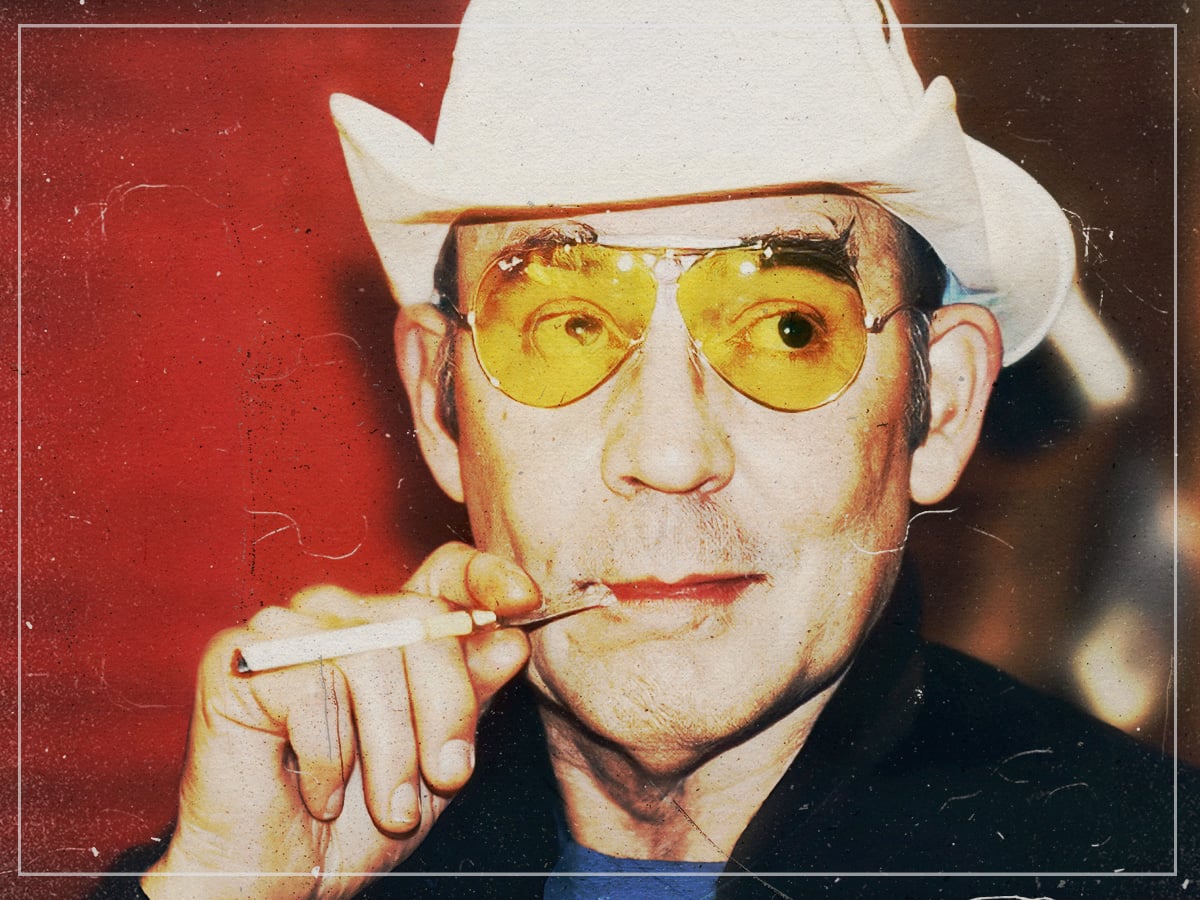
Amongst it was one song that embodied clinging to the good times. It came from Hunter S Thompson’s favourite musician, Bob Dylan. In a published letter to a friend, he heaps praise on the original vagabond, proclaiming: “Dylan is a goddamn phenomenon, pure gold, and mean as a snake”. As for the song, well, as the dedication on Fear and Loathing in Las Vegas states: “to Bob Dylan, for Mister Tambourine Man“. Beyond that honour, he even went on to liken his opus to the song itself.
When Jann Wenner was grappling with the wayward ‘gonzo’ documents being flung his way by Thompson while he was editing Rolling Stone, with the beleaguered editor later surmising that Hunter “needed a lot of hand-holding”, Thompson rallied, “The central problem here is that you’re working overtime to treat this thing as Straight or at least Responsible journalism … You’d be better off trying to make objective, chronological sense of … ‘Mister Tambourine Man’.”
So, what is ‘Mr Tambourine Man’ all about? For my money, it’s about juicing life down to the pith. Those evenings when you stay out to watch the sunrise. The rare nights that happen in your youth where energy and jubilation seem to stick to you like the wrapper to a warm toffee, and when the rising finally casts a shade of weariness, you wander to some sofa to the tune of ‘Daylight come and me want to go home’.
The track is more accurately seen as a moment of reflection of writing itself. Built out of moving imagery and non-contextual vignettes, the track does carry similar nuances to the actual feeling of being a little spaced out, but that’s the exact same effect as the best poetry has too.
In the backdrop of the horrors of the 1960s – the imminent dreaded Vietnam War draft – it is easy to see how this could’ve taken hold on less of a personal level. As he documents in Fear and Loathing in America: “This, to me, is the Hippy National Anthem,” he writes about Dylan’s anthem. “To anyone who was part of that (post-beat) scene before the word ‘hippy’ became a national publicity landmark (in 1966 and 1967), ‘Mr. Tambourine Man’ is both an epitaph and a swan song for the lifestyle and the instincts that led, eventually, to the hugely-advertised ‘hippy phenomenon‘”.
Thus, when the separatist nation of hippiedom arrived in earnest, Dylan’s 1965 anthem was already in place. And soon, he’d be the mean snake also pointing his finger at its fickle ways and going his own way. Much of Thompson’s work also reconciles the ways of the world and surmises that there is nothing so strange as folk. Which is why, when he passed and his mortal remains were blasted from a cannon, he wanted the party to roll on under magic swirling ships for a little bit longer to the tune of ‘Mr Tambourine Man’.

Never Miss A Tale
The Far Out Bob Dylan Newsletter
All the latest stories about Bob Dylan from the independent voice of culture.
Straight to your inbox.