


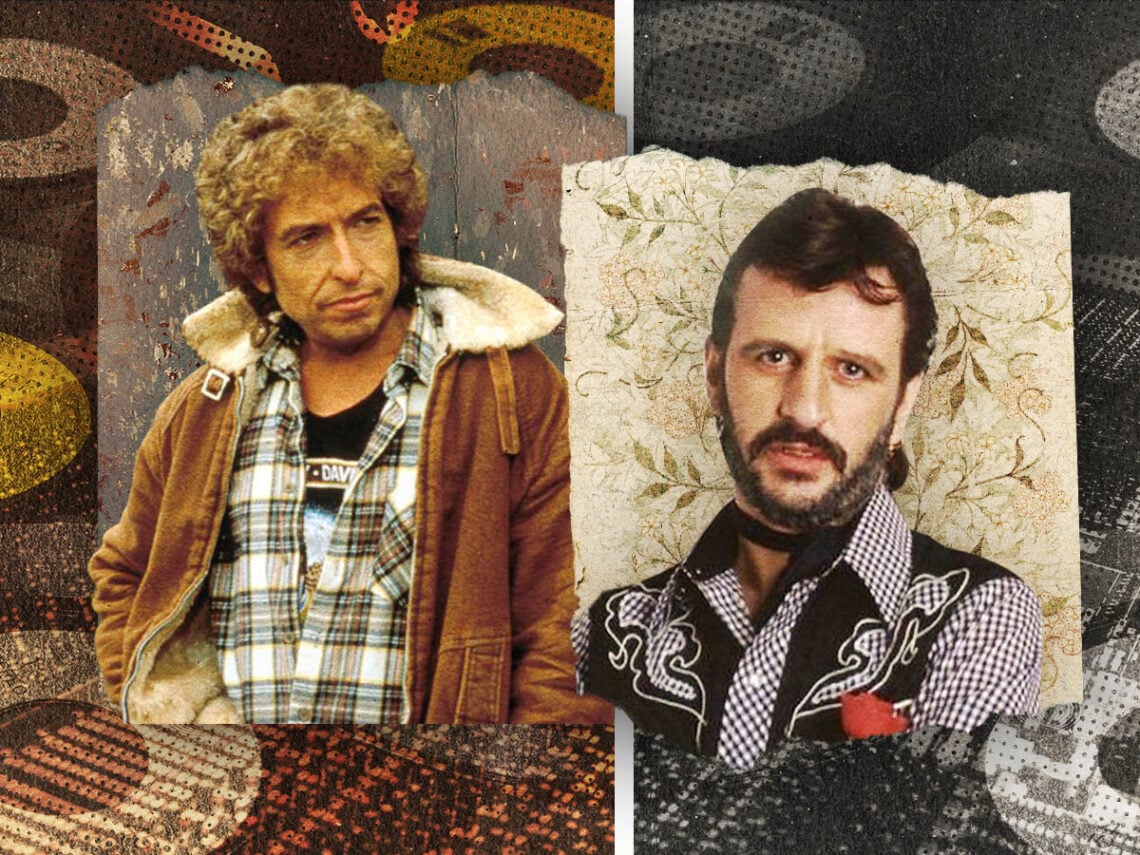
The song Bob Dylan wrote for Ringo Starr

In the 1960s, Bob Dylan was writing so many classic songs that he was literally losing them around the house in the same idle way that a single glove always goes missing. Joan Baez found ‘Love Is Just a Four Letter Word’ down the back of his piano, and when he came into the room to hear her playing it, and he remarked on how lovely her new song was, she had to exclaim, “You wrote it you dope!”
Baez was far from the only benefactor, too. He gave away tracks to The Byrds, Ronnie Wood, Nico and even Elvis Presley. In fact, the original vagabond was so utterly prolific during that era, and in an array of different styles, that a rumour was soon spawned that he sold his soul to the devil. This is a rumour he has gleefully tapped into ever since with a wry smile, quipping that he’s still touring and making because he’s holding up his end of the bargain.
However, even if you take glibness aside, offering up a song to The Beatles, of all people, is surely inhuman. Alas, it seems Dylan truly didn’t, and never even cared to mention it. In fact, Dylan strangely didn’t mention them much at all despite striking up a friendship with them over a joint as he famously introduced them to weed on August 28th, 1964, at New York’s Delmonico hotel. It was a meeting akin to something from Greek mythology, and the fateful offering of marijuana from Dylan to The Beatles is now ascribed in history as a moment that coloured the Fab Four’s back catalogue with a kaleidoscopic hue. And, indeed, the whole era of psychedelia that followed thereafter.
Paul McCartney once said: “I could feel myself climbing a spiral walkway as I was talking to Dylan. I felt like I was figuring it all out, the meaning of life.” Dylan may have been more laconic with his praise of the Fab Four, thus propagating the notion of a one-way relationship, but he has on occasion let his stiff upper lip loosen to eulogise his contemporaries and acknowledged their influence on him. “I just kept it to myself that I really dug them,” Dylan told biographer Anthony Scaduto.
The fact he was happy to offer them a song is even more proof. In the background of the Let It Be sessions, you can hear Dylan’s best friend in The Beatles, George Harrison, mutter, “Here’s one Dylan wrote for Ringo” before strumming out ‘Maureen’, a track named after Ringo’s wife. In 1968, he had been writing alongside Harrison and offered him ‘I’d Have You Anytime’ and ‘Nowhere To Go’ so it is likely that this completed the trilogy.
However, none of this can be corroborated beyond the various utterances from Harrison in the session recordings, and it is indeed possible that Harrison simply didn’t want to say, ‘This is one I wrote about your wife Ringo mate, because at this stage I am, in fact, already having an affair with her’. Countering this is the distinctly Dylan-esque vibe to the song with its off-kilter rhythm. In the same sessions, Harrison shared a few confirmed Dylan rarities with the band: ‘Please Mrs Henry’ and ‘Get Your Rocks Off’.
Perhaps the most indicative factor of all about this tale is what it says about Dylan’s relationship with Harrison. “George got stuck with being the Beatle that had to fight to get songs on records because of Lennon and McCartney,“ Dylan once proclaimed in an interview with Rolling Stone. “Well, who wouldn’t get stuck? If George had had his own group and was writing his own songs back then, he’d have been probably just as big as anybody.” And it is evidenced from their collaborations that the pair shared a musical and spiritual bond, with a master passing songs to his songwriting apprentice and the apprentice trading guitar-playing tips in return.
As Dylan also said: “George had an uncanny ability to just play chords that didn’t seem to be connected in any kind of way and come up with a melody and a song. I don’t know anybody else who could do that, either. What can I tell you? He was from that old line of playing where every note was a note to be counted.”
As for ‘Maureen’, the song remains a mysterious relic from a period akin to a modern pop culture renaissance where ideas were flowing so freely in artistic revolt that sharing songs, stealing songs, and songs slipping into obscurity as a symptom of prolificness was commonplace, especially among the two titans of the time.

Never Miss A Beat
The Far Out Beatles Newsletter
All the latest stories about The Beatles from the independent voice of culture.
Straight to your inbox.