


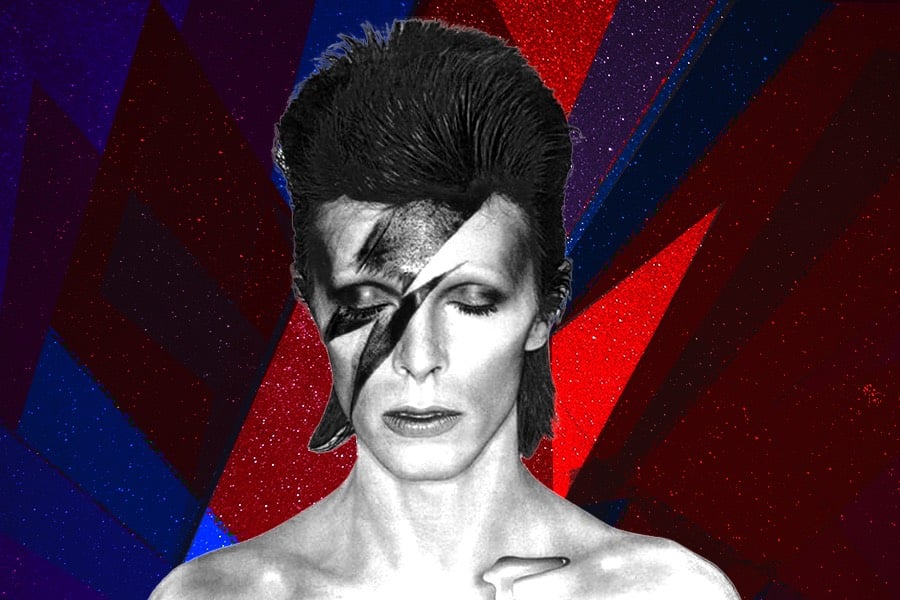
Becoming a star: The six most pivotal moments in David Bowie’s life

David Bowie made a lot of quips in his life, but perhaps the most inciteful was when he proclaimed, “If it’s wearing a pink hat and a red nose and it plays the guitar upside down, I’ll go and look at it. I love to see people being dangerous.” He was an endless slew of superlatives, but the area where he excelled way beyond any of his peers is just how dangerously daring he was as an artist. When the world zigged, Ziggy zagged. He flashed a lightning bolt through mainstream culture, blazing a revolutionary trail that remains a beacon for us all to aspire towards in our individualistic way.
Even that lightning bolt defied convention. It was stalling and wavering. Bowie failed to succeed in every sense. Then, when the pinnacle of fame arrived, he reclined away from the spotlight, proving that you can’t second-guess the master of misdirection and reinvention. Perhaps it was his led balloon start that made him so carefree when it came to the reception of his artistry—when you’ve penned masterpieces that have afforded you the measly liberty of putting the heating on in your bedsit for an hour then your capacity to court failure in search of artistic conquest is surely heightened.
Bowie stayed true to this throughout his life, eventually reaching an unrivalled spot in pop culture. That spot is a summit he can call his own. He is an outsider artist at the centre of society, an oddball accepted by everyone, and an adored flawed fellow embraced with more sentiment by his fans than just about any other artist in history. He said he “felt very, very puny as a human” and he thankfully achieved something more than that.
Everything seemed to be out of the electric blue in the life of the world’s best-known enigma, but each moment of diegesis had a distinct impact on the next somewhere in the obfuscated domino tumble of his life. Below, we have charted these moments. From his humble rise to his recoil, these are the moments that make up David Bowie.
The six most pivotal moments in David Bowie’s life:
When Terry Burns went to National Service…
David Bowie’s elusive half-brother, Terry Burns, was the epitome of cool in his impressionable eyes. When he moved to Bromley, a place that Bowie said was devoid of culture, Burns showed him that there was a bohemian world beyond the suburbs. He introduced the fledgling oddball to modern jazz, Buddhism, the Beat prose of William S. Burroughs and Jack Kerouac, and even the occult. The exposure to these elements was nothing short of transformative for the young star in waiting.
Bowie acknowledged Terry’s influence, saying that from him, he got “the greatest serviceable education that I could have had. He just introduced me to the outside things,” he said. “I saw the magic, and I caught the enthusiasm for it because of his enthusiasm for it. And I kinda wanted to be like him.” Even the fact that he would come and go was a symbol for the wavering lifestyle of a 1960s counterculture kid—a link to a generation determined to undertake things in a different fashion to their stilted forebearers still reeling from the stiff-upper-lip shackles of the war.
However, when his brother returned brother returned from National Service with the RAF, a darker allure drew Bowie towards him. By this stage, the evidence of Burns’ schizophrenia was readily apparent. With this Bowie became aware of the duality of man—the notion that a person can also be someone else. A tragic lesson in the illusory intangibility of persona was afoot. Bowie’s perverse attraction to edging towards the transitory wormhole of a mask began. Perhaps that’s why his subsequent characters proved so evanescent; he didn’t want to flirt with their darkness for too long.

A defining punch on the playground…
If Bowie was curious about duality from an early age, then this would soon manifest in the most literal sense. “When you’re young, you’re still ‘becoming’,” Bowie once said, “Now I am more concerned with ‘being’.” While the Starman was still very much in the embryonic phases of ‘becoming’, a pivotal creative moment would be thrust upon him. As Bowie explains: “When I was about 12/13 years old, I had a fight. I was hit in the eye and it’s one of the muscles at the back of the eye that always holds the pupil open.”
Bowie was always determined to be different and having two different looking eyes made him inherently so. He was forced to embrace the pariah status of individuality from an early age, and he propagated it ever since. As George Underwood, the punching culprit behind the creative messiah’s inception, once revealed, “[Bowie] said to me later, I did him a favour [with the punch] it gave him that enigmatic look… ‘people always talk about the eyes’ he said.”
This was his first phase of reinvention. Thereafter, there would be so many that he once joked, “I reinvented my image so many times that I’m in denial that I was originally an overweight Korean woman.” The chameleonic and kaleidoscopic reinventions that Bowie swirled through like an alchemist of identity were a calling card for his otherworldly artistic talent. They were not just character studies or quirky conduits for creativity; they redefined what was possible in rock music. Bowie happened upon the powers of reinvention at an early age and quite by chance.

A damning review by the BBC…
In the beginning, Bowie wanted more than anything to be an architect of change in some way and everything else was secondary. He merely wanted to be an influential figure. He once stated: “I suppose for me as an artist it wasn’t always just about expressing my work; I really wanted, more than anything else, to contribute in some way to the culture I was living in.” Whether through music, his understandably short-lived multimedia mime act or some other means. However, he would learn quite early that a conventional rock ‘n’ roll channel might not be for him.
When a little-known local London act called David Bowie and the Lower Third auditioned for a BBC Talent Scout, the notes they received were hardly glowing. “The singer is devoid of any personality,” one statement remarked. A slew of other observations on the audition report call for a frontal lobotomy on the mind of the reviewer who wrote it. Whilst there is no doubt that refinement and depth were probably required, David being only 18 at the time, the reviewer took this into account and still wasn’t even willing to afford them the liberty of time, stating “I don’t think the group will get better with more rehearsal.”
The legacy of this letter is not only to exist as an artefact proving the author Kurt Vonnegut’s quote, “It is too easy to make perfectly horrible mistakes”, but also to show the worth of criticism and rejection. No matter what it is that you’re pursuing, some people will just fail to see it, but if you persevere with sincerity, then your Ziggy moment may well arrive. It would seem that Bowie learnt at the BBC that if you’re going to fail, then you may as well do it on your own original terms. He scrapped the ‘new Mick Jagger’ act shortly after.

Glastonbury 1971…
You can only fail for so long before you either quit or succeed. The tales of Bowie’s performance at the 1971 incarnation of the Glastonbury Festival are enshrined in a mist of retrospective myth. As the legend goes, the little-known, jaded extra-terrestrial protégée took to the stage at 5 am as the full furore of night acquiesced to the beckoning wink of tents, chirping birds orchestrated the new dawns precession, and butterflies pulled the sun up amid the sanguine beginning of new blue daybreak on June 23rd.
In 1971 Bowie was as he always remained, a sui generis force of freakishly creative intent but when he arrived on stage he was sheepish and weary following The Man Who Sold the World’s failure to chart on either side of the pond. But as fate would have it, Glasto was his golden turning point. Dana Gillespie recalled watching the myth unfurl before her awestruck eyes, “People were waking up in their sleeping bags having been frozen all night in the mud. It was quite extraordinary. He didn’t have a full audience in attendance, but the ones he did have, he completely won over.”
Before reappearing for a triumph encore, he announced to the enraptured crowd, “I’ll try and be serious for a second… I just want to say that you’ve given me more pleasure than I’ve had in a good few months of working, and I don’t do gigs anymore because I got so pissed off with working and dying a death every time I worked, and it’s really nice to have somebody appreciate me for a change.” Rather than hanging up his jaunty hat, he was invigorated to reach new heights, weirder heights than the world had ever seen before.

The iconic Top of the Pops performance…
You don’t get many chances to make a first impression. Bowie seemed determined to ensure he grabbed Ziggy’s chance by the lapels and shake it like a Skoda going at 30 over a cattlegrid. In many ways, he embodied the bohemian revolution of Terry Burns in this moment. After all, there is a moment in everyone’s childhood when the floor is just about pulled out from under them, and the dangerous precipice of the future presents itself. Often music is the cultural slap across the chops which coaxes this presentiment to the fore. David Bowie appearing on Top of the Pops already represented a weird allure — inducing something between a mildly perturbing mass meshuga and the dangerous come-hither attraction of some street side fisty-cuffs.
Who was this creation and what kind of monster bore it? That was the question that accompanied the first part of his appeal. And then it happened—with one lanky finger, he unzipped the TV screen and welcomed a million bewildered eyes into his new bohemian oeuvre. From that moment on, the world wouldn’t just change for a couple of thousand enamoured youngsters, but for all of us, and the reverberating ripples are still shaping things to this day.
The beauty of the ‘Starman’ melody is almost lost amid the commotion that it caused that night. It was quite simply pop perfection, but pop perfection had already been done by 1972. There was something different about this pristine example. There was something more to it. And whether you were swept up by his pointed bony wand – that spoke to a nation of youths looking for their hero after the counterculture Gods of old fell away – or your screen was angled in the wrong direction, it was undoubted that something had just happened. Finally, David Bowie had fans.

Killing an icon…
We began by saying that the apex of Bowie’s power was his audacious daring and in 1973 he was about to set that asset in stone. Imagine, if you will, struggling to make any creative impact at all for roughly half a decade then finally finding an acclaimed outlet in Ziggy Stardust, only to kill off your grand creation and head back to the drawing board just as your garden was beginning to flower?
While fools who don’t care for ‘The Starman’ might call his chameleonic approach facile or insincere, I would argue that his kaleidoscopic rotation implies the very opposite. He loved art too dearly to ever be cajoled into a single lane by success or veneration—he was always determined to explore the far reaches of pop culture and see what he could dredge up.
He wanted to find a new way to interact with society and his dazzling attack on mundanity proved world-changing. Despite that, Bowie still had his stiff-upper-lipped detractors, and when asked about whether there came a point that his music wasn’t taken seriously, he responded: “I think I moved out of Ziggy fast enough so as not to be caught by that one, because most rock characters that one can create only have a short lifespan. They are one-shots, they are cartoony, and the Ziggy thing was worth about one or two albums before I couldn’t really write anything else around him or the world that was sort of put together for him.” Now, he would open up a new world, new realms to explore, and he dragged up along with him.

