


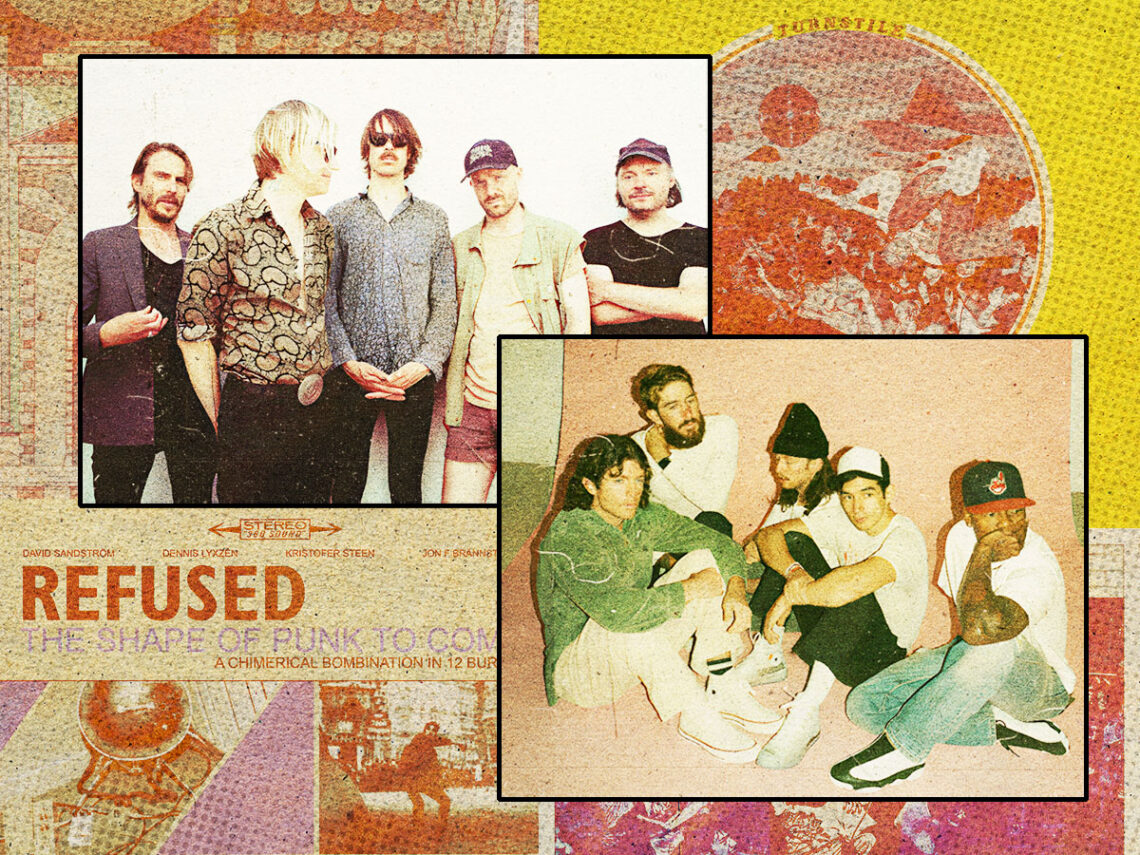
The shape of punk to come: did Refused pave the way for Turnstile?

Hardcore punk is having a moment. There are many signifiers of this, with prominent bands stretching their creative scope and festivals deemed cornerstones of the subculture also encompassing a much broader range than they once did. All in all, a scene once criticised by some adherents for being too insular is now looking outwards. While the gatekeepers have criticised this metamorphosis, broadly speaking, it’s spread the gospel of the genre, which can only be helpful in an era where the boundaries of genre are more blurred than ever. One band that has been at the forefront of this is Turnstile. Although many will hate it, there’s an argument that Refused paved the way for what they would later achieve.
Formed in 2010 in Baltimore, Maryland, at this point in time, Turnstile are veterans. They released their debut EP, Pressure to Succeed, in 2011 and their revered second EP, Step 2 Rhythm, in 2013. The latter remains one of their finest releases, featuring cuts such as ‘Canned Heat’ and ‘Pushing Me Away’. Fusing alternative metal with New York hardcore and a smattering of poppier melodies, the band crystallised their early formula on this body of work, with ‘Pushing Me Away’ remaining one of their heaviest grooves.
Cultivating an eminent status on the hardcore circuit, in January 2015, Turnstile released their debut album, Nonstop Feeling. In support of the record, they toured both the East and West Coasts of the US with Superheaven on the ‘Nonstop Feeling Tour’. This period also saw them support New Found Glory in the Spring, with guitarist Sean Coo stepping down and Pat McCrory of fellow Baltimore hardcore outfit Angel Du$t entering the fold.
Continuing to refine their craft, in February 2018, the group released their second album, Time & Space, their first on a major label, the famous home of rock and metal, Roadrunner. It was produced by the Grammy-nominated Will Yip, who worked on various influential hardcore records, including Title Fight’s three albums, Code Orange’s Forever and Turnstile’s 2016 EP, Move Thru Me. This opus saw the group push their boundaries even further. Of course, the hardcore was still there, as were the alternative metal twists, with the Life of Agony-evoking classic ‘Can’t Get Away’ and other staples, such as the frenzied ‘Big Smile’, a reflection of this.
Much more was going now on, though. There’s the loungey interlude after opener ‘Real Thing’, bassist Franz Lyons’ increasingly pop-inflected vocal melodies, the stoned electronica at the start of ‘Bomb’ and the exotic, jazz-leanings of the instrumental ‘Disco’. A total success, this saw Turnstile branch out of hardcore in a more tangible way than ever before and tap deeper into the other areas they’d always teased. Putting this into context, in the interlude of ‘Bomb’, former Lauryn Hill backing singer Tanikka Charraé provides vocals.
A huge success, the band embarked on a US tour of the album supported by emo legends Touché Amoré, the now-defunct Californian punks Culture Abuse, and Razorbumps, indicating their increased status. The record, and Turnstile’s rising prominence, set the scene for the third album, 2021’s Glow On. This crossover hit saw them expand their reach even further, breaking into an area many original fans would assert is so far away from their early material that it’s no longer hardcore.
Again, the melodic hardcore and alternative metal of Turnstile’s early years remain. However, Glow On is a largely genre-bending offering, touching on alt-pop, grunge, indie, R&B, soul, and even samba on ‘Don’t Play’. A stellar reflection of the postmodern spirit of transcending labels, whilst it is technically a hardcore or, perhaps better even, a ‘rock’ album, it’s much more than these one-dimensional tags. It embodies the contemporary mode of fusing disparate genres to create a sonic palette that’s still unique to themselves but has a broader cultural pull than their earlier records. In short, the band are closer to being themselves than ever.
It sums it up that the single, ‘Alien Love Call’ is an alternative pop masterwork featuring Blood Orange, who also appears on ‘Lonely Dezires’. This collaboration would have been largely unthinkable around the time of Step 2 Rhythm, irrespective of the British musician’s – real name Dev Hynes – previous projects in the world of rock and indie. Glow On was so successful that it even earned Turnstile three Grammy nominations at the 2023 awards, demonstrating just how far they’ve come from the hardcore underground of Baltimore. There, they, and by association, hardcore, quite literally entered the home of Western popular music.
So what is the point of addressing Turnstile’s arc? Whilst it may not be the most agreeable assertion for purists, it’s interesting to suggest that Refused’s cult 1998 album, The Shape of Punk to Come, went someway in signalling the direction that hardcore would take some 20 years later. Whilst most fans know the song ‘New Noise’, there’s much more to the album than frontman Dennis Lyxzén’s opening yelp, “Can I scream?”
Drawing on jazz, techno, ambient, blues, classical, and other forms, the record challenged established punk sensibilities, criticising hardcore and other punk sounds that claimed to be anti-establishment whilst being increasingly co-opted by the mainstream. They offered an entirely new sonic challenge to tradition through cherrypicking. Sound familiar?
As part of the boundary-pushing, the band included nods to Allen Ginsberg, Charlie Parker, Igor Stravinsky, Ornette Coleman, and Apocalypse Now. As well as these and references to a pair of other influential punk bands, Born Against and Rye Coalition, Refused increased the intensity of their political leanings – a key signifier of all their efforts – creating a body of work that had more pulp than most of what was released during this era, whether it be from the hardcore scene or more general popular music.
Although The Shape of Punk to Come is now hailed as a majorly influential album impacting artists from a range of genres, not just hardcore, ironically, Refused imploded only months after its release. However, the gravity of their break-up would set the scene for the iconic status of the music.
In an infamous twist, in 1998, the band were four songs into a basement show in Harrisonburg, Virginia, when the police shut it down. This exacerbated the cracks and became their final show until they reunited in 2012. Before this, they had completed only eight half-empty shows in coffeehouses and basements, an experience the band would later describe as “emotionally devastating” and “an awful experience”. This led to a visceral internal fight in Atlanta, Georgia, which prompted the band to break up.
At the time of release, The Shape of Punk to Come was a complete failure, but as the story of Refused’s last show spread, it began to ship tens of thousands of units, capturing the imagination and gradually gaining the seminal status it holds today. Since then, everyone from Linkin Park to Steve Aoki has cited its impact and a certain Touché Amoré, providing an implicit musical link to Turnstile.
Whilst musically, The Shape of Punk to Come and Glow On are distinct, particularly regarding the heavily political angle of the former, spiritual similarities exist. Genre-defying musical medleys both show the power that can be unlocked when stepping out of a defined comfort zone and challenging what common perceptions of the genre can be. The Shape of Punk to Come could not have had a more fitting title; I wonder if what the world is now seeing with Turnstile is anything like what Refused had in mind when conceiving their masterpiece 26 years ago.
