


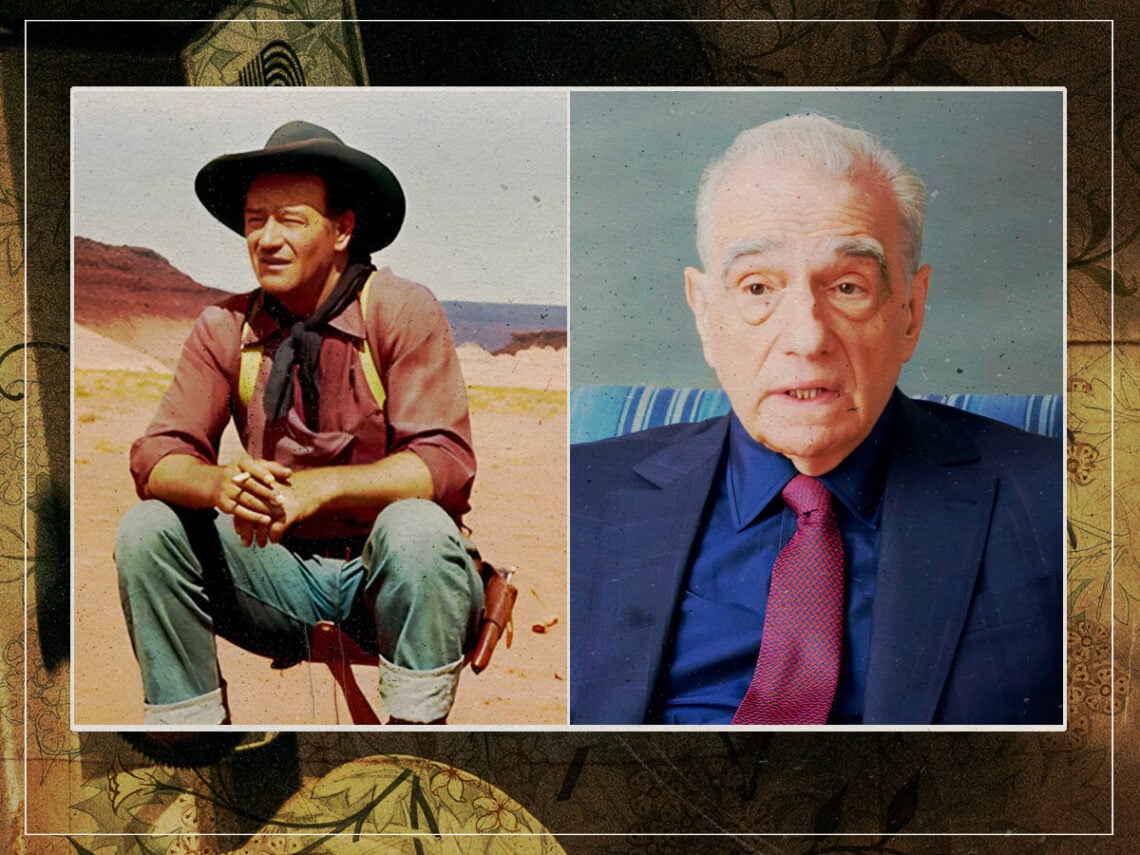
The John Wayne “masterpiece” Martin Scorsese called the ultimate depiction of American racism

There is nothing better for nationalism than winning a just war. The boon of pride and jubilation that followed the horrors of World War II were more potent cultural forces rising from the rubble than sober reconciliation. Somehow, pride blossomed in the wake of humanity’s lowest trough. These virtuous tenets also pervaded a happy and wholesome era of cinema where the baddies got killed, the boy got the girl, and everyone lived happily ever after. This conservative narrative masked many of the social problems hidden in the underbelly of society. Hollywood’s spotlight didn’t dare to shine into the darkness. And then came The Searchers.
The movie is widely considered a masterpiece among cinephile circles, of which Martin Scorsese is the nerdy king. In fact, he even puts it in his ten greatest films of all-time list, yet he also asks, “What about average movie watchers? Is it as well-known as It’s a Wonderful Life or Casablanca or Breakfast at Tiffany’s? What place does John Ford’s masterpiece occupy in our national consciousness?” While Scorsese poses these questions rhetorically, the resounding answer is ‘no, it is not as well known’, and for the most part, ‘the national consciousness has avoided it’.
The Searchers proved an uncomfortable watch upon release, as it still does now. It was young kids like Scorsese – who first saw it in the cinema when he was 12 or 13 – with a penchant for the perturbing feeling that challenging art can often bring, who would first praise director John Ford’s creation. 13 years earlier the leading Hollywood frontman had been Humphrey Bogart. When he starred in Casablanca, he was 43. In the feature, he was portrayed as a young, honourable man. This was standard fare for Hollywood in that era.
Society was stern, kids were being shipped off to slaughter in their droves in wars beyond reconciliation, and there was very little cause for playfulness. Men in smart suits with furrowed brows and well-dressed women with their wits about them were almost a comforting reflection of the backbone of society for the beleaguered masses in need of some gentle entertainment.
Now, Ford evidently thought that the days of gentle entertainment as a vital necessity seemed to be bygone. Post-war nationalism seemed to have shackled the country in the conservative past and liberation was required—questions needed to be answered. “We had grown-up on Ford Apache, She Wore a Yellow Ribbon, Rio Grande, and kindly John Wayne characters. But here it was 1956, the repression of the ‘50s and things were changing,” Scorsese told the AFI.

“The movie business was changing, and what you could say in a movie too. You had Stanley Kramer making certain kinds of very socially conscious films,” he continues. “These films are coming out and they’re showing this underbelly of the American psyche at that time.”
The focus of The Searchers was to shine a light on a very American brand of racism. In the film, John Wayne plays Ethan Edwards, an American Civil War veteran who embarks on a brutal decade-long journey to rescue his niece from the Comanches after the rest of his brother’s family is massacred in a raid on their Texas farm. However, Edwards’ mission goes beyond retribution and justice; it loses all objectivity and ventures towards a spree of hate.
“He literally acts out the worst aspects of racism in our country,” Scorsese told AFI, “It’s right there. You can see the hate. And you can also see how he could go that way.” The extent of his hatred, a hatred that stretches far beyond his objective, comes to the fore in a crucial scene where he and his posse uncover the grave of a recently fallen Comanche.
In a brutally downplayed passage, Edwards shoots out the eyes of the deceased. Then he lays out his reason: if he has no eyes, he will be a wanderer forevermore, he can’t go to the happy hunting grounds, and he will be trapped in the winds of eternity. In essence, his racism runs beyond meaning, the happy hunting grounds are not even something he believes in. In fact, he has no reason to even know about this mythology, but learning it seems to satiate his macabre fantasy. He has invested in his hatred in order to perpetuate it. He has all but lost sight of his niece and the cause of his crusade, but the myth of justice galvanises his own inhumanity.
Alas, vitally, there are also likeable parts to the character. Wayne’s charisma naturally shines through the fear that he induces. In essence, he showed two things: how racism went far beyond any search for justice, poisoning his psyche and deriding any reasoning, and how such a vengeful and ugly paradigm can actually be hidden beneath a rather personable surface. In the end, he even betrays his own virtues. The aim of his mission is merely to perpetuate the hate that he has now fetishized beyond any reason. In this regard, he was a reflection of society.
As Scorsese explains: “He just shows us the worst part of ourselves that is coming out of the late ‘40s, early ‘50s. He just brings it right up to the surface, so that we have to deal with it.” Edwards might have been an extreme example, but it was a reflection that the suppression of liberty had started to hoist itself with immortality. How on earth can being moral and virtuous exist alongside hate? How can we be the good guys and wage war? How can we be the Land of the Free with widespread segregation? These were the questions being asked.
“That’s the craziness of Ethan Edwards and the craziness of race hatred — murderous fixation and disgust are side by side with fascination and attraction. The author does an excellent job of addressing that craziness and how it played out in American history,” Scorsese wrote in the Hollywood Reporter.
Ultimately, Edwards’ niece has integrated and lived a full and wholesome life of peace among the Comanches, while Edwards himself has wasted his better days on a hateful obsession. There is a lesson in that which resonates to this day. Perhaps that is why Ford does such an expressive job of casting the story into the primordial landscape—a stunning cinematic depiction of how we are doggedly tethered to the past and must stop searching for further battles and move on to peaceful pastures.
The confrontational nature of the film is shocking but that is part of its lesson to those who dared to deal with its message. As Dom Hicks, the cinema director behind The Nickel recently told Far Out: “Maybe the work could be saying a terrible thing, then we can respond to it. People react, and there’s nothing wrong with that: having a reaction rather than just agreeing.” The Searchers, in its brutal reflection of society’s abhorrent flaws, projected the need for change in its uncompromising ugliness. Sadly, it’s change that is still needed. So, perhaps more films like The Searchers are needed too.

Never Miss A Tale
The Far Out John Wayne Newsletter
All the latest stories about John Wayne from the independent voice of culture.
Straight to your inbox.