


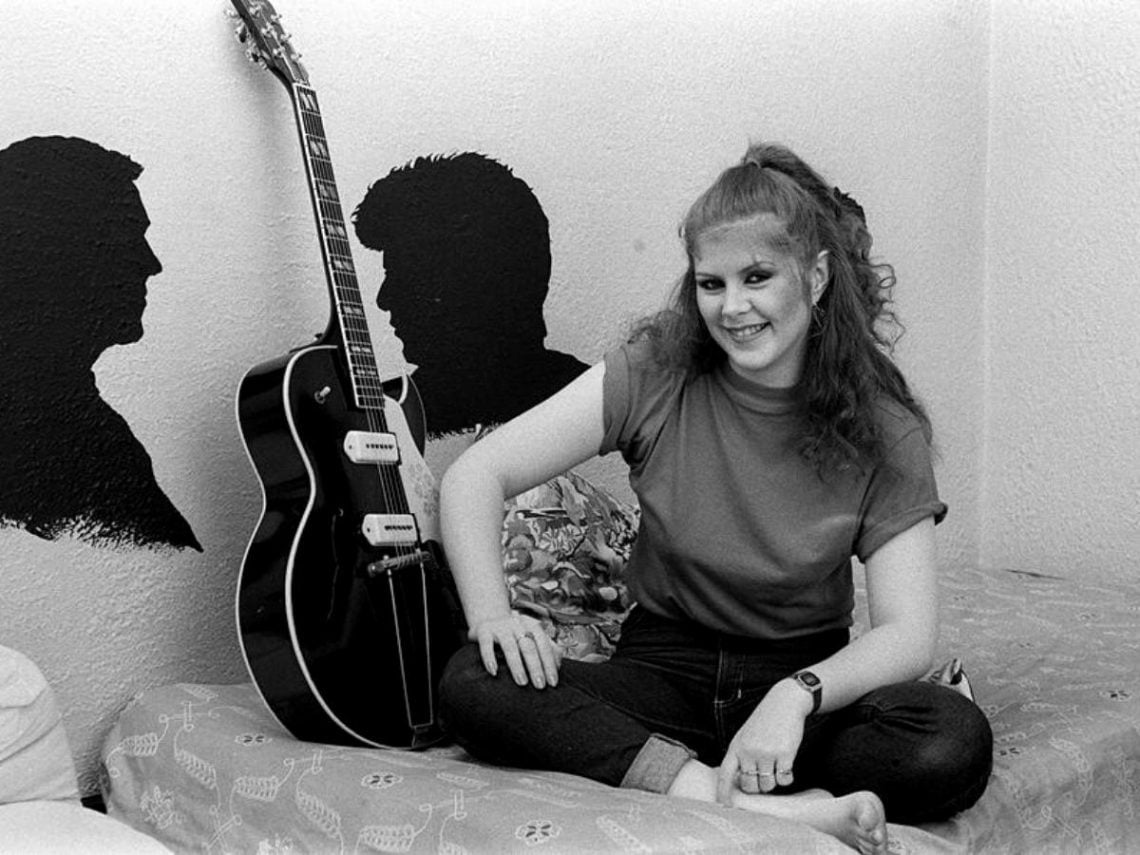
Beyond the ‘Fairytale’: Remembering the sardonic brilliance of Kirsty MacColl

‘Fairytale of New York’ is arguably the most successful Christmas song in British history, even if it famously never reached the number one spot during its initial release.
It is also the song Kirsty MacColl will likely be remembered for by the masses, thanks to its enduring re-emergence every time the mercury drops. Her sharp-tongued delivery of “Happy Christmas, your arse” is a seasonal staple, yet while that track was penned by The Pogues’ Jem Finer and Shane MacGowan, MacColl was a brilliantly talented, quick-witted artist in her own right, far beyond the realms of tinsel and holly.
Born in Croydon to folk singer Ewan MacColl and dancer Jean Newlove, Kirsty carved out a significant career of her own in post-punk England, offering a grounded approach filled with quirky compositions rather than the typical shiny female pop star image of the time. She was first noticed when she appeared as the backing vocalist on an EP by local punk rock band the Drug Addix in 1978 under the pseudonym Mandy Doubt. While Stiff Records executives were not impressed with the band, they were immediately struck by MacColl and signed her to a solo deal.
MacColl moved to Polydor Records in 1981 and secured a number 14 UK hit with ‘There’s A Guy Works Down The Chip Shop Swears He’s Elvis’, from her critically acclaimed debut album Desperate Character. The track is a sardonic put-down that doubts the sincerity of men, delivered with a witty, country-rocking energy; surely, if there is ever an award for the best song title of all time, this would take the crown.
“There’s a guy works down the chip shop swears he’s Elvis / Just like you swore to me that you’d be true / There’s a guy works down the chip shop swears he’s Elvis / But he’s a liar and I’m not sure about you,” sings MacColl in a deadpan, charming vocal delivery that made the track a beloved ‘80s classic.
Across her career, her songwriting was used to unmask serial liars, misogynists, and good-for-nothing men in all forms. In her song ‘England 2 Colombia 0’, the singer finds herself in a pub watching a World Cup match, only to discover the man she is with is a fraud. “You lied about your status / You lied about your life,” she sings, before concluding, “Now it’s England 2 Colombia 0 / And I know just how those Colombians feel”.
Similarly, in ‘Don’t Come the Cowboy with Me Sonny Jim!’, taken from the album Kite, she takes to task men who she feels are using her, noting, “They never feel guilty / They don’t know the meaning of hurt / The boots just go back on / The socks that had stayed on”.
Beyond her solo work, MacColl left a quiet yet indelible mark on the wider British music scene, and central to this was her long-standing friendship with Billy Bragg, who famously penned two additional verses of his hit ‘A New England’ for her cover (she offered to cook him a full English in return), resulting in the most commercially successful track of her career.
Yet despite MacColl’s quipping wit, debilitating stage fright often kept her away from the front of the stage, instead choosing to operate from the shadows of the studio, lending her voice to the Simple Minds’ 1984 album Sparkle in the Rain and providing the harmonies for The Smiths on ‘Ask’ and ‘Bigmouth Strikes Again’ two years later. MacColl was also frequently found singing on records produced or engineered by her husband, Steve Lillywhite, including tracks for The Rolling Stones on the Dirty Work album, Robert Plant, Happy Mondays, Alison Moyet, Shriekback, Talking Heads, and The Wonder Stuff.
She even set the track sequencing for U2’s acclaimed breakthrough album The Joshua Tree, with Bono later remarking that the album wasn’t coming together as a cohesive piece until MacColl volunteered to set the running order. The band told her to put ‘Where the Streets Have No Name’ first and ‘Mothers of the Disappeared’ last, with the rest sequenced according to her preference.
Bono said of her contribution, “Your hope for your album is that it will always be greater than the sum of its parts. It wasn’t happening for The Joshua Tree, and she came in, and she organised it, and it worked as an old-fashioned album: a beginning, middle and end.”
Later in her career, after several trips to Cuba and Brazil, MacColl recorded the world music-inspired Tropical Brainstorm. Released in 2000 to critical acclaim, it included the song ‘In These Shoes?’, which garnered airplay in the US and was later covered by Bette Midler. During an appearance on Later… with Jools Holland, MacColl said the song was about being a “slave to fashion and crippling yourself in the process”.
The chorus, sung in Spanish (“No le gusta caminar / No puede montar a caballo / Cómo se puede bailar / Es un escándalo”), translates to a scandal of a woman who cannot walk, dance, or ride a horse due to her footwear, and is single-handedly what made this author want to learn Spanish as a teenager. The slinky tale serves as a warning that fanciful footwear may often come in the way of adventure: “He said, ‘Let’s make love on a mountain top on a big hard rock’ / I said, ‘In these shoes? I don’t think so’”.
After MacColl’s death, the track was adopted by Catherine Tate as the theme tune for The Catherine Tate Show and featured on the soundtrack to the film Kinky Boots.
We all know how MacColl’s life story tragically ends. – the most important thing we can do now is remember her as more than just the woman who matched MacGowan’s festive snarl with such magic. Not only is her voice and influence quietly threaded through some of the greatest records of the 20th century, but her own body of work remains a brilliant, witty, brave reminder to never suffer fools gladly. It is a void in the heart of British music that has never truly been filled.
