


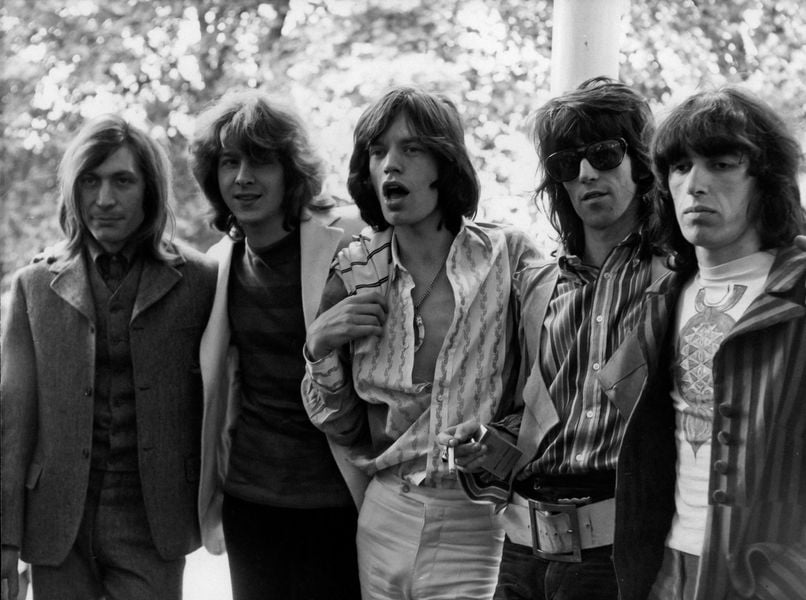
The Rolling Stones on the lo-fi greatness of ‘Street Fighting Man’

In the late 1960s, Keith Richards came across an innovative new approach to recording the guitar. While in-studio innovations and new effects pedals were starting to take over the rock scene by the end of the decade, Richards preferred a more lo-fi and personal approach to getting a signature guitar tone for The Rolling Stones. Somehow, Richards found that he could record the dirtiest guitar sounds with just an acoustic guitar and a Phillips tape recorder.
“Playing an acoustic, you’d overload the Phillips cassette player to the point of distortion so that when it played back, it was effectively an electric guitar,” Richards divulged in his book Life. “You were using the cassette player as a pickup and an amplifier at the same time. You were forcing acoustic guitars through a cassette player, and what came out the other end was electric as hell.”
Richards demonstrated the process in his documentary Keith Richards: Under the Influence. Richards famously employed the technique for the first time on 1968’s ‘Jumpin’ Jack Flash’. However, it was on that year’s ‘Street Fighting Man’ from Beggars Banquet that saw Richards perfect the lo-fi innovation. In order to match his grimey sound, Charlie Watts decided to embrace simplicity in his performance as well, playing a mini trap kit made for children.
“‘Street Fighting Man’ was recorded on Keith’s cassette with a 1930s toy drum kit called a London Jazz Kit Set, which I bought in an antiques shop, and which I’ve still got at home,” Watts explained in 2003. “It came in a little suitcase, and there were wire brackets you put the drums in; they were like small tambourines with no jangles … The snare drum was fantastic because it had a really thin skin with a snare right underneath, but only two strands of gut.”
“Keith loved playing with the early cassette machines because they would overload, and when they overload they sounded fantastic, although you weren’t meant to do that,” Watts added about Richards’ recording technique. “We usually played in one of the bedrooms on tour. Keith would be sitting on a cushion playing a guitar, and the tiny kit was a way of getting close to him. The drums were really loud compared to the acoustic guitar, and the pitch of them would go right through the sound. You’d always have a great backbeat.”
“The basic track of that was done on a mono cassette with very distorted recording, on a Philips with no limiters,” Richards later stated. “Brian is playing sitar; it twangs away. He’s holding notes that wouldn’t come through if you had a board, you wouldn’t be able to fit it in. But on a cassette, if you just move the people, it does. Cut in the studio and then put on a tape. Started putting percussion and bass on it. That was really an electronic track, up in the realms.”
Check out the overloaded lo-fi sound on ‘Street Fighting Man’ down below.
