


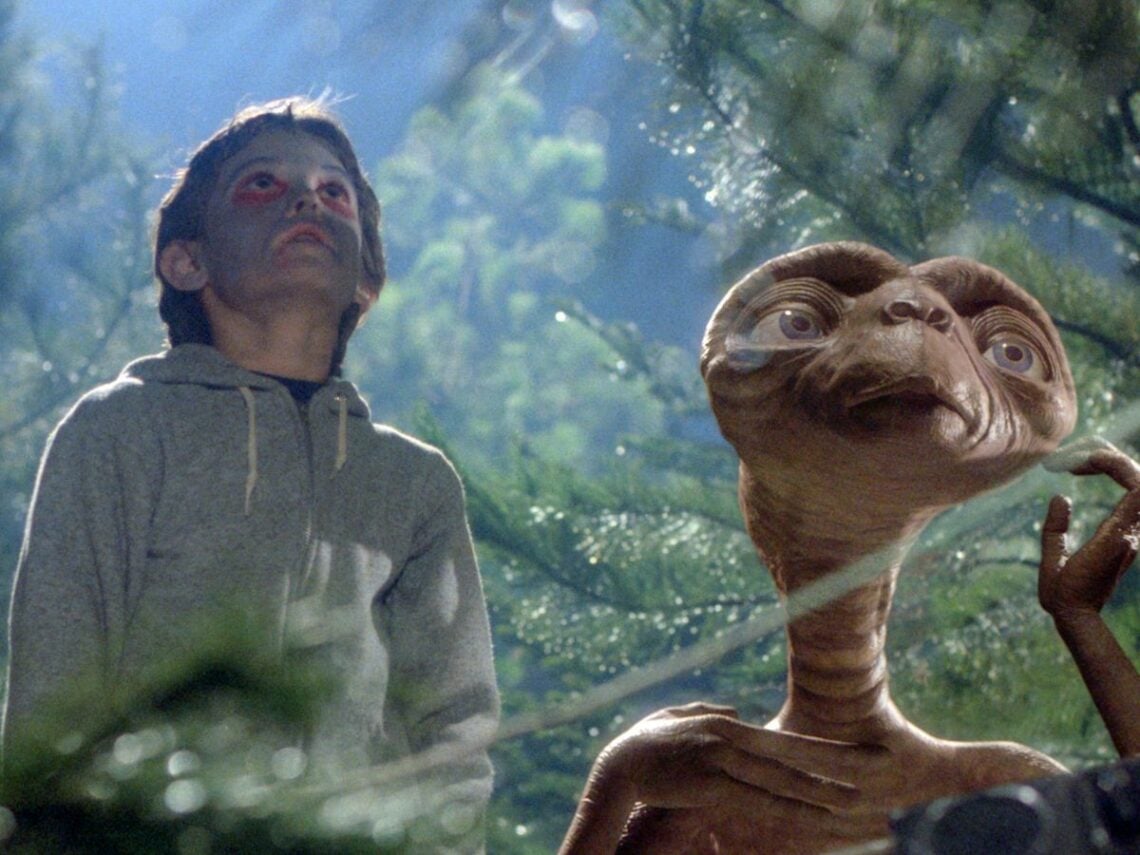
‘E.T.’ explained: Why does E.T. eat Reece’s Pieces?

To find the truth of one’s art in one’s own life is to become a purer idyll of an artist. Taking the lessons you’ve learned in life, the experiences you’ve endured and the many highs and lows you’ve witnessed and applying them to your work is what great art is all about. Before The Fabelmans became Steven Spielberg’s most personal movie, strangely, it was the cosmic tale E.T. the Extra-Terrestrial that was most inspired by the childhood of the esteemed filmmaker.
Telling the story of a lonely young boy who strikes up an unlikely friendship with a curious brown bulbous alien, Spielberg’s 1982 movie is often considered to be his very best. It showcases his storytelling proficiency and remarkable scope for cinematic spectacle.
Arriving on earth in a vast spacecraft, the titular alien is abandoned by his impatient family, who flee back into space after being pursued by federal agents, leaving ‘E.T’ to fend for himself. Eventually, he comes into contact with a young boy, Elliot (Henry Thomas), and his family, with the two forming a close bond as they evade the authorities and engage in an unlikely coming-of-age tale.
The alien is not a mere rubber suit, however. E.T. has special abilities, levitating objects around the family home and creating psychic links between himself, Elliot, Gertie, and Michael. Spielberg kept part of this special connection on set, ensuring that the kids never saw E.T. when he wasn’t animated, never losing the magic of the alien from outer space.
Keeping the alien as a supernatural figure was incredibly important for the balance of the movie. Still, despite his supernatural abilities, Elliot’s supernatural friend turned out to have a cheeky sweet tooth like the rest of us, famously becoming fond of the delicate peanut butter candies, Reese’s Pieces.

Why does E.T. eat Reece’s Pieces?
So, how exactly did one of the world’s tastiest chocolate snacks become a key part of Spielberg’s classic movie? Turns out, the whole thing was a massive missed opportunity for Mars Incorporated.
Appearing in one key scene, when Elliott lures the alien with a trail of the mini candies, Spielberg originally intended for this iconic moment to involve M&Ms. The only reason they never ended up in the movie was that Mars Incorporated, who own M&Ms, refused to give the filmmaker permission to use the multi-coloured chocolates. As a result, Spielberg chose Reese’s Pieces as a replacement.
Hershey Foods, who own Reese’s Pieces, struck a deal to promote the movie, dedicating $1million to advertising, all whilst Universal allowed them to feature the titular alien in their visual media. Earning close to $800million at the box office from a budget of just $10.5m, E.T. the Extra-Terrestrial became a significant hit and, as a result, sales for Reese’s Pieces jumped 85% in the weeks following its release in June 1982.
Remarkably, the film and candy are still inextricably linked, with the deal between the movie and the food company being one of the most successful examples of product placement in movie history. Its success can only really be matched by 2000s CastAway, which promoted FedEx and Wilson, as well as the James Bond franchise, which has long-held ties with the likes of Aston Martin, Omega and Heineken.
More than an extraterrestrial being and a great friend to Elliot, it turns out that E.T. was also a savvy businessman, helping Hershey’s see a tidy profit while he got a generous helping of the sweet, peanut-based snack.
Does E.T. make it home?
Without wishing to spoil a four-decade-old movie, the entire picture is dedicated to trying to get the little guy back on his spaceship and on to his home planet. Just like his love for sweet treats, E.T. is just like us in his desire to be with his family. Famously, he wanted to “phone home” but a quick call was never enough. After they communicate with his home planet, a ship is sent back to Earth to pick up their forgotten comrade.
As the finale of the picture kicks into gear, Eliot and his gang are tasked with breaking E.T. out of the house, transporting him under the nose of the authorities and getting him on the spaceship back home. They achieve their goal but not before more than a few tears are shed, with Eliot losing a new friend. As the credits ready themselves to roll, E.T. comforts Eliot and the audience by sharing his famous line, “I’ll be right here”, while pointing to the boy’s chest. It’s a classic Spielberg end to a classic Spielberg movie.
