


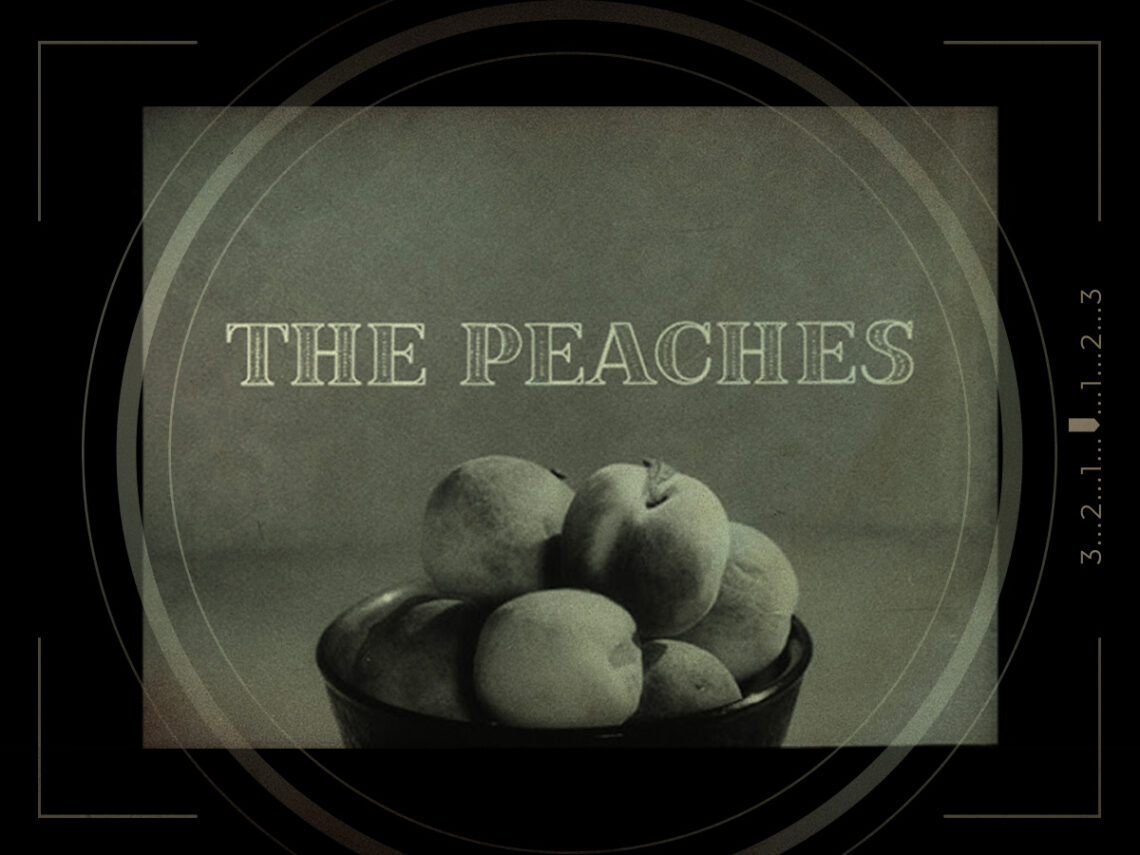
‘The Peaches’: a surreal slice of 1960s British avant-garde filmmaking

While various British filmmakers have tried their hands at avant-garde filmmaking, like Derek Jarman or Malcolm Le Grice, it’s not a genre that has become as notable within the country’s cinematic history compared to comedies, thrillers, or social realist dramas. Avant-garde cinema is always going to occupy a certain niche because, at its core, it’s not an easily accessible genre – but it’s also one that can offer lots of fun if you allow yourself to be swept away by it, surrendering to the fact that you might not understand what you’re watching straight away.
If you’re looking for an experimental yet wholly enjoyable and stylistically satisfying piece of British cinema, look no further than The Peaches, a short released in 1964. Possibly inspired by the popular French New Wave movement, the 16-minute film was directed by Michael Gill, written by Yvonne Gilan, and submitted to the Cannes Film Festival, although now it is somewhat of a lost relic of British cinema (for context, the film has been logged on Letterboxd less than 100 times).
Yet, The Peaches is a rather quirky reflection of the changing landscape of British cinema during the 1960s when London was swinging and an emphasis on bright colours, shapes, and experimentalism manifested within fashion, art, cinema, architecture, and interior design. The Peaches feels like the natural precursor to movies like The Knack… And How to Get It and even Blow-Up, both of which take an experimental approach to capturing a pivotal moment in British culture, where sexuality was becoming more fluid and visible, and there was an emphasis on playfulness and youthfulness.
In The Peaches, a young woman, played by Juliet Harmer, wakes up and eats a peach, her favourite fruit. Her life is narrated by Peter Ustinov, whose dryly comedic approach, pointing out the woman’s various intellectual abilities and hobbies, brings to mind a children’s television episode. She’s the stereotypical perfect woman without a single flaw – smart, beautiful, well-dressed, a good dancer, well-loved by her family, and effortlessly chic – and the film presents this with a layer of satire, as though the filmmakers know how unrealistic her characterisation is.
However, when she heads out to start a career working as a cleaner, happy to be free from the pressures of beauty and intelligence (as long as she’s got peaches to eat), she is soon chased by a group of business-suit-wearing men, personifications of capitalism, in an almost slapstick-esque sequence. All the woman really wants is a simple life full of love and peaches, a fruit that is often said to symbolise fertility and romance.
The movie cleverly uses symbolism to tell its story, and the woman often breaks the fourth wall – spitting out a fruit stone and giggling, for instance – involving us in her charming world. The music is often melodramatic, with Gill leaning into the movie’s surreal and fantastical elements through horror-esque tinkling keys or sensual melodies. It’s an endearing short that is gorgeously shot in black-and-white, and due to the fact that the characters never speak, the film calls back to the silent era, where physical expressions are emphasised in favour of dialogue.
So, while The Peaches isn’t exactly a groundbreaking film, it’s evidence of a time when British filmmaking was becoming considerably more fun and experimental, breaking further away from studio systems and embracing a wider scope of artistic influences.
