


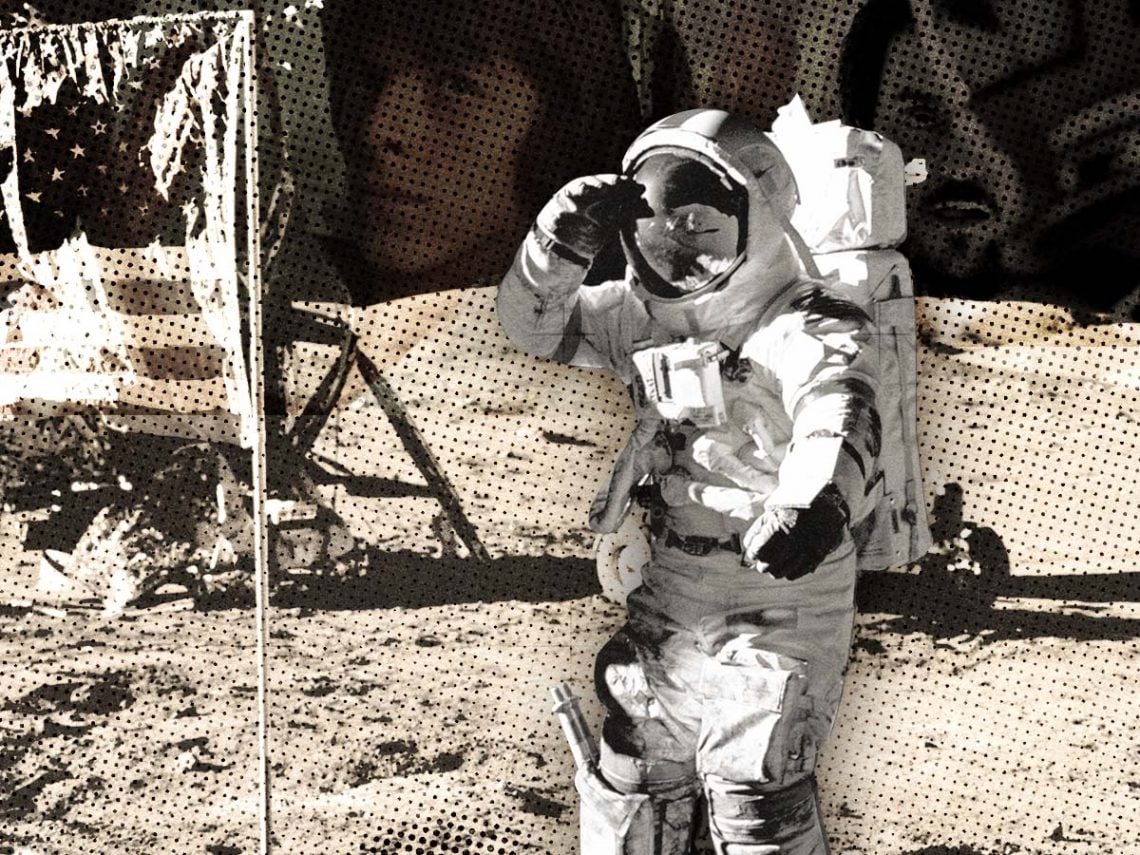
The only song to be banned from space by NASA

If the moon landing had ended in a fatal disaster, then President Richard Nixon would have read the following words written by Bill Safire: “Fate has ordained that the men who went to the moon to explore in peace will stay on the moon to rest in peace. These brave men, Neil Armstrong and Edwin Aldrin, know that there is no hope for their recovery. But they also know that there is hope for mankind in their sacrifice…” Fortunately, Safire’s poetic eulogy never saw the light of day, and NASA pulled it off, but its existence is a reminder – if a reminder were ever needed – that space is a perilous place.
It is certainly not a place for the Legendary Stardust Cowboy and his manic ways, and now, this has even been decreed by NASA following a near-tragicomic disaster. This outsider artist, whose real name was Norman Carl Odam, would often stargaze as a boy, but in his case, fate ordained that he would remain terrestrial, simply channelling stardust from the earthly ether and retain his cowboy status by the only man whose music is unofficially banned from space.
Odam was born in Lubbock, Texas, in 1947. He took a sharp liking to music. As he approached adulthood, he decided to hone an act. He dreamed of being the first man on the moon, which constituted the stardust element of his subsequent musical moniker; his interest in westerns brought about the cowboy part, and as for ‘legendary’, well, he simply stated: “I am a legend in my own time.”
That time certainly wasn’t 4/4 because his rambling one-man-band shows defied most musical rules. His biggest hit, in fact, ‘Paralysed’, just saw him yell, in a barely intelligible fashion, “I’m paralysed” over and over… which was heavily juxtaposed by the fact his body was spasmodically gyrating like the love-child of Mick Jagger and a battery-powered lemur every time he played the song.
Five hundred copies of the track were pressed and released on Odam’s very own Psycho-Suave label. The song attained a level of cult popularity locally and slowly but surely snowballed over time. Then, something remarkable happened, in a true space oddity: Odam really did make it to the realm of the stars. Or at least his song did. In 1973, NASA deployed it as an alarm call for sleepy astronauts. However, the crew were so distraught by the shock of this madness that it was thereafter essentially outlawed from space.
The wailing nonsense of the song does not pair well with the delicate psychological balance required of astronauts. The impact of ‘Paralysed’ is said to have not only initially distressed the crew, who may well have feared some sort of collective mania had taken hold, but also must have had lingering effects as their performance of tasks thereafter was subpar. The government investigated and banned the track from all future missions. Somewhere in NASA’s archives, there is also no doubt a document whereby a superior is incredulously drilling a mission controller, wondering why they thought this wake-up call was a remotely good idea.
Nevertheless, NASA’s connection with music in a wider sense remains. After all, the boom of counterculture and the space race run hand-in-hand as emblems of the era’s desire to pursue a brighter future following the scourge of war. Thus, to continue to inspire this sense of imagination (and suppress any questions of funding usage), they have often fired songs out into space.
In 2008, for the first time in history, NASA beamed The Beatles’ ‘Across the Universe’ directly into deep space. And Elon Musk even blasted a mannequin in a car into orbit with the stereo eternally playing ‘Starman’ as it orbits the sun.
