


The one essential solo jazz album, according to Tom Waits

The other day, I peered out from the apartment at some commotion unfurling on the street below. The curbside racket was revealed to be two drunken homeless men fighting over a trolley.
As I feasted on the cartoon cacophony of growls, grunts, clanging aluminium, and brazen aggression hopelessly unmatched by enfeebled strength, I thought to myself one thing, ‘I wish Tom Waits would release some new music soon’.
Waits is the poet in the gutter, the songsmith with the drunken piano, and the artist who never wants to grow up. He’s lived his life in fits and starts. He’s walked every alley that the urban dispossessed have ever ambled. He’s perched in the nookiest of crannies and poked about in the cranniest of nooks in cities all over the world in search of inspiration from the source.
And he’s done it all with a hat so jaunty it seems to defy gravity and a cigarette with a magnetic attraction to his bottom lip. But beneath the quirky persona is a maestro who understands music of all sorts incredibly well. It’s part of the magic of his own sound that he is able to whip up a swirl of proletariat joys that borrow from everywhere.
The ultimate result is that he creates songs that sound ‘jazzy’. It’s a vague and overused term, but it’s rather apt when it comes to Waits. And while it is usually the clang and clatter of ensembles that he enjoys, there is one masterpiece that gets right to the source of his artistic motivation: Solo Monk by Thelonious Monk.
Who was Thelonious Monk?
There are artists who are inimitable, and then there are the rarefied few who are unplayable – Thelonious Monk was both. Monk took the term ‘sui generis’ to new levels with his revolutionary playing style. Poet and jazz aficionado Philip Larkin once affectionately described him as “the elephant at the keyboard”, and it’s easy to see why.
When he sat down in front of those keys, he played them like no other. He was like some musical mutant hybrid between beast, man and genius. It is also in this rare middle ground that his work now retrospectively resides, he is perhaps the most challenging of all the mainstream jazz artists, but behind Duke Ellington, he is the second most recorded and certainly one of the most loved, too.
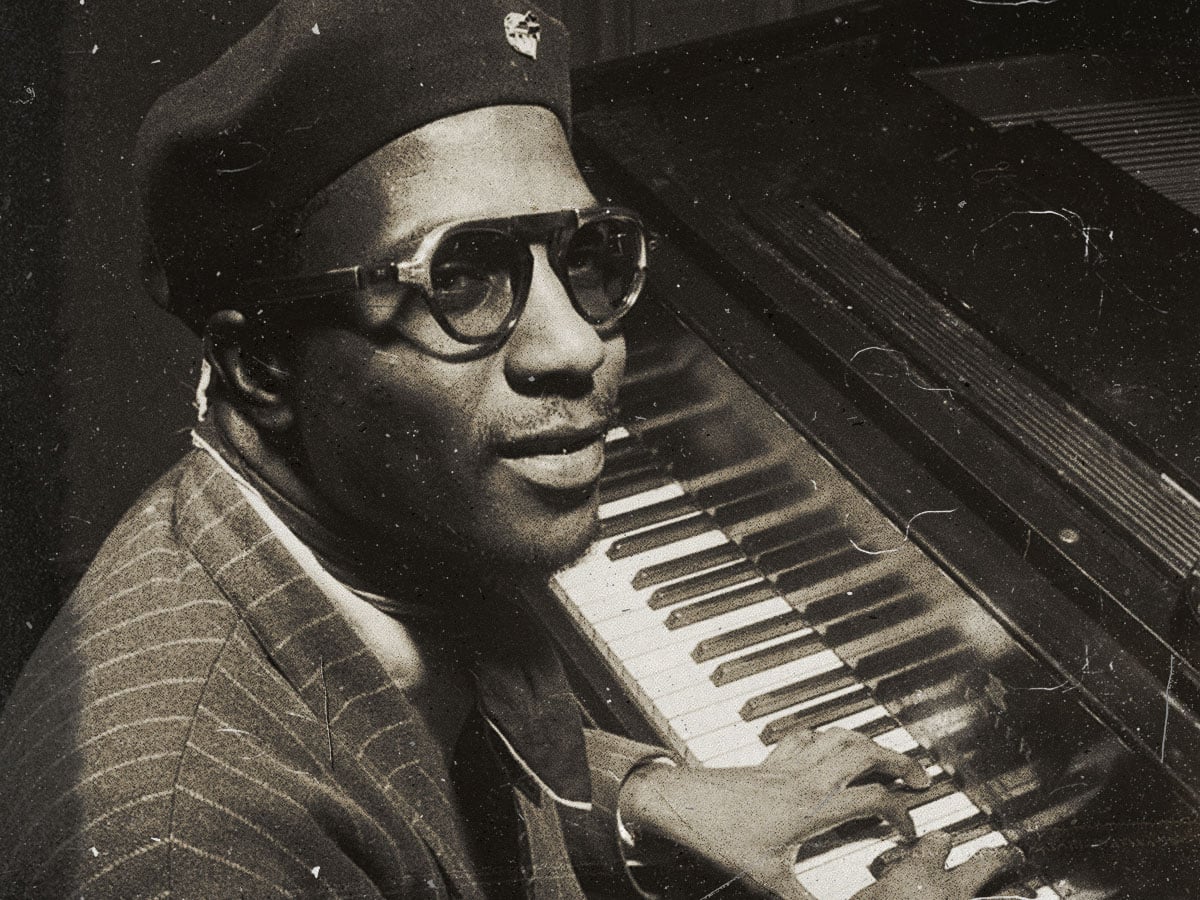
He once said himself that “the piano ain’t got no wrong notes”, and it is this notion that makes him a tricky gateway, but also the reason that he proves so rewarding. Monk goes where his mind takes him, and that makes for a wild musical ride. In fact, he even used to rise up from his stool mid-performance and simply dance. His reason for doing so? “I get tired sitting down at the piano! That way I can dig the rhythm better.”
With Solo Monk, he was free to do so. It finds him at his most pure and unrefined (or refined, depending on which way you look at it). And it finds him going back to his roots, too. The defining moment in Monk’s musical development came when he was hired by Minton’s Playhouse, a Manhattan Night Club in the spring of 1941.
While he was a house pianist at the club, his style was forced to evolve out of necessity as much as anything. The jazz scene was so fervent in Manhattan at the time, envious rival pianists would attend the club and secretively jot down notes on the inside cuff of their shirts. In response to these ‘leeches’, Thelonious invented a style simply too hard to copy.
While Solo Monk doesn’t quite see him in that vein, forming a more leisurely waltz, it does showcase the searing skill and sense of spontaneity that he developed in Minton’s hallowed Playhouse. Much like Waits’ own endearing music, there is always a sense that the music could go anywhere, but invariably, it goes right where you want it to.
Sunday morning coffees have never tasted sweeter than with the accompanying serving of Solo Monk. Just as Waits, who for a long while medicated his weekend hangovers with this grooving masterpiece of pure expression. (And the album cover is a touch of class).
As the ‘Martha’ singer put it himself when crowning it among his 20 favourite records, “On Solo Monk, he appears to be composing as he plays, extending intervals, voicing chords with impossible clusters of notes. ‘I Should Care’ kills me, a communion wine with a twist. Stride, church, jump rope, Bartok, melodies scratched into the plaster with a knife. A bold iconoclast. Solo Monk lets you not only see these melodies without clothes, but without skin. This is astronaut music from Bedlam.”
